

Overview
The era of buying the cheapest goods from anywhere in the world is quietly coming to an end. While Apple still assembles iPhones in China, it's simultaneously building manufacturing capacity in India and Vietnam. Tesla is constructing factories across multiple continents instead of centralizing production. This isn't coincidence—it's the new playbook. Governments worldwide are choosing security over savings, resilience over rock-bottom prices. The result? Our interconnected global economy is slowly reorganizing into distinct economic neighborhoods, each with its own rules, priorities, and trading partners.
Here's What's Happening
The numbers tell a clear story. US-China trade peaked at $690 billion in 2022 but has since declined as both nations implement strategic decoupling policies. Meanwhile, India's trade with ASEAN countries grew by 31% in 2023, while European Union internal trade now accounts for 64% of total EU commerce—the highest in a decade.
Countries aren't abandoning international trade; they're becoming pickier about their partners. Mexico has replaced China as America's largest trading partner, benefiting from the USMCA agreement. Vietnam's exports surged 15% last year as companies relocated supply chains from China. The European Union launched its Global Gateway initiative, investing €300 billion in infrastructure projects with "trusted partners." This is "friend-shoring"—trading primarily with allies and like-minded nations.
Let's Break This Down
Think of the global economy like a massive apartment complex that's being renovated. Instead of one giant communal space where everyone mingles freely, we're building separate wings with connecting doors—doors that can be locked when needed.
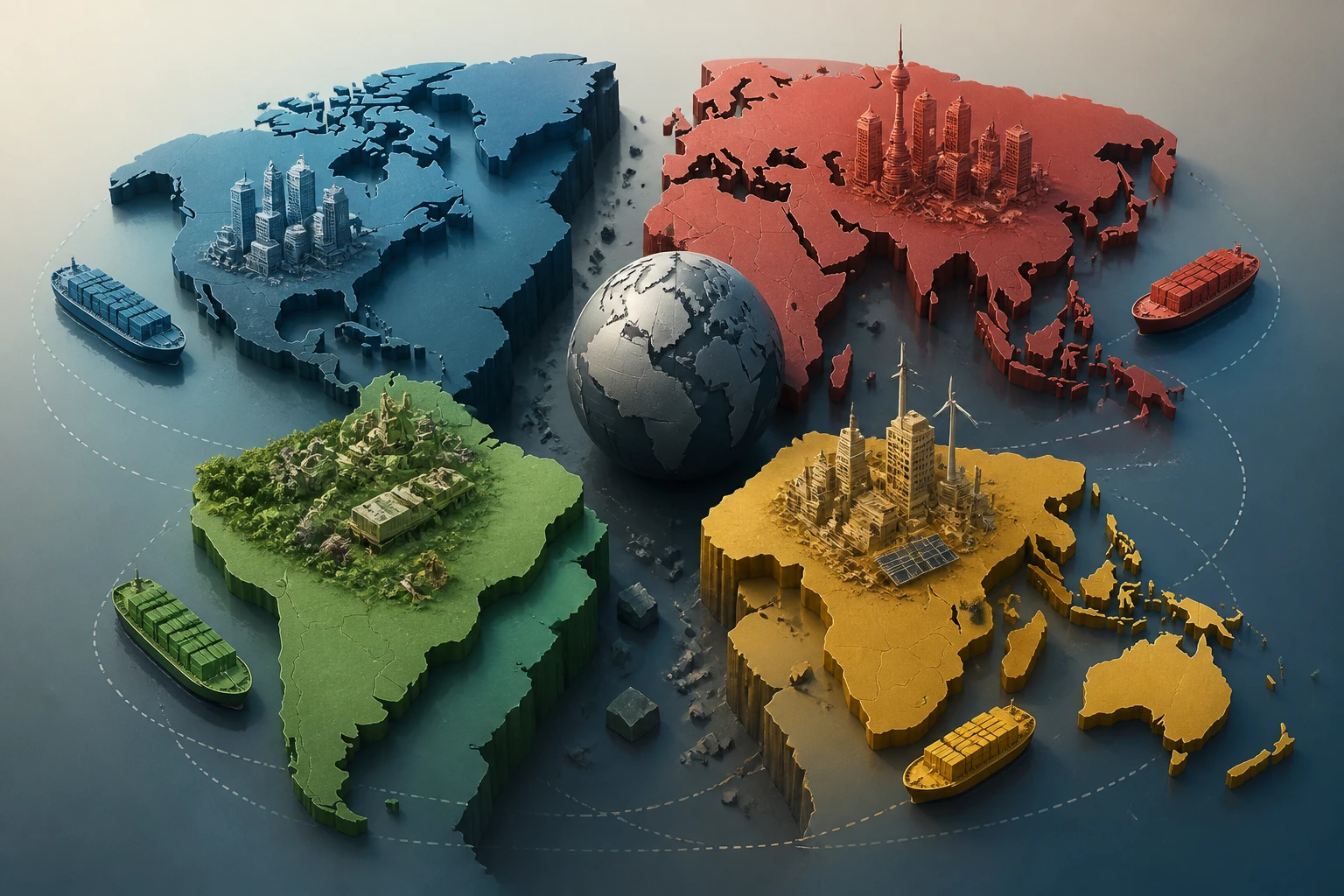
Three major blocs are emerging. The Western bloc includes the US, EU, and allies like Japan and Australia, emphasizing democratic values and technological security. The China-centric bloc encompasses nations participating in the Belt and Road Initiative, focusing on infrastructure development and manufacturing efficiency. A middle ground bloc includes countries like India, Brazil, and Indonesia that want to trade with everyone without choosing sides.
This shift stems from recent wake-up calls. The COVID-19 pandemic exposed dangerous dependencies when medical supplies and semiconductors became scarce. Russia's invasion of Ukraine showed how quickly energy and food supplies could become weapons. Taiwan's central role in chip manufacturing highlighted the risks of concentrating critical industries in geopolitically sensitive regions.
The semiconductor industry exemplifies this transformation. The US CHIPS Act allocated $52 billion to boost domestic chip production, while China invested $143 billion in its own semiconductor industry. India launched a $10 billion semiconductor mission, and the EU approved €43 billion for chip manufacturing. Instead of one efficient global supply chain, we're building four parallel ones.
The Bigger Picture
For working professionals, this reorganization creates both opportunities and challenges. Indian IT companies are expanding beyond traditional outsourcing as Western clients seek alternatives to Chinese technology providers. Manufacturing jobs are returning to countries like Mexico and Vietnam as companies prioritize supply chain security over labor cost savings.
However, this comes with trade-offs. McKinsey estimates that full supply chain regionalization could increase global manufacturing costs by 25-30%. Consumers will likely face higher prices for electronics, clothing, and other goods as companies sacrifice efficiency for resilience.
Financial markets are already adapting. Regional development banks like the Asian Infrastructure Investment Bank and New Development Bank are gaining prominence as alternatives to traditional Western-dominated institutions. Currency arrangements are evolving too—ASEAN countries are increasingly settling trade in local currencies, reducing dollar dependency.
The technology sector faces particular complexity, as innovations require global collaboration but geopolitical tensions demand technological sovereignty. This creates a paradox where countries simultaneously compete and cooperate in different areas.
What's Next?
The world isn't becoming less connected—it's becoming differently connected. These economic blocs will likely coexist and overlap, with some countries belonging to multiple groups depending on the sector or issue.
For India, this presents a strategic opportunity. As companies seek alternatives to China-dependent supply chains, India's demographic dividend and improving infrastructure position it as an attractive manufacturing destination. The key will be building capabilities across multiple blocs without getting trapped in any single alliance.
The ultimate question remains whether this more fragmented world will prove more resilient or simply more expensive. The answer will shape the next generation of global commerce and career opportunities.