

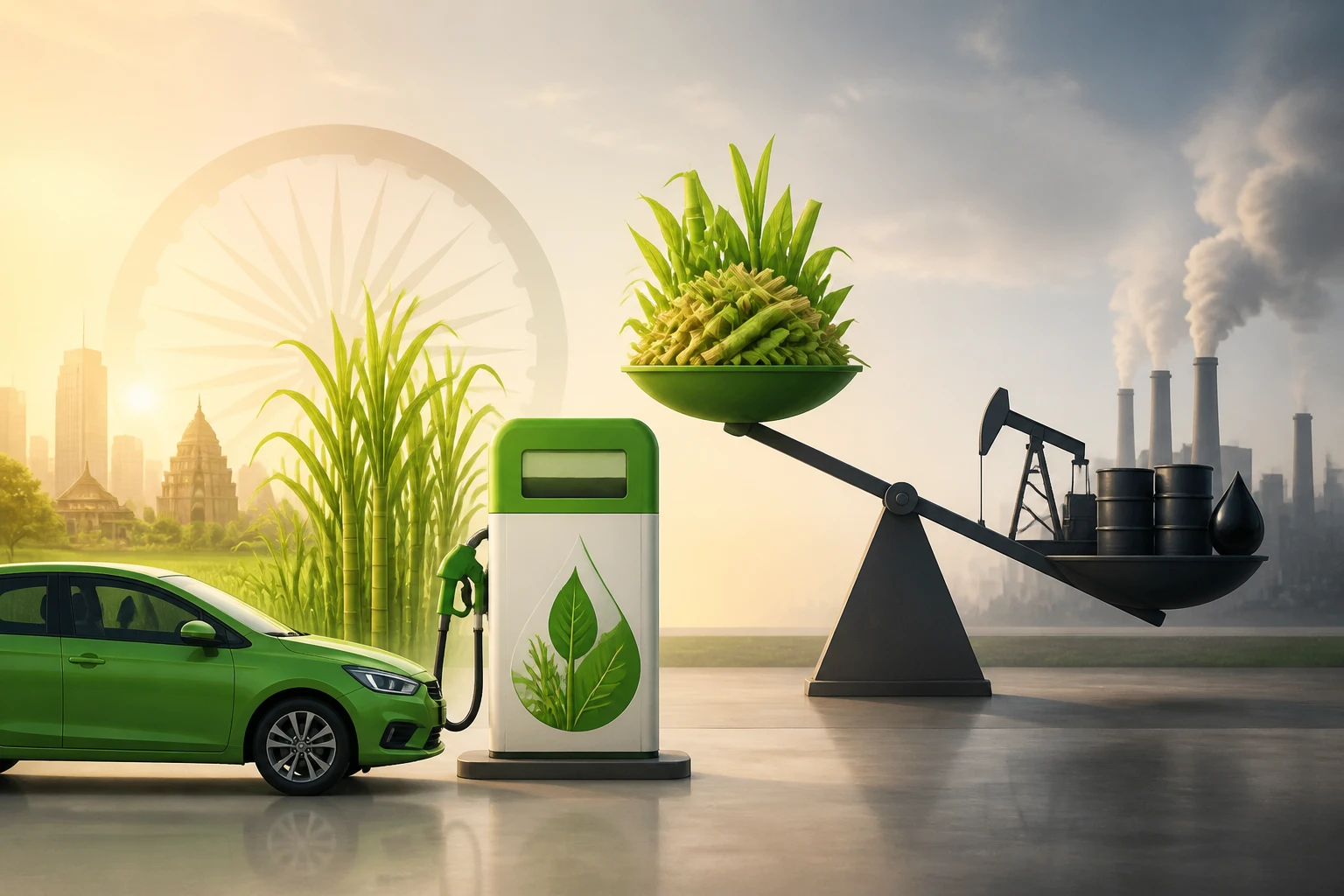
On World Environment Day, Union Petroleum and Natural Gas Minister Hardeep Singh Puri inaugurated India's first E85 fuel dispensing station at Indian Oil's Pusa Road outlet in New Delhi. The fuel is cheap, it's cleaner, and social media immediately erupted with panic that regular petrol was being phased out. It isn't. But the arrival of E85 does signal that India's relationship with petrol is quietly, structurally changing.
What E85 Actually Is
While standard E20 petrol contains up to 20% ethanol blended with 80% conventional petrol, E85 contains around 80–85% ethanol mixed with 14–19% petrol. That's a dramatic jump — and it's not just a recipe change. Flex-fuel vehicles come with modified engines, fuel systems, sensors, and calibration that allow them to run on varying ethanol-petrol blends. Standard cars simply aren't built for it.
The high-ethanol blend has been priced at ₹82.12 per litre in Delhi, exactly ₹20 lower than regular E20 petrol. That's roughly a 20% discount at the pump — genuinely attractive on paper. The catch: the savings in fuel cost do not fully offset the efficiency penalty. Flex-fuel vehicles running on E85 can be expected to return roughly 25–35% lower mileage than an equivalent E20 vehicle, owing to ethanol's lower energy density compared to petrol.
Your Existing Car Is Safe — Here's How to Check
The launch triggered widespread confusion on social media, with viral claims suggesting that normal petrol and diesel supplies would soon be discontinued. Hardeep Singh Puri clarified that E85 fuel is meant only for a specific category of vehicles and will not replace regular petrol for existing vehicles.
So how do you know where your vehicle stands? Check your car's fuel-filler flap for the E-rating label. Every BS6 Phase 2 car carries a sticker specifying the maximum allowable ethanol blend. For most Indian cars sold from April 2023 onwards, this reads E20 maximum; for a true flex-fuel car, it will read E85 or 'Flex-fuel'. If your car says E20, it runs on E20 — and that's fine. The introduction of E85 does not mean conventional petrol or E20 fuel will be phased out.
A Thin Fleet, a Thin Network
The honest constraint right now is on both sides of the equation. In the first phase, E85 is available at 48 retail outlets operated by public sector oil marketing companies. The government plans to scale this to 500 outlets by December 2026, with an ambitious target of 5,000 operational E85 dispensing stations across major Indian cities by end-2027.
The compatible vehicle list is equally sparse. The number of E85-compatible flex-fuel vehicles on sale in India is currently quite low. On the two-wheeler side, Hero MotoCorp has launched the Splendor+ Flex Fuel at ₹82,710 and the HF Deluxe Flex Fuel at ₹72,792, both ex-showroom Delhi. On four wheels, the Maruti Wagon R is currently the only flex-fuel car in production in India, though it is set to be available only to the commercial sector. Tata Motors has previously indicated its first flex-fuel passenger vehicle could be ready by end-2026, while Toyota has showcased flex-fuel prototypes of the Innova Hycross.
The Number That Tells the Real Story
India's ethanol ambitions aren't new — they're just accelerating. Ethanol blending in petrol climbed from 1.53% in 2014 to 20% in 2025, achieving the E20 target five years ahead of schedule. The government now aims to push aggregate ethanol blending to nearly 26% by 2030–31, with the E85 rollout forming a key pillar of that strategy. And the economic logic is hard to argue with: ethanol blending has helped save nearly ₹1.85 lakh crore in foreign exchange and reduced crude oil imports by approximately 32 lakh metric tonnes.
E85 is not a fuel revolution today. It's a runway being built — slowly, deliberately, for vehicles most Indians don't yet own.
Sources
- India's First E85 Fuel Station Opens In Delhi — Price, Availability, & Compatible Vehicles - DriveSpark News
- Explained: What Is E85 Fuel? Will Old Petrol Vehicles Stop Working? Government Clarifies | Outlook India
- E85 Fuel Launched In Delhi At ₹82.12/Litre: India’s Flex-Fuel Era Begins
- Flex-Fuel Vehicles E85 in India 2026 — Hyryder, Wagon R Flex | VahanBazaar
- E85 Fuel in India: New Ethanol Blend Launched to Cut Emissions, Oil Imports and Fuel Costs