

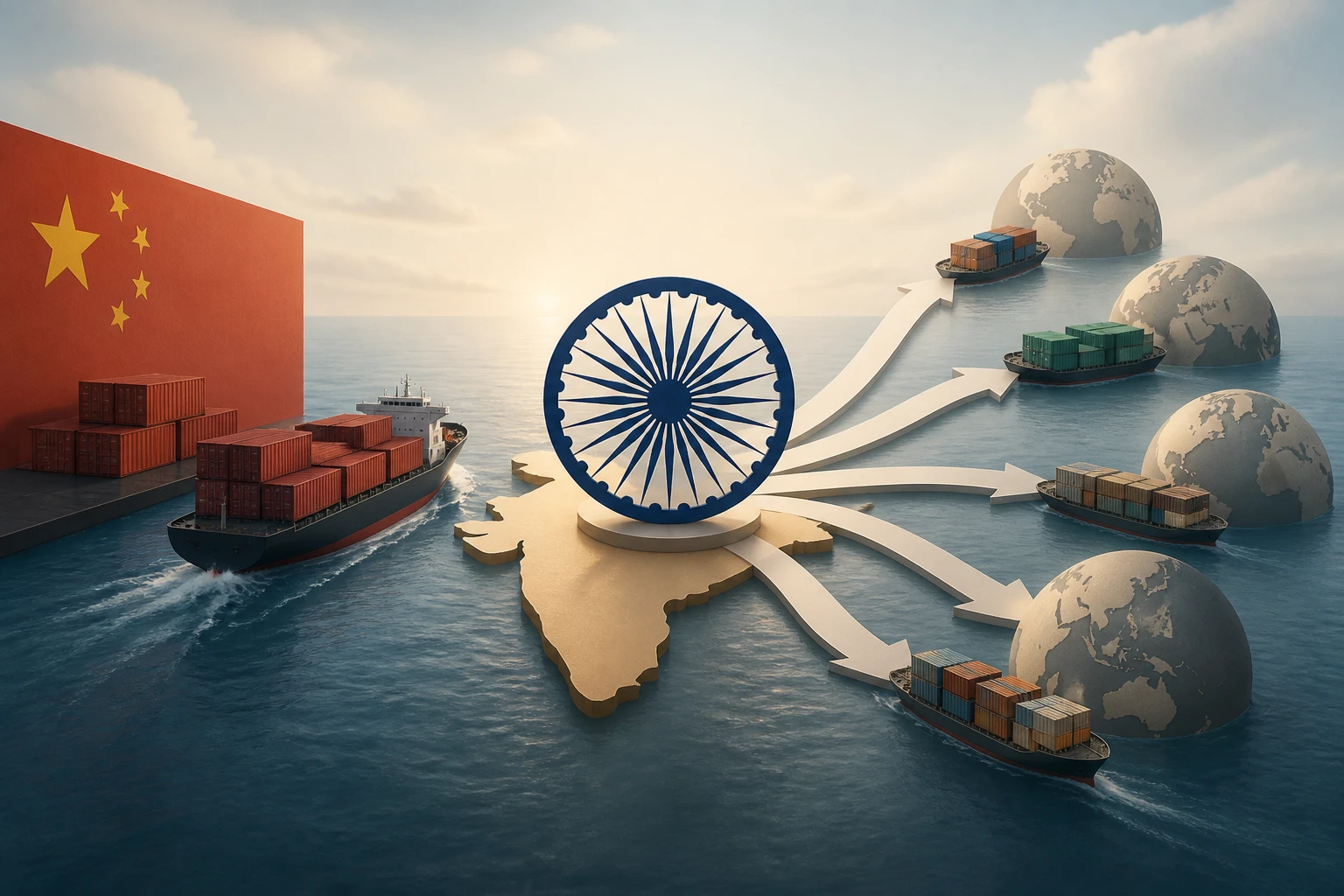
For most of its post-liberalisation history, India's export story has been a story of concentration — a handful of products, a handful of buyers, and an uncomfortable reliance on the global appetite for petroleum, gems, and generic drugs. FY26 is starting to look a little different.
1,821 New Combinations, One Important Idea
India's commerce department analysis shows that Indian exporters added 1,821 new principal commodity–country combinations during FY26, generating incremental exports of $202.2 million. The number sounds bureaucratic, but the logic behind it is worth unpacking. A "commodity–country combination" is simply a product being sold to a market it was never sold to before — graphite going to a new African buyer, a telecom instrument finding a customer in Latin America, a vessel ordered by a port operator in Northeast Asia.
Ships, boats and floating structures generated $57 million of additional exports from 19 new markets, while telecom instruments expanded into 20 new markets with exports of $5.8 million, and nuclear reactors, industrial boilers and parts garnered $14.3 million from 13 new markets. These are not blockbuster numbers individually, but taken together they signal a structural shift in what India is willing to try to sell — and where.
The trend, as one official put it, is "a gradual move away from traditional commodity-led growth toward wider participation across high-value manufacturing, engineering, agri-processing and technology-driven sectors."
Northeast Asia Is the Quiet Winner
Geographically, the diversification story has an unexpected lead character. The sharpest growth came from Northeast Asia, where exports rose 21.6% to $41.6 billion, increasing the region's share to 9.4%. Seven of the eight countries in the region recorded positive growth, "reflecting stronger demand for Indian electronics, engineering goods, chemicals and industrial products."
Regionally, export growth spread across Asia, Africa and Latin America, while North America remained the largest destination, accounting for $97.7 billion, or 22.1% of total exports. The spread matters. When your buyer base is diversified, one country raising tariffs or slowing down doesn't crater your entire trade balance.
The China Paradox That Won't Go Away
Here is the uncomfortable footnote to this progress. India's export diversification strategy is partly a response to how lopsided its relationship with China has become — but the lopsidedness is deepening, not narrowing. India's exports to China rose roughly 37% to $19.47 billion in FY26, but imports from Beijing increased 16% to $131.63 billion in the same year. The bilateral trade deficit with China alone — which has risen from $99.2 billion in FY25 to $112.6 billion in FY26 — is growing faster than any diversification programme can offset.
China accounts for 30% of India's industrial product imports, with dependencies exceeding 70% in electronics, machinery, chemicals, and textiles. India sells more telecom instruments to new markets in Africa; it still buys the components from Shenzhen. That tension is structural, and it won't be resolved by adding export rows to a spreadsheet.
What Makes This Round Different
That said, the nature of what India is now exporting is shifting in ways that matter for the medium term. Agriculture and food exports diversified further, with fresh fruits and non-basmati rice gaining traction in new markets, while emerging segments such as aircraft and spacecraft components, along with consumer electronics, also saw rising global acceptance.
India's total merchandise exports reached $441.8 billion in FY26, a 0.9% increase over the previous fiscal — modest headline growth, but achieved against a backdrop of global trade disruption, elevated freight costs, and geopolitical uncertainty.
The real test isn't whether India can log 1,821 new market combinations. It's whether those combinations survive past year one, deepen into reliable trade relationships, and eventually pull more domestic manufacturing upstream. Sustained export strength will depend on lower logistics costs, better quality control, faster ports, deeper manufacturing capacity, and trade agreements that genuinely improve market access. The geography of India's exports is quietly changing. The underlying economics need to catch up.
Sources
- India accelerates export diversification in FY26, adds 1,821 new market-product combinations
- Exports diversification drive adds $202m to kitty | Webnewswire
- India Following Diversified Strategy To Boost Exports To China Cut Import Dependence: Official – Outlook Business
- The Indispensable Adversary: India's Approach to China
- India’s export diversification works, partly - The Financial World