

At February's AI Action Summit in Paris, French President Emmanuel Macron had a pointed message for anyone wondering how Europe intends to compete in the global AI race. "Last year we exported 90TWh," he told delegates, "which means we can localize a lot of data centres on top of the electricity we need for our companies and households." Then, riffing on a certain American president's fossil-fuel slogan: "I have a good friend across the ocean saying 'drill baby, drill.' Here, there's no need to drill, it's just plug baby, plug." France, he noted, has 17 operational nuclear plants with 57 reactors, all run by state utility EDF.
It was a quip. It was also a geopolitical statement.
When a Power Grid Becomes a Strategic Asset
The argument Macron is making is deceptively simple. Nuclear power's continuous, dispatchable, weather-independent generation profile is particularly well-suited to AI data centres, which require constant, high-density power around the clock. Renewables — solar and wind — are cheap but intermittent. AI data centres need power that is firm, dispatchable, always-on and carbon-free; wind and solar, by their intermittent nature, cannot fulfil these requirements without expensive storage.
This is the crux of the nuclear revival. Electricity demand from data centres soared 17% in 2025, and that of AI-focused data centres climbed even faster — well outpacing growth in global electricity demand of 3%. Meanwhile, global electricity generation to supply data centres is projected to grow from 460 TWh in 2024 to over 1,000 TWh in 2030. That is a colossal gap to fill, and countries are scrambling.
In the US, the math is turning uncomfortable. Grid interconnection queues have swelled to over 2,600 gigawatts of pending requests — more than twice the total installed capacity of the entire national grid — and wholesale electricity costs near data centre clusters have surged as much as 267% over the past five years. The result? In parts of Ohio, commercial AI load growth pushed coal generation up 23% in 2025 because it was the only dispatchable fuel available fast enough. Clean ambitions, dirty reality.
France's Head Start — and the Money Following It
France does not have this problem, at least not yet. It is not being asked to choose between powering its citizens and powering AI infrastructure. The 90 TWh it exported in 2024 represents available generation capacity that is currently leaving the country rather than supporting domestic industrial development.
Capital has noticed. The French government claimed to have secured €110 billion for digital infrastructure at the AI Summit — dwarfing commitments to rival European markets. By comparison, the UK government, also on a mission to attract data centre operators, brought in £25 billion in investment since July 2024. According to a UNCTAD investment report, France was among the top destinations for data centre foreign direct investment in 2025, alongside the United States and South Korea.
The Broader Realignment
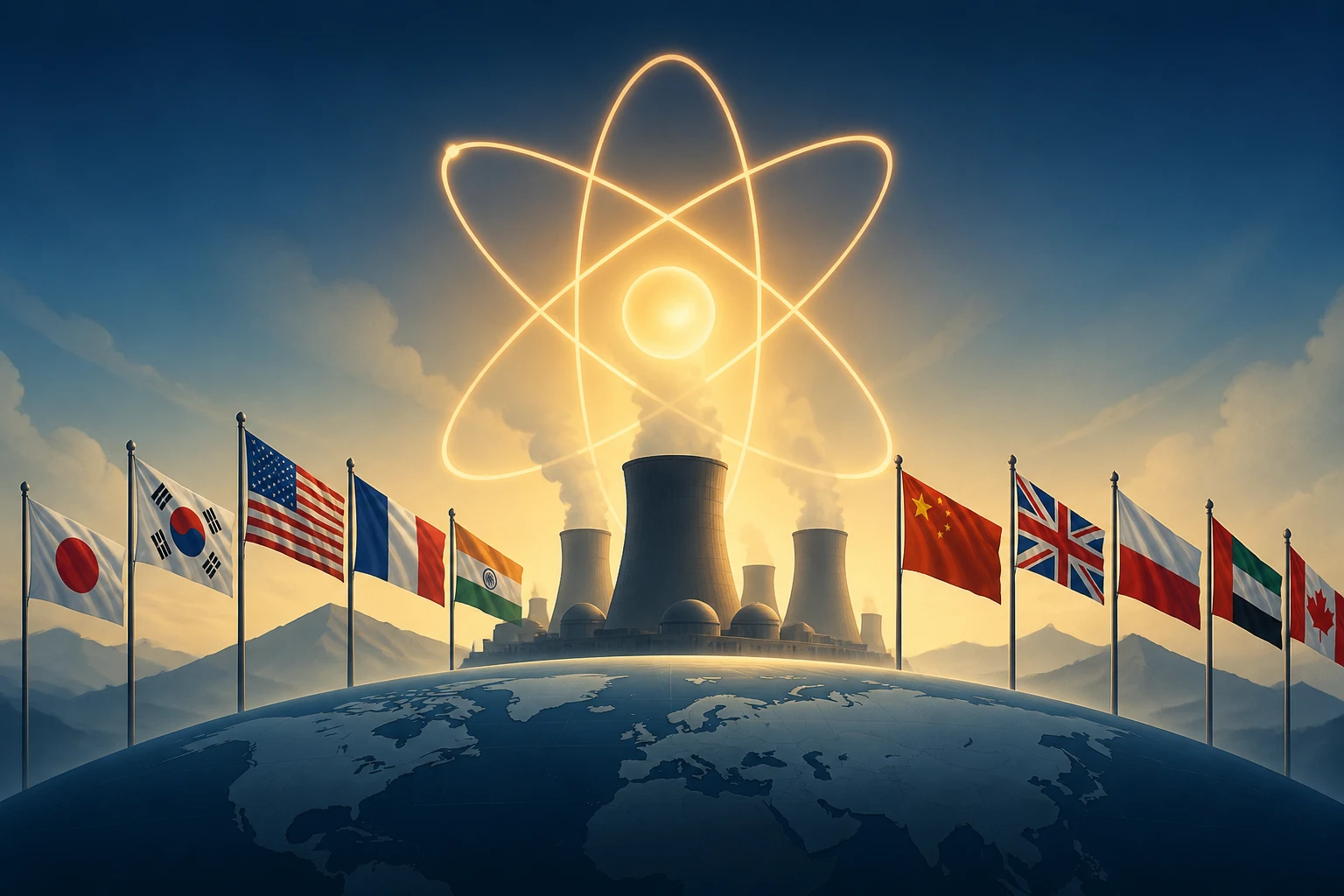
France's advantage is clarifying something for the rest of the world. AI-led power consumption, combined with energy security concerns and decarbonisation goals, is pushing countries to reconsider nuclear power. Global nuclear generation reached a record high in 2025, with over 12 GW of new capacity under construction. Nearly 40 countries have pledged to triple nuclear capacity by 2050.
For India, the lesson is pointed. Countries including India, Indonesia, and Vietnam represent some of the fastest-growing markets for data-centre investment, with booming internet adoption and rapid digitalisation pushing infrastructure to keep pace. If these countries align digital growth with firm, clean power — including small modular reactors — they could build some of the world's most sustainable AI corridors.
The global AI race, it turns out, will not be won only by the country with the best models or the most chips. It will partly be won by whoever kept their reactors running.
Sources
- Vive la révolution: The inside story of the big French AI data center build-out - DCD
- France Is Betting Its Nuclear Grid on the AI Energy Race — and the Timeline Is Not What Anyone Expected
- AI-driven power demand revives global nuclear energy push: Report
- Data centre electricity use surged in 2025, even with tightening bottlenecks driving a scramble for solutions - News - IEA
- Energy supply for AI – Energy and AI – Analysis - IEA
- France is becoming a global hub for data centers — and the environmental bill is due - Futura-Sciences
- AI Power Demand Drives Nuclear Energy Comeback
- The Atom and the Algorithm: Nuclear Energy and AI are Converging to Shape the Future | IAEA