

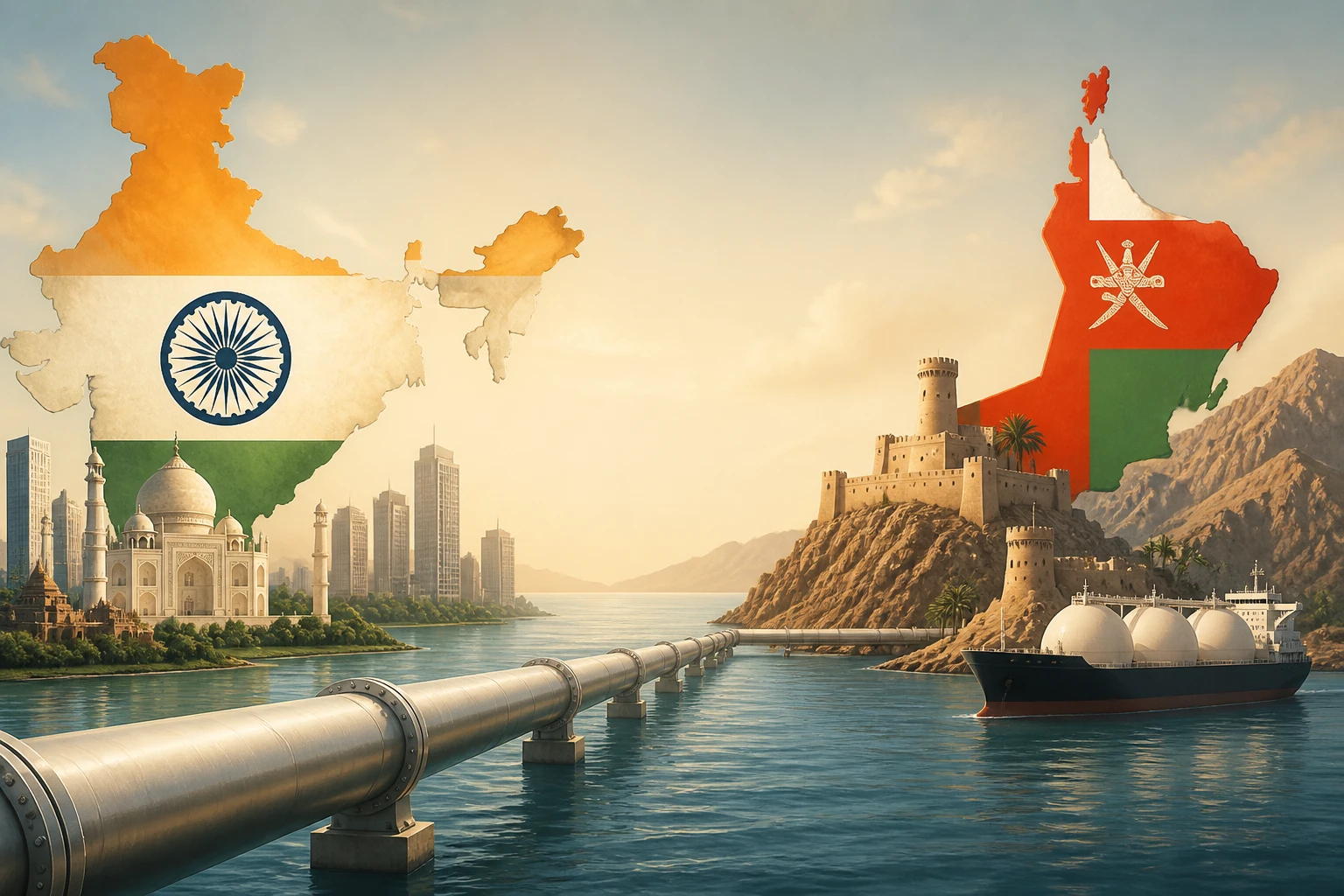
Every time a tanker full of LNG leaves the Gulf and threads its way through the Strait of Hormuz, India holds its breath a little. That narrow, 33-kilometre-wide chokepoint is not just a geography lesson — it is the single most consequential passage in India's energy supply chain.
And in early 2025, that vulnerability stopped being theoretical.
When the Strait Blinked
The Strait of Hormuz disruption in late February 2025, triggered by conflict involving the United States, Israel, and Iran, caused global LNG supply to fall by more than 20%, driving Asian spot gas prices from $10–12 per MMBtu to $24–25 per MMBtu. For India, that wasn't a distant market signal — it was a direct hit. Nearly two-thirds of India's LNG imports passed through the Strait of Hormuz in 2025.
The structural problem runs deep. Crude oil imports now make up nearly 89% of India's total crude supply, while natural gas imports have grown 67% over the last decade and now account for over half of total gas availability. The country's domestic reserves aren't filling that gap — India produced 36.94 million tonnes of crude domestically in 2015–16; by 2024–25, that had fallen to 28.7 million tonnes, a drop of over 22%.
Critically, India does not maintain gas reserves the way it does for oil, making gas supply disruptions even more consequential. A price spike in LNG has almost nowhere to absorb.
The Pipe That Changes the Equation
India's response is audacious on paper: a ₹40,000 crore subsea pipeline that would run directly from Oman's coast to Gujarat, bypassing the Strait entirely.
The proposed Middle East–India Deep-water Pipeline (MEIDP) will stretch 2,000 kilometres under the Arabian Sea, connecting Oman directly to the Gujarat coast, and deliver around 31 million standard cubic metres per day of natural gas. To put that in context, India's current gas consumption stands at roughly 190–195 mmscmd and is projected to reach nearly 290–300 mmscmd by 2030 — meaning this single pipeline could supply a meaningful share of the country's future needs without a single tanker involved.
The engineering challenge is almost as striking as the price tag. The pipeline could run at depths of up to 3,450 metres, making it one of the deepest subsea pipelines ever attempted globally.
Not Just an Oman Pipeline
The bilateral framing — India to Oman — understates the project's ambition. The pipeline would enable India to access gas supplies from Oman, the UAE, Saudi Arabia, Iran, Turkmenistan, and Qatar. Together, these regions hold an estimated 2,500 trillion cubic feet of gas reserves. Think of the MEIDP less as a bilateral deal and more as India plugging itself into the Gulf's gas grid — permanently, and on its own terms.
India's petroleum ministry is expected to direct state-run companies GAIL, Engineers India, and Indian Oil Corporation to prepare a detailed feasibility report, working from a pre-feasibility study submitted by the South Asia Gas Enterprise (SAGE), a New Delhi-based private sector consortium. A positive outcome from that report would pave the way for formal government-level negotiations with Oman on gas supplies, financing, and project execution.
The Catch
None of this is happening anytime soon. The project is expected to take five to seven years to complete once approved — and it has not yet received government clearance. Financing for a project of this scale across international waters will require complex multilateral agreements. The route itself is no simple engineering task — the proposed alignment includes the Arabian Sea, the Owen Fracture Zone, and the Indus Fan, presenting significant seabed challenges.
There is also the question of whether India can execute. Past cross-border pipeline ambitions — including the long-discussed TAPI pipeline through Central Asia — have stalled repeatedly over geopolitical and financing hurdles.
But the Hormuz shock has changed something in New Delhi's calculus. Officials believe a fixed subsea pipeline can permanently reduce India's dependence on volatile LNG tanker markets and politically vulnerable maritime chokepoints. When spot gas prices double in a matter of weeks, that argument writes itself.
The MEIDP may still be a feasibility report today. But for an economy importing nearly nine-tenths of its crude and half its gas through routes it doesn't control, the question is no longer whether India can afford to build it — it's whether India can afford not to.
Sources
- India-Oman Subsea Gas Pipeline: Strategic Energy Security 2025
- India mulls $4.8bln deep-sea gas pipeline from Oman
- Articles - India’s Import Energy Dependence is Rising Despite Renewable Gains
- India To Build One Of The World’s Deepest Gas Pipelines Worth $4.8 Billion To Secure Energy Supplies From Gulf
- India mulls $4.8bln direct deep-sea pipeline for gas imports from GCC: Report
- India Fast-Tracks Oman-Gujarat Subsea Gas Pipeline – GKToday
- Explained: How India plans to bypass Hormuz with a Rs 40,000 crore Oman–India Gas Pipeline