

Overview
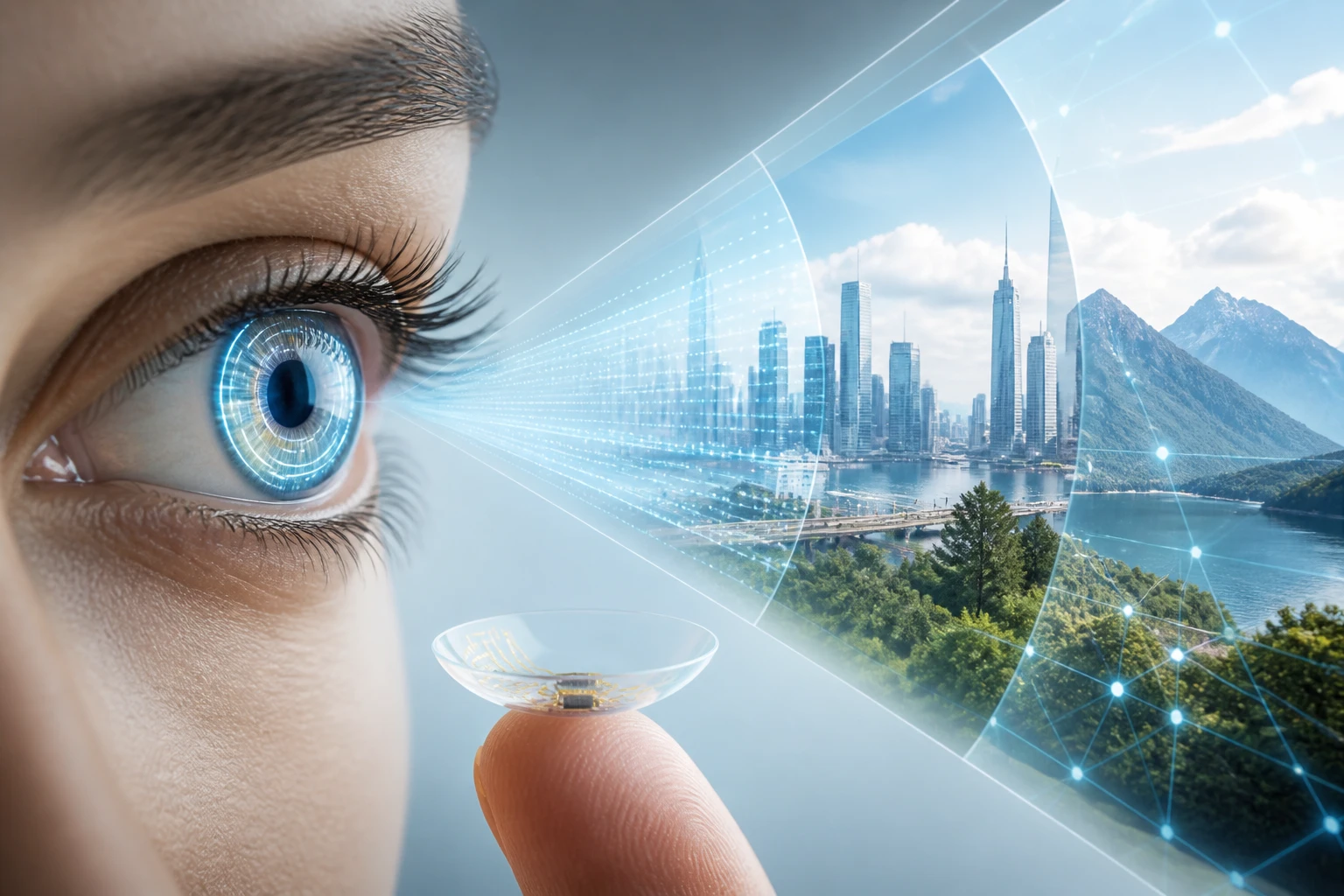
Imagine closing your eyes in a completely dark room and still being able to "see" the heat signatures of people walking around, or detecting infrared light that's completely invisible to the naked eye. This sounds like something straight out of a superhero movie, right? Well, scientists have just made this fantasy a reality. Researchers have developed revolutionary contact lenses that can give humans what they're calling "super vision" – the ability to see beyond our natural visual spectrum and detect infrared light even in complete darkness or with eyes closed. This breakthrough, published in Cell journal, could fundamentally change how we interact with the world around us.
Here's What's Happening
The breakthrough comes from a team of scientists who have created specialized contact lenses embedded with graphene-based sensors that can detect infrared radiation. Unlike our regular vision, which only captures light wavelengths between 380 to 700 nanometers (the visible spectrum), these lenses extend human sight into the infrared range of 700 nanometers to 1 millimeter.
Here's the fascinating part: the technology works by converting infrared signals into electrical impulses that the brain can interpret as visual information. The lenses contain ultra-thin graphene layers – just one atom thick – that act as photodetectors. When infrared light hits these sensors, they generate small electrical currents that stimulate the eye's photoreceptors, essentially "tricking" the brain into seeing heat signatures and infrared patterns as visible images.
During testing, subjects wearing these lenses could successfully identify objects and people in complete darkness, detect heat sources through walls, and even perceive infrared patterns with their eyes completely closed.
Let's Break This Down
Think of it like this: if your eyes are like a radio that can only tune into certain stations (visible light), these contact lenses are like upgrading to a premium radio system that can suddenly pick up frequencies you never knew existed. The infrared spectrum is all around us – every warm object, from your coffee cup to your smartphone, constantly emits infrared radiation that we simply can't see.
The technical achievement here is remarkable. The researchers solved a decades-old challenge in materials science: how to make infrared detectors small enough, flexible enough, and biocompatible enough to sit directly on the human eye. Traditional infrared cameras require bulky cooling systems and rigid semiconductors, but these contact lenses use room-temperature graphene sensors that are just 50 micrometers thick – thinner than a human hair.
The implications are staggering. In medical applications, doctors could potentially see blood flow patterns and detect inflammation without expensive thermal imaging equipment. Security professionals could identify threats in complete darkness without night-vision goggles. Firefighters could navigate smoke-filled buildings by seeing heat signatures of trapped individuals. Even everyday applications emerge – imagine never losing your keys again because you can see their heat signature from when you last touched them.
The technology also opens possibilities for augmented reality integration. Unlike bulky AR headsets, these lenses could overlay infrared information directly onto our natural vision, creating a seamless "enhanced reality" experience. Early trials suggest the brain adapts to this additional visual input within 72 hours, incorporating infrared perception as naturally as we process color.
The Bigger Picture
This breakthrough represents more than just a cool gadget – it's a fundamental expansion of human sensory capabilities. For professionals in security, healthcare, and emergency services, this could be as transformative as the introduction of smartphones was for communication.
However, the technology also raises important questions. Privacy advocates are already expressing concerns about a world where some people can literally see heat signatures through walls. Regulatory bodies will need to establish frameworks for when and how such enhanced vision can be used legally.
From an economic perspective, the global night vision market is currently valued at $8.9 billion and is expected to grow significantly. Contact lens-based infrared vision could disrupt entire industries built around traditional thermal imaging equipment.
The manufacturing challenges are substantial too. Mass-producing graphene-based sensors with the precision required for human eye contact remains expensive, though researchers predict costs could drop dramatically within 5-7 years as production scales up.
What's Next?
While the technology is still in early clinical trials, researchers expect commercial versions could be available within the next decade. The immediate focus is on medical and professional applications, where the benefits clearly outweigh potential risks.
The broader implications are profound: we're witnessing the beginning of voluntary human enhancement through technology. As these lenses become more sophisticated, they could incorporate multiple types of sensors, essentially giving humans superhuman perception capabilities.
For young professionals today, this represents a glimpse into a future where the boundaries between human biology and technology continue to blur, opening up career opportunities and capabilities we can barely imagine today.