

Overview
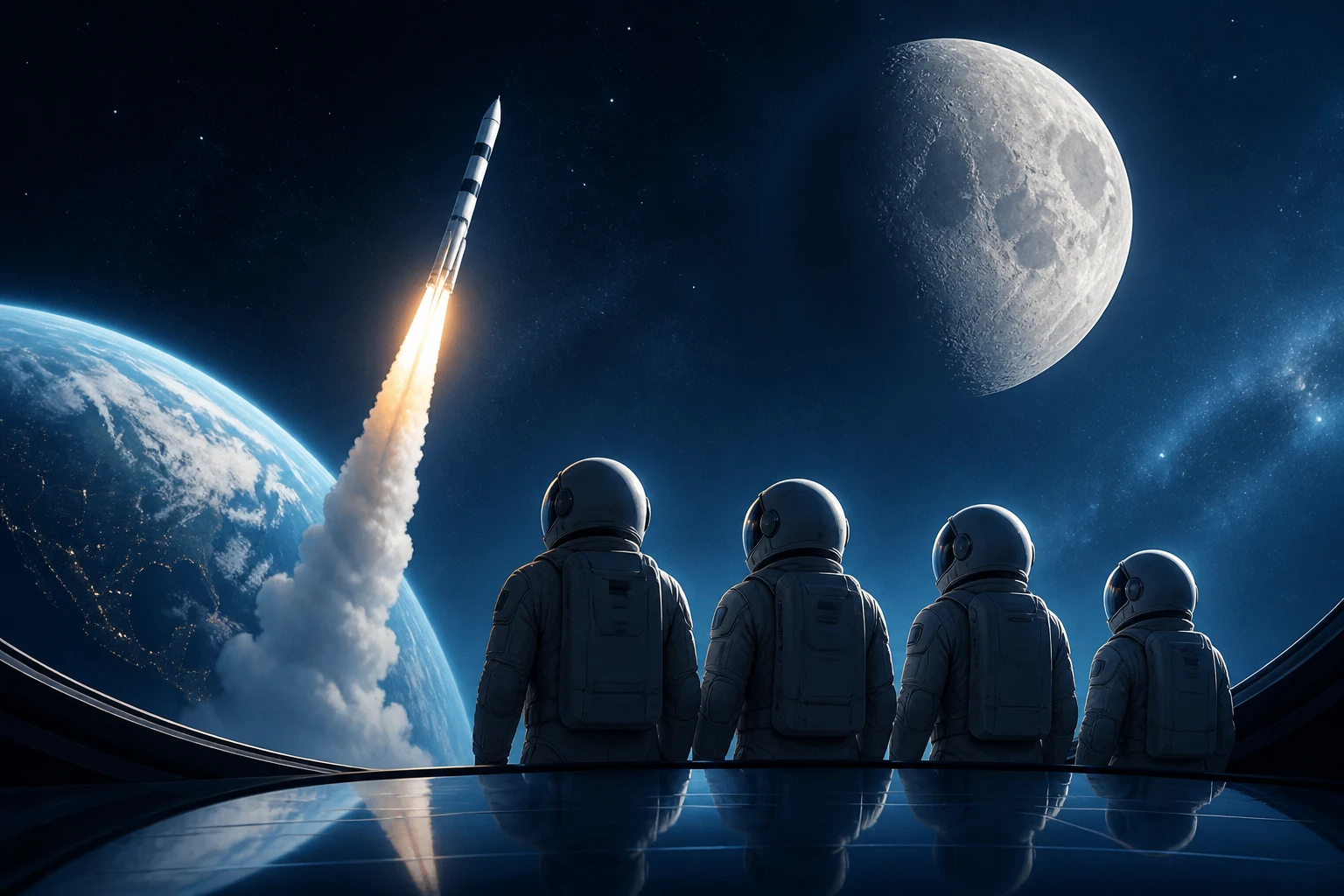
After a 51-year gap, humans have finally ventured beyond Earth's protective embrace into the vast expanse of deep space. NASA's Artemis II mission, launched on April 1, 2024, marked this historic milestone by sending four astronauts on a lunar flyby aboard the Orion spacecraft. This isn't just another space mission – it's humanity's bold declaration that we're ready to become a multi-planetary species. The mission represents the culmination of decades of technological advancement and serves as a critical stepping stone toward establishing a permanent human presence on the Moon by 2026.
Here's What's Happening
The Artemis II crew – consisting of NASA astronauts Reid Wiseman, Victor Glover, Christina Hammock Koch, and Canadian Space Agency's Jeremy Hansen – completed a 10-day journey around the Moon, testing every critical system that future lunar explorers will depend on. Unlike the uncrewed Artemis I mission in 2022, this flight put human lives on the line to validate that the $93 billion Artemis program can safely transport people to deep space.
The mission utilized NASA's Space Launch System (SLS), currently the world's most powerful operational rocket, generating 8.8 million pounds of thrust – enough to lift 27 metric tons to the Moon. Think of it as the difference between a motorcycle and a freight train in terms of raw power compared to previous human spaceflight vehicles.
Let's Break This Down
The technical achievements of Artemis II extend far beyond just getting humans to the Moon and back. The Orion spacecraft demonstrated its ability to sustain human life for extended periods in the harsh radiation environment beyond Earth's magnetosphere – something no vehicle has done since the Apollo Command Module in 1972.
The mission tested critical life support systems, including advanced environmental control systems that can recycle air and water for up to 21 days – essential for future Mars missions that could last 6-9 months. The spacecraft's heat shield, measuring 16.5 feet in diameter, successfully protected the crew during re-entry at speeds of 25,000 mph – about 32 times faster than a commercial airliner.
From an economic perspective, the Artemis program represents a fundamental shift in space exploration strategy. Unlike Apollo, which was primarily a government endeavor, Artemis involves over 3,000 suppliers across 50 states, creating a sustainable space economy. SpaceX's Starship will serve as the lunar lander, while companies like Blue Origin and Dynetics contribute various components, demonstrating how public-private partnerships are reshaping space exploration.
The mission also validated international cooperation in deep space exploration. Canada's contribution of the Canadarm3 robotic system and Europe's service module technology prove that lunar exploration has become a truly global endeavor, much like how the International Space Station operates through international partnerships.
The Bigger Picture
For India's growing space ambitions, Artemis II offers both inspiration and practical lessons. ISRO's Chandrayaan-3 success in 2023 positioned India as a key player in lunar exploration, and NASA has already expressed interest in collaboration opportunities. The Artemis Accords, signed by 29 countries including India, create frameworks for peaceful lunar exploration and resource utilization.
The mission's success has significant implications for the emerging space economy, projected to reach $1 trillion by 2040. Indian space startups like Skyroot Aerospace and Agnikul Cosmos are developing technologies that could eventually support lunar missions, while ISRO's upcoming Gaganyaan program builds foundational human spaceflight capabilities.
The technological innovations from Artemis II will likely trickle down to terrestrial applications, just as Apollo-era innovations gave us everything from memory foam to cordless tools. Advanced life support systems, radiation shielding, and autonomous navigation technologies developed for lunar missions often find applications in healthcare, manufacturing, and transportation sectors.
What's Next?
Artemis III, planned for 2026, will attempt the first crewed lunar landing since Apollo 17, with ambitious goals to establish a lunar base camp by 2030. This permanent outpost will serve as humanity's stepping stone to Mars, expected in the 2030s.
The success of Artemis II proves that the dream of becoming a spacefaring civilization isn't science fiction – it's an engineering challenge we're systematically solving. For young professionals entering STEM fields, space exploration offers unprecedented career opportunities in everything from life sciences to advanced manufacturing. The Moon isn't just our next destination; it's our gateway to the solar system.