

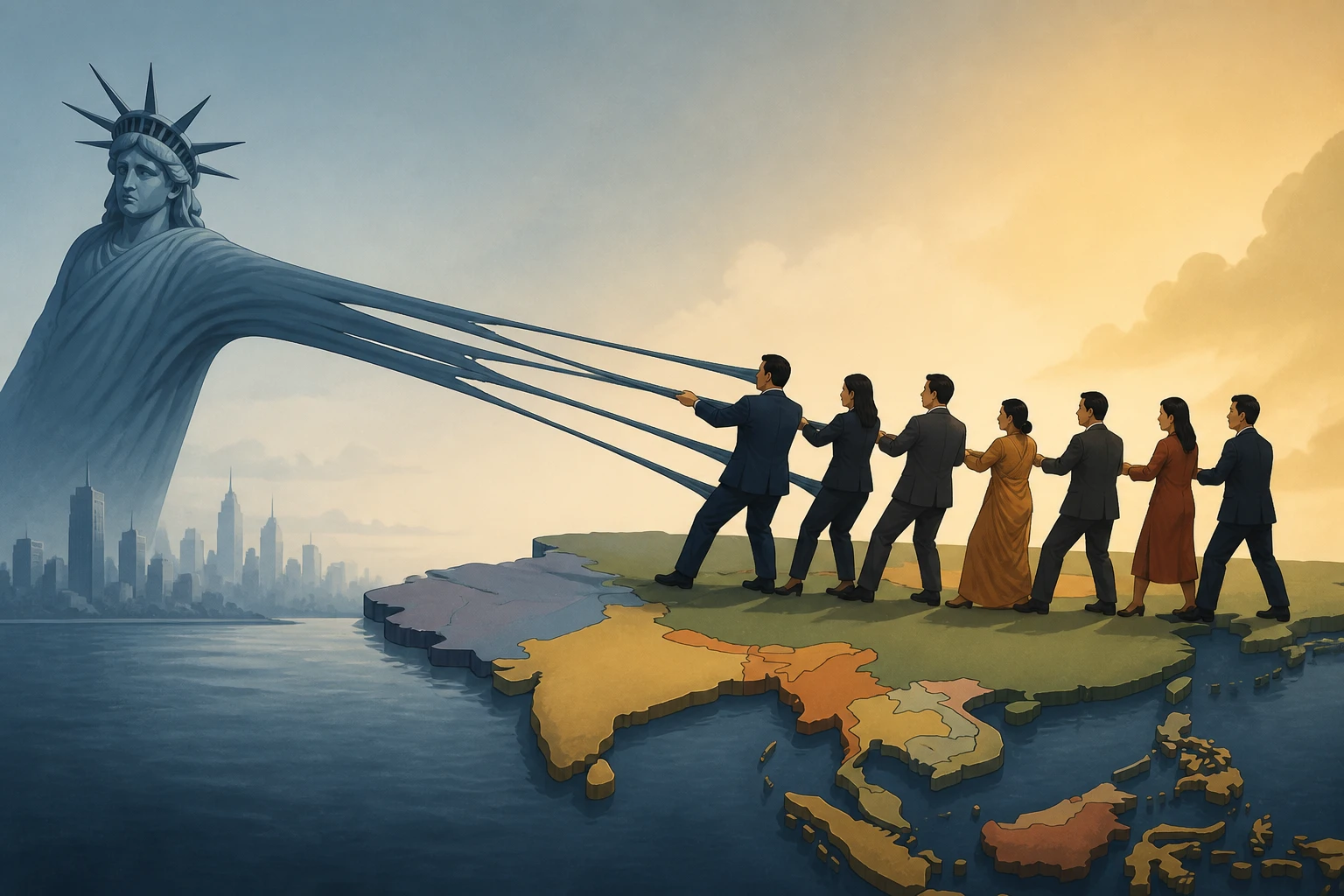
The annual Shangri-La Dialogue in Singapore has, for over two decades, been the region's most important security gathering — a room where defence ministers sit close enough to pass notes and America's top defence official sets the tone for the year ahead. This year's edition, held at the end of May, had all the familiar rituals. But the atmosphere was different. The questions being whispered in the corridors were no longer about what Washington would do in Asia — but whether it could still afford to show up at all.
The Speech That Reassured No One Enough
US Secretary of Defense Pete Hegseth struck a bullish tone, stating that America is proud to operate in the Indo-Pacific and is here to stay. He invoked "peace through strength," warned of consequences if China moved on Taiwan, and called on Asian countries to increase their defence spending, pointing out that NATO countries had already pledged to spend 5% of their GDP on defence.
The words were strong. The reception was complicated.
Hegseth's speech aimed to address questions about the US commitment to Asia — yet, with his domestic focus, insistence that Asian countries spend more on defence, and inconsistencies between words and policy, it will take more than words to convince Asia of US credibility. Regional officials who spoke to analysts noted that he was offering reassurance on US commitment in the area where it is arguably least needed, given disruptions in non-defence aspects of US policy.
Translation: Asia is fine with the security pledges. It's the tariffs, the unpredictability, and the sense of a distracted superpower that are doing the real damage.
Two Theatres, One Sponsor
The subtext running through Singapore's ballrooms was impossible to ignore. Hegseth himself acknowledged that the US was simultaneously committed to a lasting peace in Ukraine and ensuring Iran never acquires nuclear weapons — and as Europe "steps up and takes greater ownership for its own security," he was counting on Asian allies and partners to be "force multipliers for peace."
That framing — Asia must do more precisely because the US is occupied elsewhere — landed awkwardly with nations already squeezed by US tariffs. The Dialogue took place against the backdrop of those tariffs on important regional allies and trading partners; it is virtually impossible to separate geopolitics and geoeconomics in current Asian security policy.
The Indo-Pacific has become the world's most consequential strategic arena — and while war and disorder rage in European and Middle Eastern theatres, the region cannot be complacent. Australia's deputy prime minister said it plainly: "There is no effective balance of power in this region absent the United States. But we cannot leave this to the US alone. Other countries must contribute as well."
Europe in the Room, China Out of It
The most symbolically loaded moment of the Dialogue wasn't anything Hegseth said. For the first time, a European leader — French President Emmanuel Macron — delivered the keynote address, a sign of growing European interest in Asian security and the intertwining of European and Asian security. Macron's message was pointed: he proclaimed that "the time for non-alignment has undoubtedly passed" and called for "coalitions of action" to build a constructive world order.
His tour of Southeast Asian countries including Singapore, Indonesia, and Vietnam, combined with increased European carrier group deployments to the region and naval exercises in the Indian Ocean, marked a recognition of Europe's growing involvement in Asian security.
Meanwhile, the other major power that usually commands the room was conspicuously absent. The summit was marked by the notable absence of Chinese Defence Minister Dong Jun — the first time China's top defence official has skipped the gathering since its inception.
India's Moment in the Uncomfortable Middle
For India, the Dialogue offered a microcosm of the country's larger strategic reality. Hegseth specifically highlighted the growing US-India defence relationship, citing "shared ventures of our defence industries" and "increased operational coordination and interoperability between the two militaries."
But India also watched the room carefully. General Anil Chauhan, India's Chief of Defence Staff, engaged in a pointed exchange with his Pakistani counterpart, warning of "red lines of tolerance" for decades of alleged cross-border terrorism — a reminder that India's most pressing security concerns remain closer to home than the Taiwan Strait.
The deeper question from Singapore isn't whether the US will leave Asia. It almost certainly won't. The question is whether a US managing Ukraine, Iran, domestic politics, and a trade war can remain the region's primary security guarantor — or whether Asia needs to quietly start building the architecture for a world in which it does more of that work itself. That conversation has begun. Singapore just gave it a stage.
Sources
- SHANGRI-LA: U.S. ‘Will Not be Pushed Out of This Critical Region,’ Says SECDEF - USNI News
- US Defence Secretary Raises More Questions than Answers at the Shangri-La Dialogue - RSIS
- At Shangri-La Dialogue 2025, US Unveils New Defense Vision
- Remarks by Secretary of Defense Pete Hegseth at the 2025 Shangri-La Dialogue in Singapore (As Delivered) - U.S. Embassy in Singapore
- Policy Backgrounder: US Policy in the Indo-Pacific: The 2025 Shangri-La Dialogue
- Address at 2025 Shangri-la Dialogue Plenary Session 3: Managing proliferation risks in the Asia-Pacific | Defence Ministers
- Shangri-La Dialogue 2025: Asian Security Going Forward - RSIS
- U.S-PRC Rivalry Takes Center Stage at Shangri-La Dialogue 2025 | Defense.info