

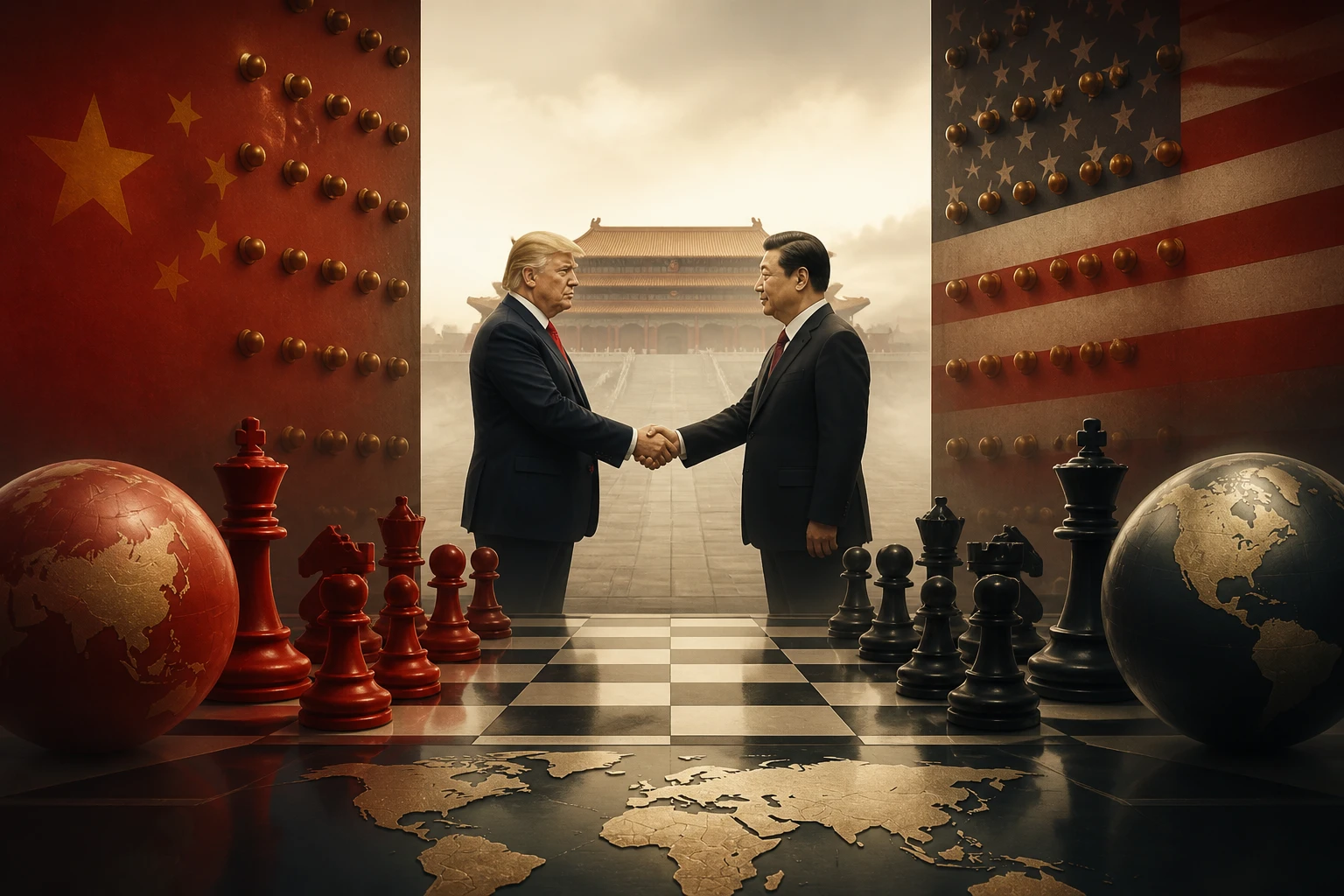
When the American president flies to Beijing with three of the most powerful CEOs on the planet in tow, it stops being a diplomatic visit. It becomes a statement.
Donald Trump landed in China alongside Elon Musk, Nvidia's Jensen Huang, and Apple's Tim Cook — a delegation that reads less like a diplomatic entourage and more like a board meeting between the world's two largest economies. The message was deliberate: this isn't just governments talking. This is capital talking too.
Why the Guest List Matters More Than the Agenda
Summits are usually won or lost in the fine print — trade clauses, tariff schedules, joint communiqués. This one produced none of that. No agreements on Taiwan. No breakthrough on Iran. By the conventional scorecard, it was a draw at best.
And yet, Jensen Huang called it "one of the most important summits in human history." That's a significant thing for a CEO to say — especially one whose company sits at the center of the US-China tech war. Nvidia's chips are precisely the kind of technology that American export controls have tried to keep out of Chinese hands. Huang showing up in Beijing, in that room, signals something: that American tech industry is not uniformly aligned with Washington's hawkish posture on China.
Xi Jinping, for his part, told the assembled American executives that China's door would only "open wider." It's a phrase calibrated for an audience — reassuring to CEOs who depend on Chinese manufacturing, Chinese consumers, and Chinese supply chains, even as geopolitical tensions have made that dependence uncomfortable to admit publicly.
The Summit as Theater, and Why Theater Has Consequences
There's a temptation to dismiss the absence of concrete outcomes as failure. That misses the point. Summits at this level often function as permission structures — they signal to markets, to governments, and to businesses what kind of engagement is acceptable. The fact that Trump, Musk, Huang, and Cook were all in the same room as Xi sends a message that dialogue, not decoupling, remains on the table.
For Indian professionals watching this, the implications run deeper than they might appear. India has spent the better part of the last decade positioning itself as an alternative to China — in manufacturing, in supply chains, in tech talent. A warming between Washington and Beijing doesn't erase that opportunity, but it does complicate the narrative. If American capital starts flowing back toward China with renewed confidence, the "China+1" strategy that has benefited India may face a quieter headwind.
What Silence on Taiwan Actually Tells Us
The absence of any agreement on Taiwan isn't a footnote — it's arguably the most important data point from the summit. Taiwan is the fault line that makes every other aspect of US-China relations conditional. As long as it remains unresolved, the warmth on display in Beijing has a ceiling. Businesses know this. That's why Huang's enthusiasm and the lack of formal agreements can coexist without contradiction: executives are optimistic about access, while remaining clear-eyed about the limits.
The world's two superpowers met, talked, and parted without a rupture. In the current climate, that alone counts for something. Whether it counts for enough is a question that won't be answered in a single summit — no matter how historically billed.