

Overview
Imagine knowing exactly how your factory will perform next month, or predicting which machine will break down before it actually happens. This isn't science fiction anymore. Digital twins—virtual replicas of real-world systems—are transforming how companies make critical decisions. From BMW's smart factories to Singapore's entire urban planning system, these virtual models use real-time data to simulate countless scenarios. The global digital twin market, valued at $6.9 billion in 2021, is expected to reach $73.5 billion by 2027. But as more businesses bet their future on these virtual crystal balls, one question looms large: what happens when the mirror shows a distorted reflection?
Here's What's Happening
Companies across industries are building virtual copies of everything—assembly lines, power plants, human hearts, and entire cities. General Electric uses digital twins to monitor jet engines mid-flight, predicting maintenance needs before pilots even land. Unilever simulates entire production processes virtually before implementing changes in their physical factories, saving millions in potential downtime costs.
The magic happens through thousands of IoT sensors feeding real-time data into sophisticated computer models. When Tesla wants to optimize battery performance, they don't need to build hundreds of prototypes. Their digital twin runs millions of simulations, testing everything from temperature variations to charging cycles. The result? Faster innovation cycles and dramatically reduced costs. Ford reports saving $2 million per vehicle program by catching design flaws in virtual testing rather than physical prototypes.
Let's Break This Down
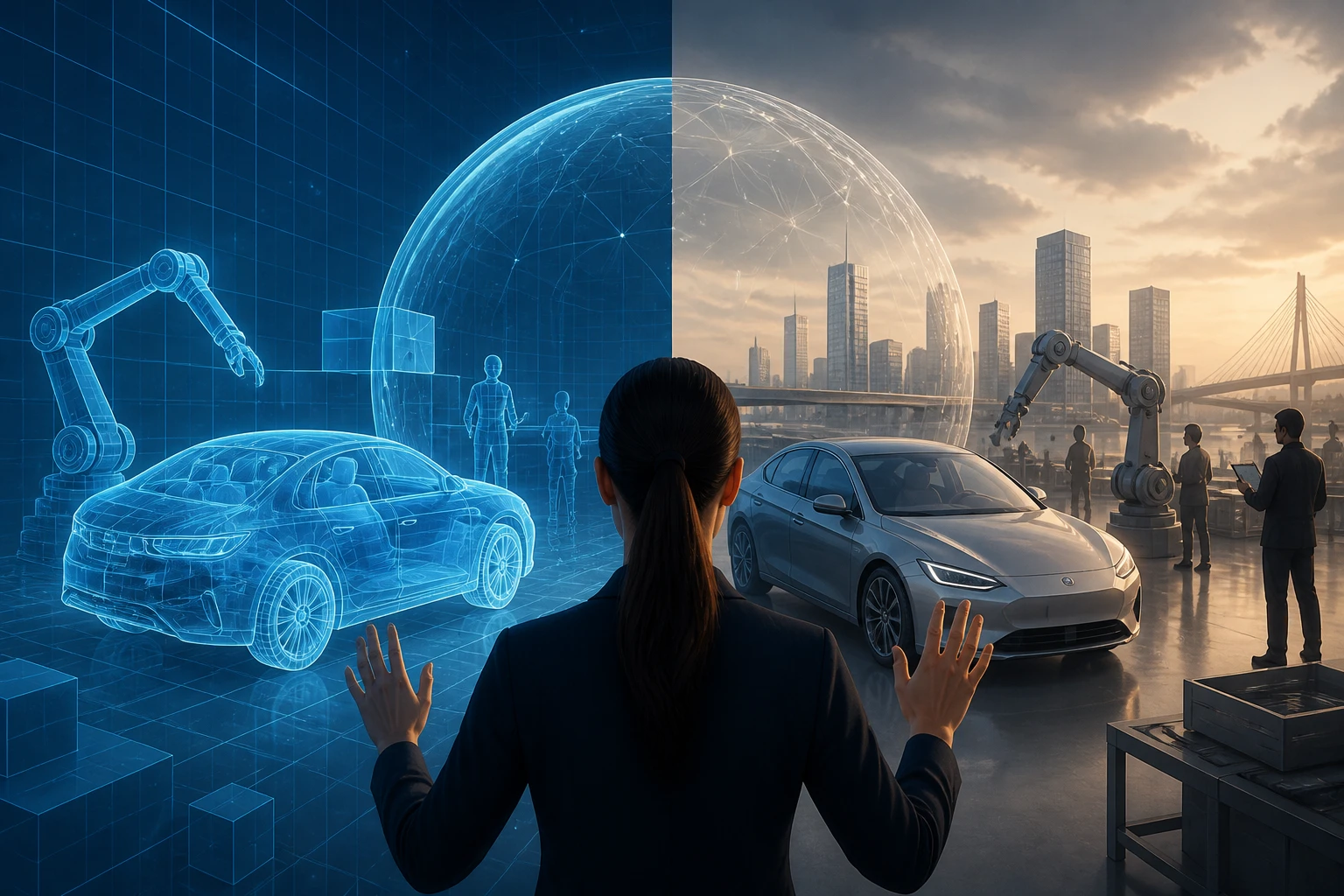
Think of digital twins like having a perfect video game version of your business—except the stakes are real money and real consequences. When Siemens creates a digital twin of a manufacturing plant, every bolt, conveyor belt, and robotic arm exists in virtual space, behaving exactly like their physical counterparts.
The power lies in the "what if" scenarios. Walmart uses digital twins of their supply chain to simulate everything from natural disasters to truck breakdowns. During the COVID-19 pandemic, companies with robust digital twins adapted 40% faster than competitors, according to Deloitte research. They could instantly model new safety protocols, reconfigure production lines, and optimize delivery routes—all without touching a single physical asset.
Rolls-Royce has built digital twins for over 13,000 jet engines worldwide. These virtual engines accumulate data from every flight, creating increasingly accurate predictions about performance and maintenance needs. The company now offers "power by the hour" services, charging airlines only for actual engine usage because they're confident in their predictive capabilities.
But here's where it gets interesting—and dangerous. A McKinsey study found that 70% of digital twin implementations fail to deliver expected value, primarily due to poor data quality. Garbage in, garbage out, as programmers say. When Boeing's early digital models missed critical stress factors in aircraft design, the consequences were measured in both dollars and safety concerns.
The accuracy challenge is real. Smart cities like Barcelona and Amsterdam use digital twins to optimize traffic flows and energy consumption. But when sensor data is incomplete or algorithms miss cultural factors—like how people actually behave versus how models predict they should behave—the virtual recommendations can backfire spectacularly.
The Bigger Picture
For Indian businesses, digital twins represent a massive leap-frogging opportunity. Tata Steel already uses digital twins to optimize their steel production, while Mahindra simulates vehicle performance across India's diverse terrain and weather conditions without physical testing in every location.
The implications extend beyond individual companies. Smart city initiatives in Pune and Bhubaneswar are experimenting with urban digital twins to manage everything from water distribution to waste management. The potential is enormous—IBM estimates that digital twins could help Indian cities reduce infrastructure costs by 15-20% while improving service delivery.
However, the skills gap is significant. Building and maintaining accurate digital twins requires expertise in IoT, data analytics, simulation software, and domain knowledge. Companies need professionals who understand both technology and the physical systems being modeled—a rare combination in today's job market.
What's Next?
The future belongs to companies that can bridge the gap between virtual perfection and messy reality. As 5G networks and edge computing mature, digital twins will become more real-time and accurate. NASA is already working on digital twins of Mars habitats, while medical companies develop virtual organs for personalized treatment planning.
The key insight? Digital twins aren't just about technology—they're about decision-making confidence. Companies that master this balance between virtual simulation and real-world validation will have a significant competitive advantage. Those that don't risk making very confident, very expensive mistakes based on beautiful but flawed virtual realities.