

Overview
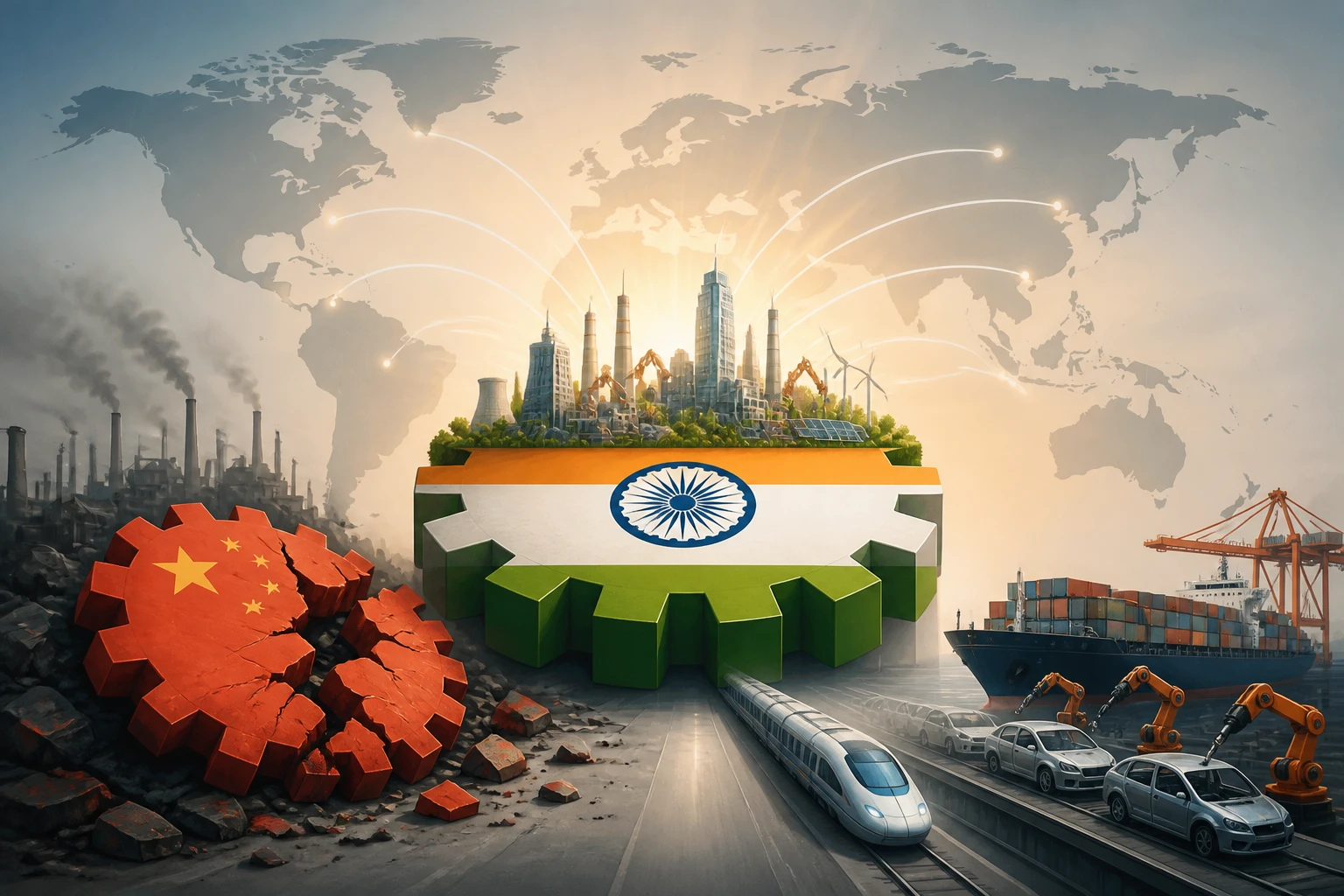
Imagine you're the CEO of a toy company that's been manufacturing in China for 15 years. Suddenly, your costs have doubled, shipping delays are constant, and geopolitical tensions make your board nervous. You're not alone – thousands of companies are asking the same question: where do we go next? Enter India, positioning itself as the world's next manufacturing powerhouse with ambitious plans to capture $1 trillion in manufacturing by 2025. But here's the thing about big dreams – they're only as good as the execution behind them. As China stumbles under rising labor costs, strict COVID policies, and trade tensions, India sees its moment. The question isn't whether companies want to diversify away from China (they do), but whether India can actually deliver on its massive promise to become the "factory of the world."
The Problem
Think of global manufacturing like a massive game of musical chairs, except the music just stopped and everyone's scrambling for new seats. China, which has dominated global manufacturing for decades, is facing its biggest challenges yet. Labor costs have risen 300% since 2005, COVID-19 lockdowns disrupted supply chains, and geopolitical tensions with the US and Europe have companies nervous about putting all their eggs in one basket. Meanwhile, India is waving frantically, shouting "Hey, we have 1.4 billion people and much cheaper labor!" But here's where it gets complicated – having people doesn't automatically translate to having the right infrastructure, skills, or systems to handle complex manufacturing at scale. It's like offering to cook dinner for 100 people when you've only ever made pasta for yourself. The intent is there, but the execution requires a lot more than good intentions.
Analysis
The numbers tell a fascinating story of opportunity mixed with reality checks. India currently accounts for just 3% of global manufacturing, compared to China's dominant 28%. However, the Production Linked Incentive (PLI) scheme has already attracted investments worth over $30 billion across sectors like electronics, pharmaceuticals, and automotive.
From an economic perspective, India offers compelling advantages: average manufacturing wages are roughly 40% lower than China's, and the country has a massive domestic market of 1.4 billion consumers. This creates a powerful combination – companies can manufacture cheaply and sell locally, reducing dependency on exports.
Policy-wise, the government has launched initiatives like "Make in India" and "Atmanirbhar Bharat" (Self-Reliant India), streamlining regulations and offering tax incentives. The National Infrastructure Pipeline promises $1.4 trillion in infrastructure investments by 2025.
But the business implications reveal significant challenges. India's logistics costs are 13-14% of GDP compared to 8% in developed countries. Port efficiency ranks poorly – Mumbai's port handles 60 containers per hour versus Shanghai's 200. The skill gap is massive: while India produces 1.5 million engineering graduates annually, most lack industry-ready skills for modern manufacturing.
The geopolitical angle adds urgency – companies need alternatives to China, and India benefits from being the world's largest democracy with stable institutions.
Real-World Examples
Apple's journey illustrates both the potential and challenges perfectly. The company now manufactures iPhone 14s in India through partners like Foxconn and Wistron, but it took years to achieve quality standards. Initial production faced issues with worker protests and quality control, highlighting the learning curve involved.
Samsung has built its largest mobile manufacturing facility in Noida, India, producing 120 million smartphones annually. However, the company still imports critical components, showing how India needs to build entire ecosystems, not just final assembly plants.
The pharmaceutical sector tells a success story – India produces 60% of global vaccines and 20% of generic medicines. Companies like Serum Institute of India have become global powerhouses, proving India can excel in complex manufacturing when the ecosystem is right.
Tesla's prolonged negotiations with the Indian government over import duties and local manufacturing requirements demonstrate the bureaucratic hurdles. Despite years of discussions, the company still hasn't established significant operations in India, contrasting sharply with its rapid expansion in China.
The Challenge
Here's why this isn't as simple as flipping a switch: manufacturing ecosystems take decades to build. It's not just about cheap labor – you need reliable power, efficient ports, skilled workers, quality suppliers, and streamlined bureaucracy all working together. India still struggles with power outages affecting 70% of manufacturers, complex GST compliance, and land acquisition challenges. Building this ecosystem while companies need alternatives now creates a chicken-and-egg problem that can't be solved overnight.
Future Implications
If India succeeds, we're looking at a fundamental reshaping of global trade. McKinsey estimates India could create 100 million manufacturing jobs by 2030, potentially lifting millions out of poverty and creating a massive middle class. For global companies, it means more resilient supply chains and reduced geopolitical risk. For consumers, it could mean lower prices as competition increases between manufacturing hubs.
However, failure could mean continued overdependence on China or fragmented supply chains across multiple smaller countries, potentially increasing costs and complexity. The success of India's manufacturing ambitions will likely determine whether we see a bipolar manufacturing world (US-China-India triangle) or a multipolar one with several regional hubs.
For working professionals, this shift means new opportunities in supply chain management, international business, and emerging market expertise will become increasingly valuable.
Looking Ahead
India's manufacturing dreams aren't impossible – they're just incredibly complex. The country has some fundamental advantages: democracy, demographic dividend, and domestic demand. But converting potential into reality requires execution at a scale and speed that challenges even the most optimistic projections. The real question isn't whether India will grow its manufacturing sector – it will. The question is whether it can grow fast enough and efficiently enough to truly challenge China's dominance before other alternatives emerge. Can India build in a decade what took China three decades to perfect?