

Overview
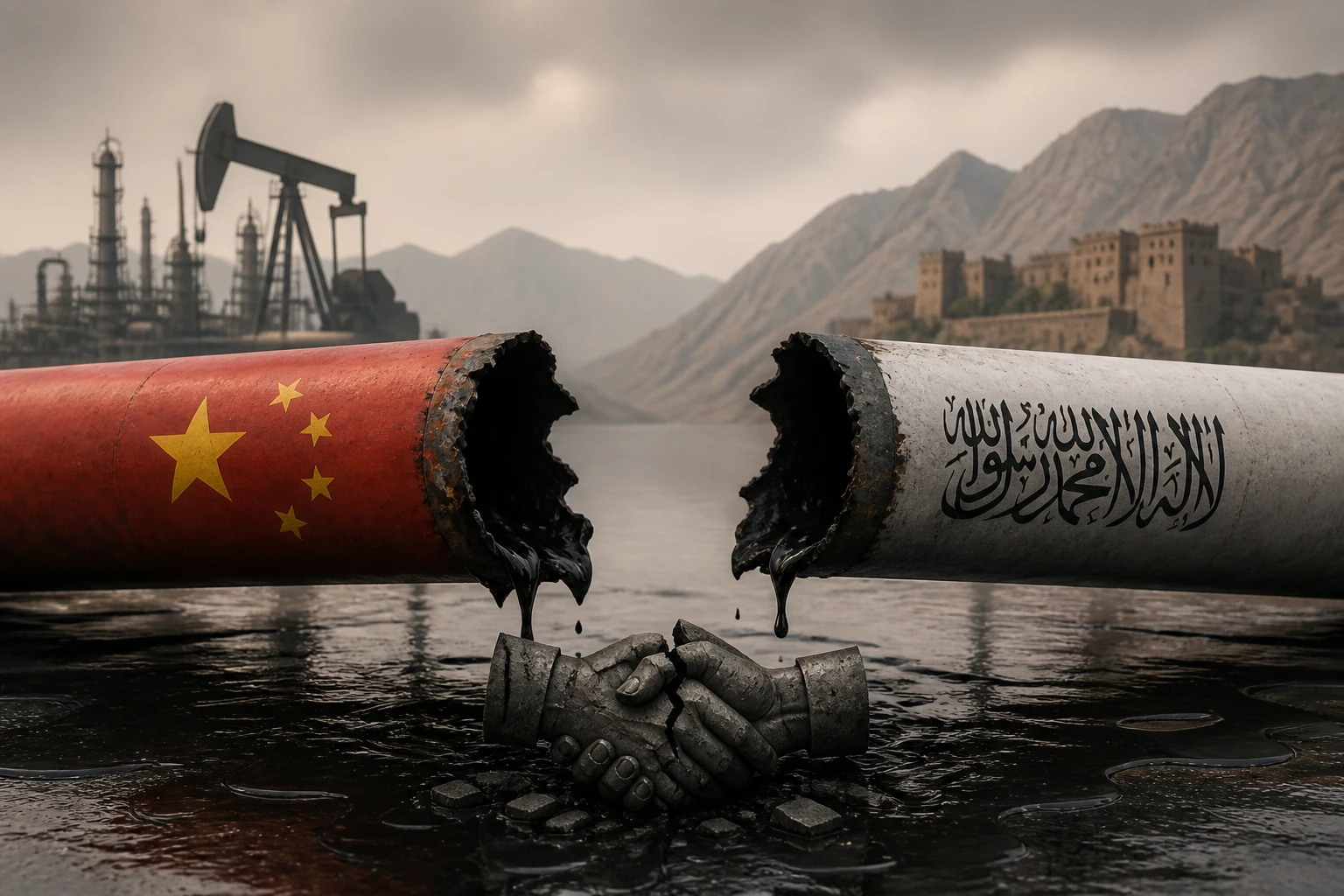
Imagine lending your friend $540 million to start a lemonade stand, only to have them kick you out two years later claiming you didn't follow the recipe properly. That's essentially what happened between China's Xinjiang Central Asia Petroleum and Gas Company (CAPEIC) and the Taliban government in Afghanistan. In what was supposed to be a groundbreaking energy partnership, the deal to extract oil from Afghanistan's Amu Darya basin has spectacularly collapsed, with Chinese employees reportedly fleeing the country and the Taliban accusing their partners of contract violations. This isn't just another failed business venture—it's a $540 million lesson in the complexities of doing business in one of the world's most challenging political environments.
The Problem
The Amu Darya oil extraction contract, signed in January 2023, was meant to be a win-win situation. Afghanistan, desperate for foreign investment and revenue after international sanctions following the Taliban's 2021 takeover, offered China access to what experts estimate could be 1.8 billion barrels of crude oil reserves. For China, it represented a strategic opportunity to secure energy resources while potentially legitimizing economic engagement with the Taliban regime.
However, by late 2024, the deal had completely unraveled. The Taliban accused CAPEIC of failing to meet contractual obligations, including insufficient investment in infrastructure and delayed project timelines. Reports suggest that Chinese personnel began evacuating from the site, with some sources indicating they left abruptly amid growing tensions. The collapse represents the largest failed foreign investment attempt in Taliban-controlled Afghanistan, highlighting the immense challenges of conducting business in a country with limited international recognition and ongoing economic isolation.
Analysis
This failure illuminates several critical dimensions of modern international business and geopolitics. From an economic perspective, the collapse represents China's cautious approach to Taliban engagement—willing to explore opportunities but quick to withdraw when risks escalate. Unlike China's confident investments in stable markets, this deal revealed the limits of even Chinese risk tolerance.
The regulatory complexity cannot be overstated. Afghanistan operates under Taliban-imposed Islamic law, which often conflicts with international business practices. There's no established legal framework for dispute resolution, no international arbitration mechanisms, and limited infrastructure to support large-scale operations. It's like trying to build a skyscraper on quicksand—the foundation simply isn't stable enough.
From a geopolitical angle, this failure sends mixed signals about international engagement with the Taliban. While China has maintained diplomatic relations with the Taliban government, this business failure suggests that even Beijing finds the operating environment too challenging for substantial investments. The deal's collapse also impacts Afghanistan's desperate need for foreign currency, as the country faces a severe humanitarian crisis with over 28 million people requiring humanitarian assistance according to the UN.
Policy implications extend beyond bilateral relations. This failure may discourage other potential international investors, further isolating Afghanistan economically and potentially destabilizing the region.
Real-World Examples
This isn't China's first challenging overseas energy investment. China National Petroleum Corporation's troubled operations in South Sudan, where civil war disrupted production and forced evacuations, offer a parallel example. Similarly, Chinese investments in Venezuela's oil sector have faced massive write-downs due to political instability and sanctions.
However, successful Chinese energy partnerships exist as well. China's $62 billion investment in Pakistan's China-Pakistan Economic Corridor (CPEC) includes multiple energy projects that have proceeded despite security challenges, suggesting that political stability and government backing make the crucial difference.
Industry experts point to risk assessment failures as a key factor. Dr. Niva Yau from the Atlantic Council noted that Chinese companies often underestimate political risks in fragile states, focusing primarily on resource potential rather than operational feasibility. The World Bank's Worldwide Governance Indicators rank Afghanistan in the bottom 5% globally for political stability, making any long-term investment extremely risky.
The Challenge
The fundamental challenge isn't just about business disputes—it's about operating in a governance vacuum. Afghanistan lacks recognized international legal frameworks, has limited banking systems due to sanctions, and faces ongoing security challenges. Even well-intentioned investors struggle with basic operational requirements like money transfers, equipment imports, and personnel safety.
Future Implications
This collapse has significant ramifications for Afghanistan's economic future. The Taliban government had projected that oil revenues could provide crucial funding for public services and economic development. Without foreign investment and technical expertise, Afghanistan's energy sector remains largely underdeveloped despite substantial reserves.
For China, this failure reinforces a pattern of selective engagement—maintaining diplomatic relationships while avoiding substantial economic commitments in highly unstable regions. Other potential investors are likely watching closely, and this high-profile failure may further discourage international business engagement with Taliban-controlled Afghanistan.
The broader implication concerns economic isolation's human cost. With limited legitimate revenue sources, Afghanistan faces continued economic crisis, potentially driving more civilians toward humanitarian dependence.
Looking Ahead
The $540 million question remains: Can Afghanistan attract legitimate foreign investment under current conditions? This deal's failure suggests that even countries willing to engage politically with the Taliban find the business environment too risky for substantial commitments. As Afghanistan's isolation deepens, will economic necessity eventually force either more pragmatic governance approaches or continued drift toward economic collapse?