

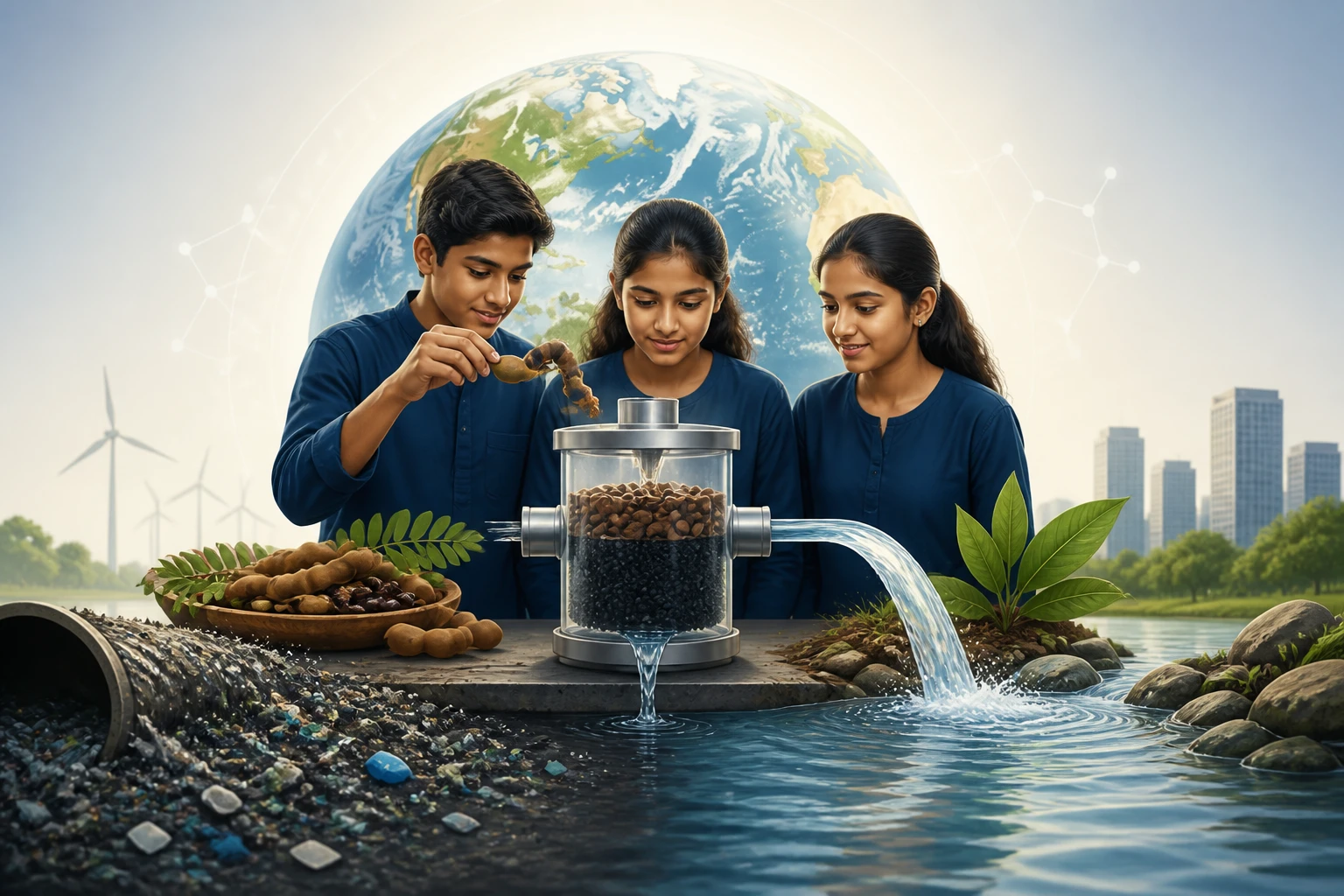
Every year, tamarind seeds are discarded by the tonne across India — a byproduct of a fruit so embedded in the country's cuisine that it barely registers as a resource. Three 16-year-olds from India just turned that overlooked waste into the world's most celebrated student environmental invention.
Vivaan Chhawchharia, Ariana Agarwal, and Avyana Mehta were named the Global Winners of The Earth Prize 2026 for Plas-Stick, a biodegradable powder that removes microplastics from drinking water. Plas-Stick is the first-ever Global Winner of The Earth Prize from India. Around 23,000 people cast their votes to select the Global Winner from seven Regional Winners representing every continent.
The Observation That Started It All
The invention didn't begin in a lab. The idea was sparked by the team's studies in environmental science and a visit to a rural community, where they observed how drinking water is often stored in shared containers without access to advanced filtration systems. Watching a child drink from one of those containers made an abstract problem suddenly concrete.
Globally, over 2.2 billion people lack safely managed drinking water infrastructure, increasing reliance on stored water that may contain microplastics. And the health implications are not trivial: recent scientific studies have detected microplastics in drinking water, seafood, human blood, lungs, placentas, and even brain tissue.
How Plas-Stick Actually Works
The team developed a biodegradable powder made from discarded tamarind seeds. When added to water, the powder attracts and binds microplastic particles into visible clumps that can then be removed using a handheld magnet. No electricity. No complex machinery. Tamarind seeds naturally contain binding compounds that may help attract and bind particles in water — a property sitting in plain sight, in kitchens across the subcontinent, waiting to be applied.
Already deployed through workshops and demonstrations, Plas-Stick has reached and educated more than 8,000 students and teachers so far. The team now plans to scale through decentralised production hubs, bringing the solution to rural communities across India.
Why "Simple" Is the Point
The instinct in environmental technology is to reach for complexity — industrial filtration, chemical treatments, AI-monitored systems. Plas-Stick argues the opposite. These clumps can be removed using a handheld magnet, helping to purify water without the use of expensive filtration systems, electricity, or harmful chemicals.
In 2026, participants from 169 countries and territories submitted projects for the Earth Prize competition, and it was this deceptively simple solution that rose to the top. The signal that sends is worth sitting with: the next breakthrough in clean water may not come from a multinational R&D budget. It may come from someone who looked at what was already around them — and asked a different question.
Sources
- Earth Prize 2026: Indian teens are Global Winners for magnetic tamarind powder that removes microplastics from water | The Earth Prize Newsroom
- 3 Teens Win Global Earth Prize for Inventing Tamarind Powder That Easily Removes Microplastics
- Indian Teenagers Win Global Award for Tamarind-Based Solution to Remove Microplastics from Water
- Indian Teenagers Win The Earth Prize 2026 for Tamarind Seed-Based Microplastic Filter