

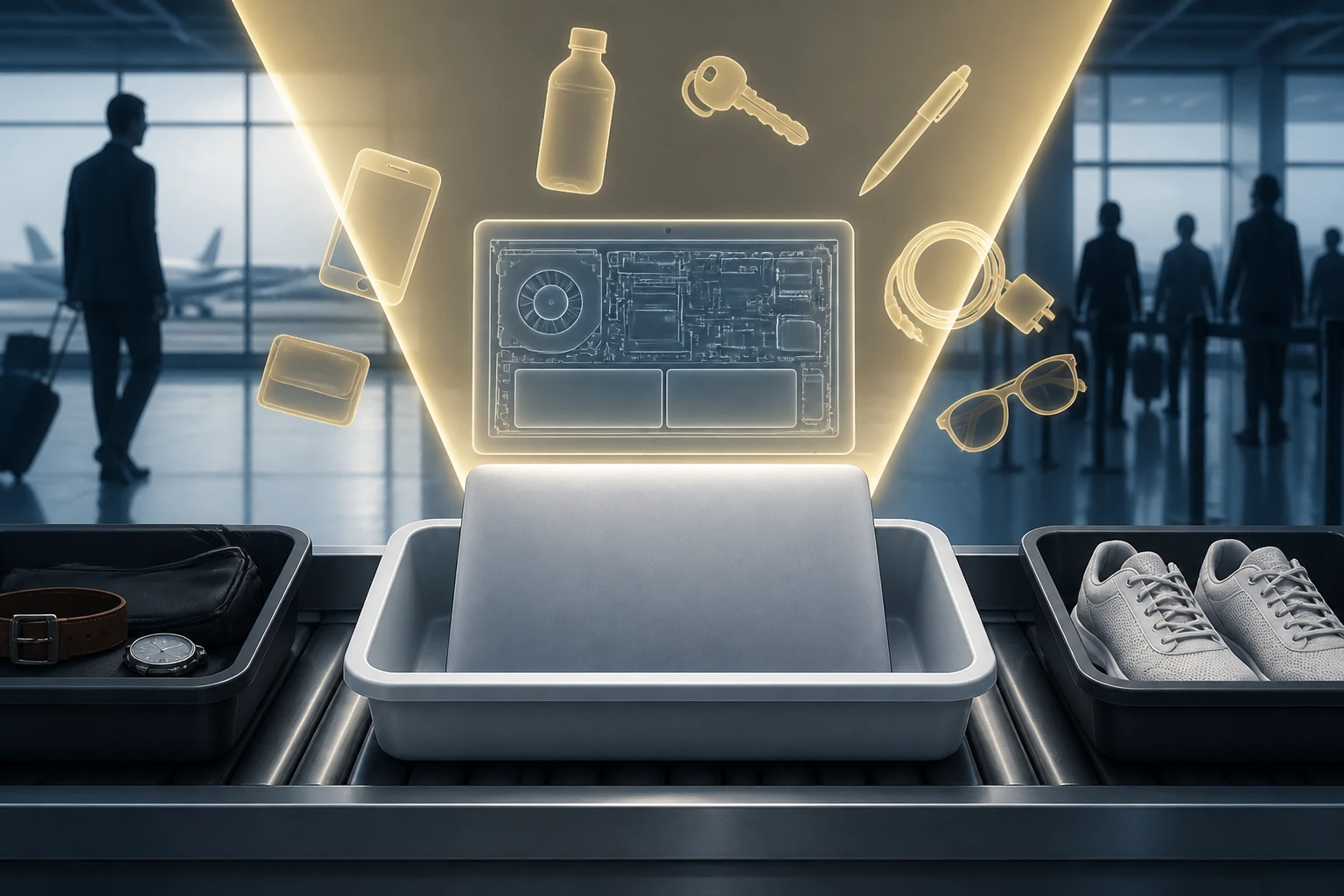
Every frequent flyer has been there: the CISF officer at Delhi's T3 or Mumbai's T2 waves you over, gestures at your backpack, and says the seven words you've heard a hundred times — "Laptop nikaalo, alag bin mein rakhna." You do it. You've always done it. But almost nobody knows why.
The answer has nothing to do with the laptop itself being suspicious.
The Physics of the Black Wall
The main reason you have to remove your laptop is that its battery and other internal components are too dense for X-rays to penetrate effectively. An airport X-ray machine fires a beam through your bag and reads what comes out the other side. Dense materials — thick metal, packed circuitry, a large lithium-ion battery — absorb more of that beam. A traditional X-ray scan is limited to producing 2D images, so if there is a component that the X-ray signal can't pass through, there is no way to see what's underneath it.
In practice, a laptop sitting inside your backpack creates a dark, opaque shadow on the screener's monitor. Anything placed beneath or behind it — in that same bag — effectively disappears from view. A laptop inside a bag can shield other items from view that may be dangerous; scanning it separately reveals its internal components on the screen.
Two Problems Solved With One Bin
Separating the laptop achieves two things at once. First, the screener gets a clean, unobstructed look at everything else in your bag — your charging cables, your toiletries, your documents. Second, the screener gets the best view of the device itself, to check whether there is anything potentially dangerous about it, be it an explosive or some other nefarious technology.
This matters because a laptop's dense interior is also exactly the kind of space where someone could attempt to conceal something. Wiring that deviates from the expected circuit-board layout, or unusual mass distribution near the battery — these are things a trained officer can spot, but only when the device is lying flat and isolated in its own bin.
With these items left in your bag, security officials can't use the screened image to determine whether a risk is present — they'll have to flag the bag for a physical search, which slows everything down. Separating devices is simply the faster and more reliable approach.
The Upgrade Already Changing This Rule
The laptop rule is not permanent. Some airports are replacing older machines with computed tomography (CT) scanners. Unlike traditional X-rays, which produce flat 2D images, CT scans generate a 3D image that can be examined from every angle — meaning the isolation of the laptop is no longer necessary. The TSA has officially ruled that laptops can stay in your bags where CT scanners are available.
Until Indian airports complete that hardware upgrade, the bin ritual stays. It is not security theatre. It is a workaround for a genuine physical limitation — one that turns out to be surprisingly elegant for something so mundane.