

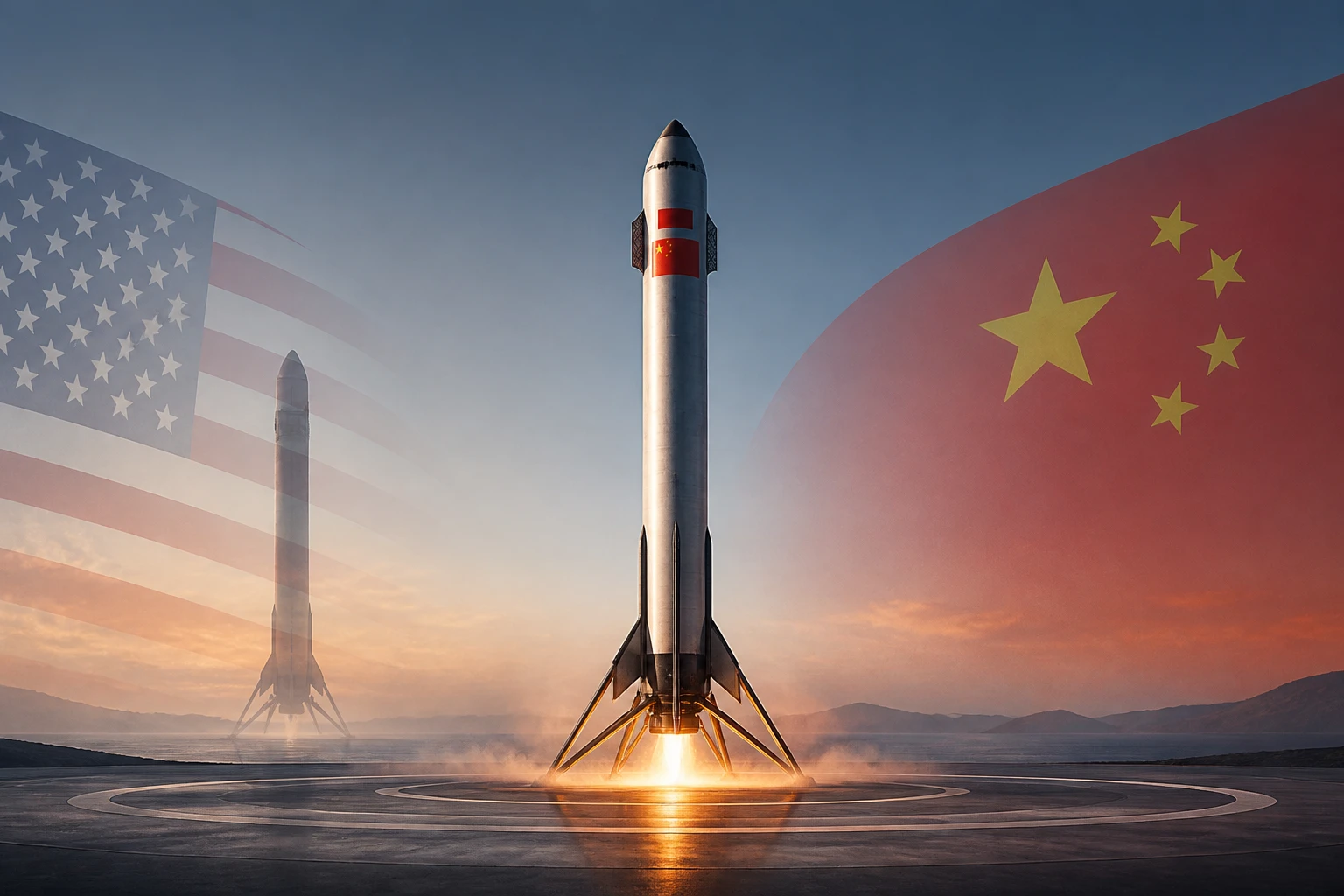
On July 11, 2025, a Long March-10B rocket lifted off from Hainan island, placed a satellite into orbit, and did something no Chinese rocket had ever done before: its first stage came back down and was caught — not on a landing pad, but in a net, on a ship at sea.
China successfully landed a reusable rocket for the first time, marking a major step in its space ambitions and in reducing launch costs. The country may now be in a position to challenge US dominance in reusable rockets, which until now has been led by Elon Musk's SpaceX and Jeff Bezos's Blue Origin.
Why Getting a Booster Back Is So Hard
When a rocket's first stage separates after launch, it is travelling at several times the speed of sound and re-entering an atmosphere that wants to destroy it. The booster has to flip itself around, fire its engines again to slow the descent — a move engineers call the re-entry burn — and then navigate the final approach using grid fins that bite into the thin air to steer. Without parachutes, engineers use the rocket's engine to slow it down, while an automatic computer control system steers using fins that adjust aerodynamic forces and keep the rocket upright. Land it wrong by even a few degrees and you get a multi-tonne explosion, not a reusable asset.
Most rockets are designed for single use, with their stages falling into the sea, burning up in the atmosphere or sometimes remaining in orbit as debris. The first stage is considered the most expensive component.
Nets vs. Legs — China's Deliberate Gamble
SpaceX's Falcon 9 lands autonomously on extendable legs — either back at the launch site or on a drone ship at sea. Unlike the Falcon 9, the Long March-10B does not land autonomously on a ground pad or drone ship. Instead, the booster is captured using landing hooks attached to a net mounted on a floating recovery platform.
The CNSA called it "China's first successful controlled recovery of a carrier rocket's first stage, as well as the world's first at-sea net-based recovery of a rocket."
Is this actually better, or just different? China's engineers argue it is leaner. Net-based recovery helps simplify the rocket's onboard structure; since the rocket does not need to be equipped with landing legs, its weight is reduced — which could allow for increased payload capacity and operational efficiency. A lighter booster that carries more cargo per flight is a straightforward cost argument.
A Rocket Built for the Moon — and the Market
The rocket has a payload capacity of 16 tons to low-Earth orbit, not far off from SpaceX's workhorse Falcon 9, which can carry 22 tons. That gap matters less if China can fly the booster repeatedly and cheaply.
The Long March-10 series is intended in particular for China's future crewed missions to the Moon. But the reusability milestone has immediate commercial resonance too. The successful landing boosted investor confidence in China's space sector, with shares of China Spacesat and China Satellite Communications each rising by the maximum daily limit of 10 per cent under the country's stock market regulations.
The gap between ambition and SpaceX's operational tempo remains wide. China has its work cut out to reach SpaceX's unparalleled launch cadence — the company came close to launching a rocket every other day in 2025, completing an astonishing 165 orbital flights, almost twice as many as China's entire space program.
Still, the net-catch on a rolling sea platform is a proof of concept that didn't exist a week ago. In the economics of space, recovering your most expensive hardware — even imperfectly — beats throwing it into the ocean every time.
Sources
- China successfully lands reusable rocket for the first time
- SpaceX or Blue Origin-Style Passive Vertical Landing Model Rocket | Science Project
- China successfully lands reusable rocket for the first time
- China achieves first reusable rocket landing - Tribune Online
- China Is Catching Up With SpaceX Fast, Landing First Reusable Rocket Booster on Offshore Platform