

Overview
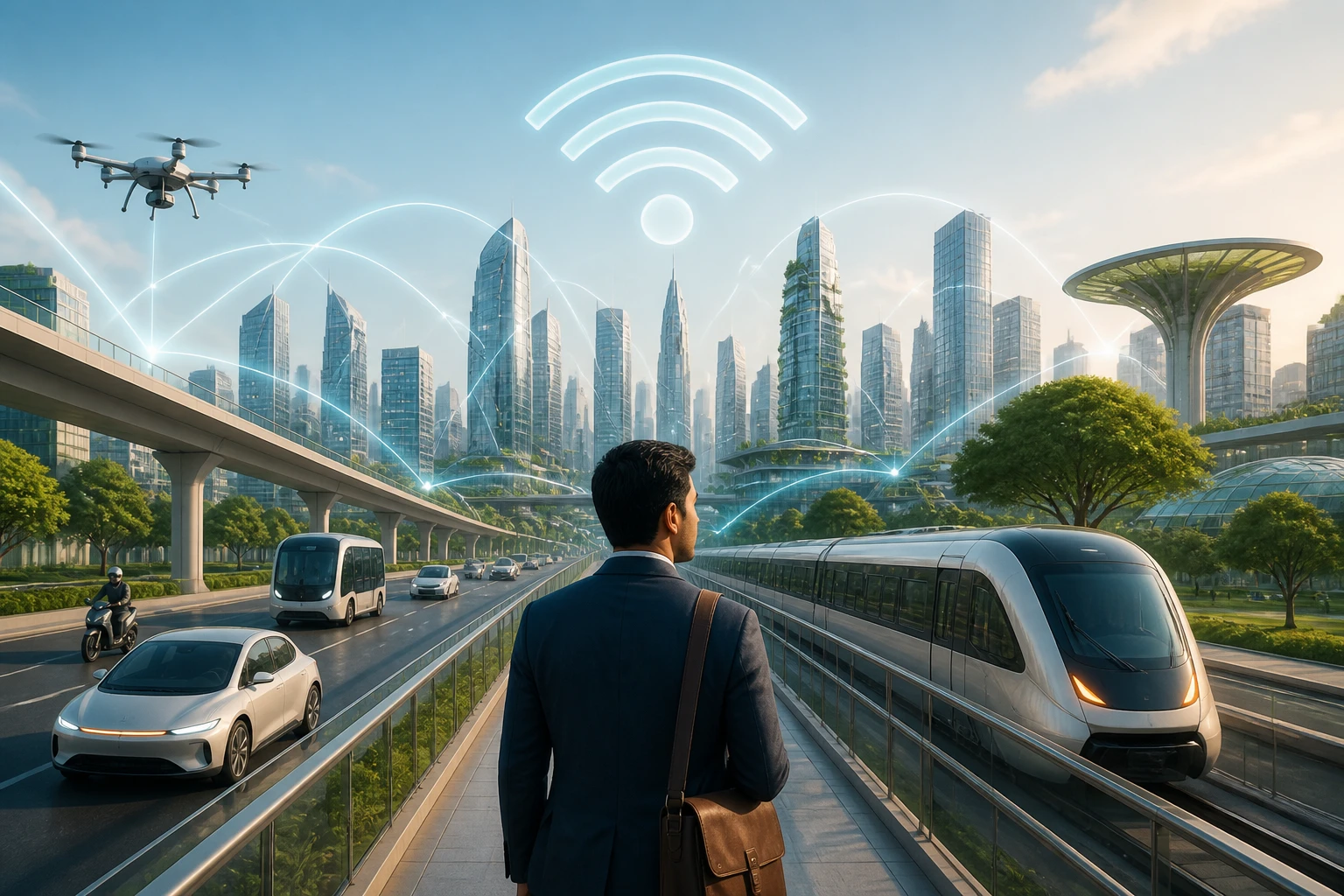
Picture this: You're rushing to catch the 8:15 AM metro in Bengaluru, but instead of checking three different apps and guessing arrival times, your phone seamlessly connects to the city's 5G network and instantly shows you that Train 4 will arrive in exactly 2 minutes and 30 seconds, with real-time crowd density data suggesting you board car 3 for the most comfortable ride. This isn't science fiction—it's the reality India's smart cities are building for 2025. With the government allocating ₹48,000 crores for the Smart Cities Mission and 5G rollouts accelerating across 100 cities, your daily commute is about to get a massive upgrade. Think of it like upgrading from a basic Nokia phone to a smartphone, but for entire cities—everything becomes faster, smarter, and more connected.
The Problem
India's urban commute crisis is staggering. The average Indian professional spends 71 minutes daily stuck in traffic, with cities like Mumbai and Delhi ranking among the world's most congested. Current transportation systems operate in silos—buses, metros, auto-rickshaws, and ride-sharing apps function independently without real-time coordination. It's like having a kitchen where the stove, refrigerator, and microwave can't communicate with each other. Meanwhile, 68% of India's population will live in cities by 2050, making the current infrastructure unsustainable. The economic cost is enormous: traffic congestion alone costs Indian cities approximately $22 billion annually in lost productivity. Traditional solutions like building more roads or adding buses provide temporary relief but don't address the fundamental lack of intelligent coordination between transportation modes.
Analysis
The convergence of 5G technology and smart city infrastructure represents a paradigm shift in urban mobility. From an economic perspective, integrated 5G-powered transportation could boost productivity by reducing commute times by up to 30%, potentially adding $150 billion to India's GDP by 2030. The policy implications are equally significant—the government's Digital India initiative now has a tangible, daily touchpoint with citizens' lives.
From a business standpoint, this creates massive opportunities. Telecom companies like Jio and Airtel are positioning themselves as infrastructure partners, while technology firms are developing AI-powered traffic management systems. The mobility-as-a-service (MaaS) market in India is projected to reach $3.7 billion by 2030.
However, the social impact extends beyond convenience. Real-time traffic optimization could reduce fuel consumption by 25%, significantly cutting urban pollution. For working professionals, predictable commutes mean better work-life balance and reduced stress. The ripple effects include reduced healthcare costs from lower pollution and stress, and increased economic participation from women who currently avoid unreliable transportation options.
Real-World Examples
Pune is leading India's smart commute revolution through its Integrated Command and Control Centre, which uses 5G connectivity to coordinate traffic signals, bus schedules, and parking availability in real-time. Early results show 20% reduction in average travel times during peak hours.
Surat's smart traffic management system, powered by IoT sensors and 5G networks, has reduced traffic violations by 40% through predictive enforcement. The city's buses now communicate with traffic lights, extending green signals when public transport is approaching.
Internationally, Singapore's smart mobility platform offers a glimpse of India's 2025 potential. Their system integrates 15 different transportation modes into a single app, with 5G enabling real-time adjustments based on weather, events, and crowd patterns. Users report 35% time savings compared to traditional commuting methods.
Cisco and IBM are partnering with Indian cities to deploy edge computing infrastructure that processes traffic data locally, reducing latency to under 1 millisecond—crucial for autonomous vehicle integration planned for major corridors by 2025.
The Challenge
The complexity lies not in technology but in coordination and standardization. India has 28 states with different transportation authorities, each potentially implementing incompatible systems. Creating unified protocols while respecting local governance structures requires unprecedented collaboration. Additionally, cybersecurity concerns around connected infrastructure and digital privacy issues need resolution before full-scale deployment. The infrastructure investment requirements are massive, demanding public-private partnerships that haven't been tested at this scale in India's urban context.
Future Implications
By 2025, your smartphone won't just be a communication device—it'll be your intelligent mobility companion. Imagine receiving personalized route recommendations that factor in your meeting schedule, weather conditions, air quality levels, and even your fitness goals (suggesting walking routes when beneficial). Autonomous vehicle integration with existing public transport will create seamless multimodal journeys.
The economic transformation extends beyond transportation. Predictable, efficient commutes will influence real estate patterns, potentially decentralizing business districts as reliable connectivity makes peripheral areas more attractive. Small businesses will benefit from delivery optimization, while gig economy workers will access better income opportunities through dynamic route optimization.
Looking Ahead
The question isn't whether India's 5G-powered smart cities will transform your commute, but how quickly you'll adapt to a world where traffic jams become predictable anomalies rather than daily struggles. Are you ready for a future where your biggest commute complaint shifts from "I'm stuck in traffic" to "my phone's battery died and I can't access real-time transit updates"?