

Overview
Picture this: You're cruising down a busy highway when suddenly a truck swerves into your lane, missing your car by mere inches. Your heart races, and you realize you need better protection. Now imagine this scenario happening 300 kilometers above Earth at speeds of 28,000 km/hour. That's exactly what happened to an Indian satellite in 2024, and it's prompted New Delhi to think like a concerned parent planning protection for their children in an increasingly dangerous neighborhood called space.
Here's What's Happening
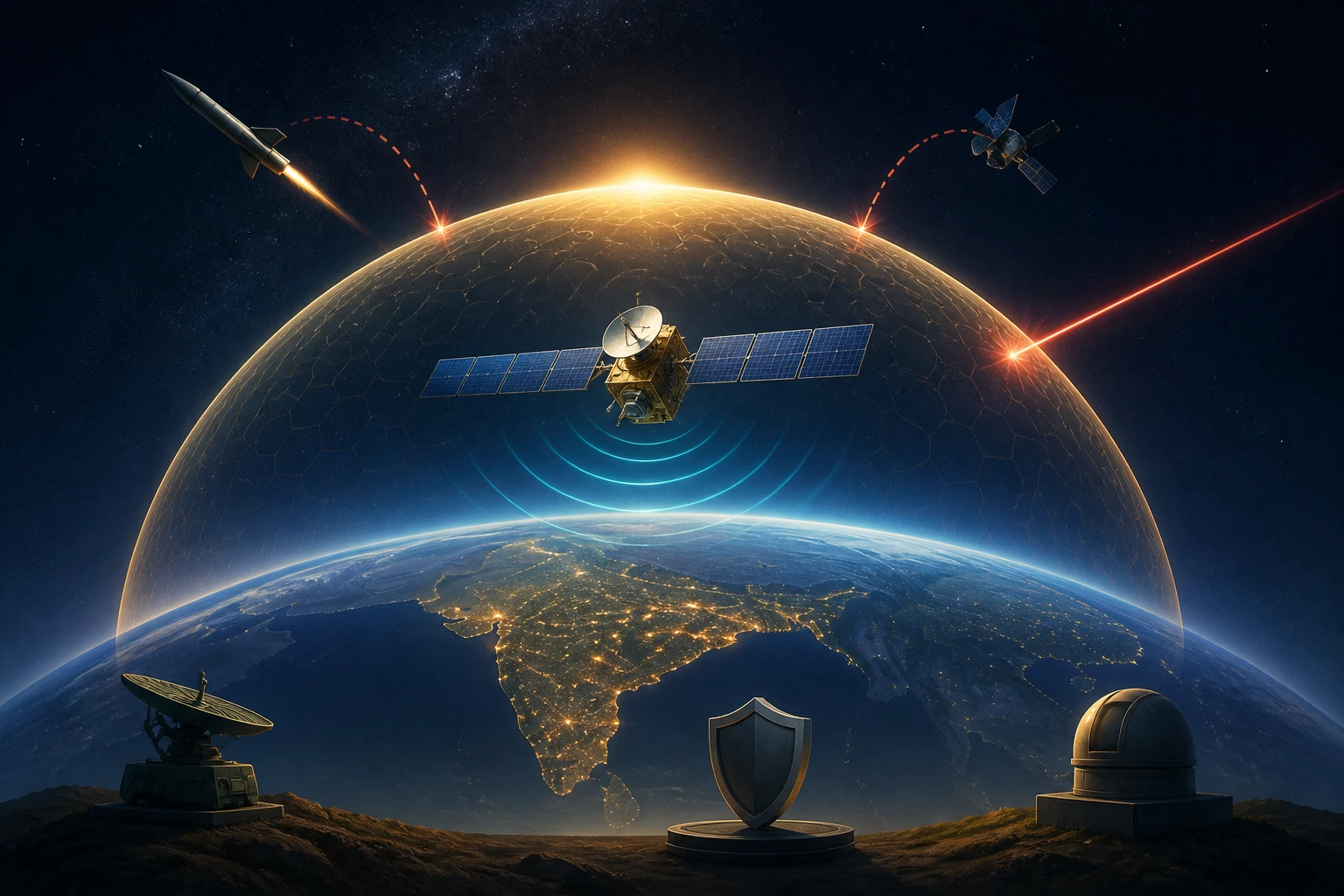
Following a near-collision between an Indian satellite and a foreign spacecraft in 2024, India's space agency ISRO and defense establishment are developing an ambitious "bodyguard satellite" program. These protective satellites will essentially act as space sentries, monitoring threats and safeguarding India's growing constellation of 104 operational satellites currently orbiting Earth.
The initiative goes beyond just bodyguard satellites. India is planning a comprehensive space surveillance infrastructure that includes new ground-based radars, optical telescopes, and advanced LiDAR technology. This represents a significant shift from India's traditionally peaceful space program to one that acknowledges the harsh realities of space as a contested domain, where accidents and intentional attacks pose equal threats.
Let's Break This Down
Think of space around Earth like Mumbai's local trains during rush hour – it's getting increasingly crowded and chaotic. Currently, there are over 34,000 tracked objects larger than 10 centimeters orbiting our planet, including active satellites, dead satellites, and space debris. India contributes about 0.3% of this space traffic, but the country's space assets are worth over $7 billion and serve critical functions from weather forecasting to military communications.
The "bodyguard satellite" concept works like having a personal security detail in space. These smaller, agile satellites will position themselves near high-value Indian assets, constantly scanning for approaching threats. They'll use advanced sensors and AI-powered algorithms to distinguish between natural debris, other satellites, and potentially hostile objects.
India's space surveillance network will include ground-based radars capable of tracking objects as small as 10 centimeters at distances up to 1,000 kilometers. The LiDAR technology – similar to what's used in autonomous cars but far more sophisticated – will provide precise distance measurements and 3D mapping of space objects.
This defensive approach becomes crucial when you consider that a piece of debris as small as 1 centimeter can destroy a satellite due to the extreme velocities involved. The 2019 Indian anti-satellite weapon test, while successful, created approximately 400 pieces of trackable debris, highlighting how quickly the space environment can become more dangerous.
The Bigger Picture
India's space protection strategy reflects a broader global trend where space is becoming militarized. China has conducted multiple anti-satellite tests, Russia has deployed what many experts believe are "inspector satellites" capable of hostile activities, and the United States Space Force was established specifically to protect American space interests.
For India's tech sector, this development signals massive opportunities. Companies working in AI, sensor technology, and satellite manufacturing could see increased government contracts. The Indian space economy, currently valued at $8.4 billion, is projected to reach $40 billion by 2040, with space security becoming a significant growth driver.
International partners are watching India's moves carefully. As a member of the Quad alliance and a key player in Indo-Pacific security, India's enhanced space capabilities strengthen regional deterrence against aggressive space activities by rival nations.
What's Next?
India's satellite protection program represents a mature acknowledgment that space infrastructure requires active defense. The first bodyguard satellites are expected to be deployed by 2026-2027, marking India's transition from a space-faring nation to a space-protecting power.
This initiative will likely accelerate India's development of indigenous space technologies and reduce dependence on foreign systems. For young professionals in aerospace, cybersecurity, and AI, this represents a generational opportunity to work on cutting-edge space defense systems that will define India's strategic capabilities for decades to come.