

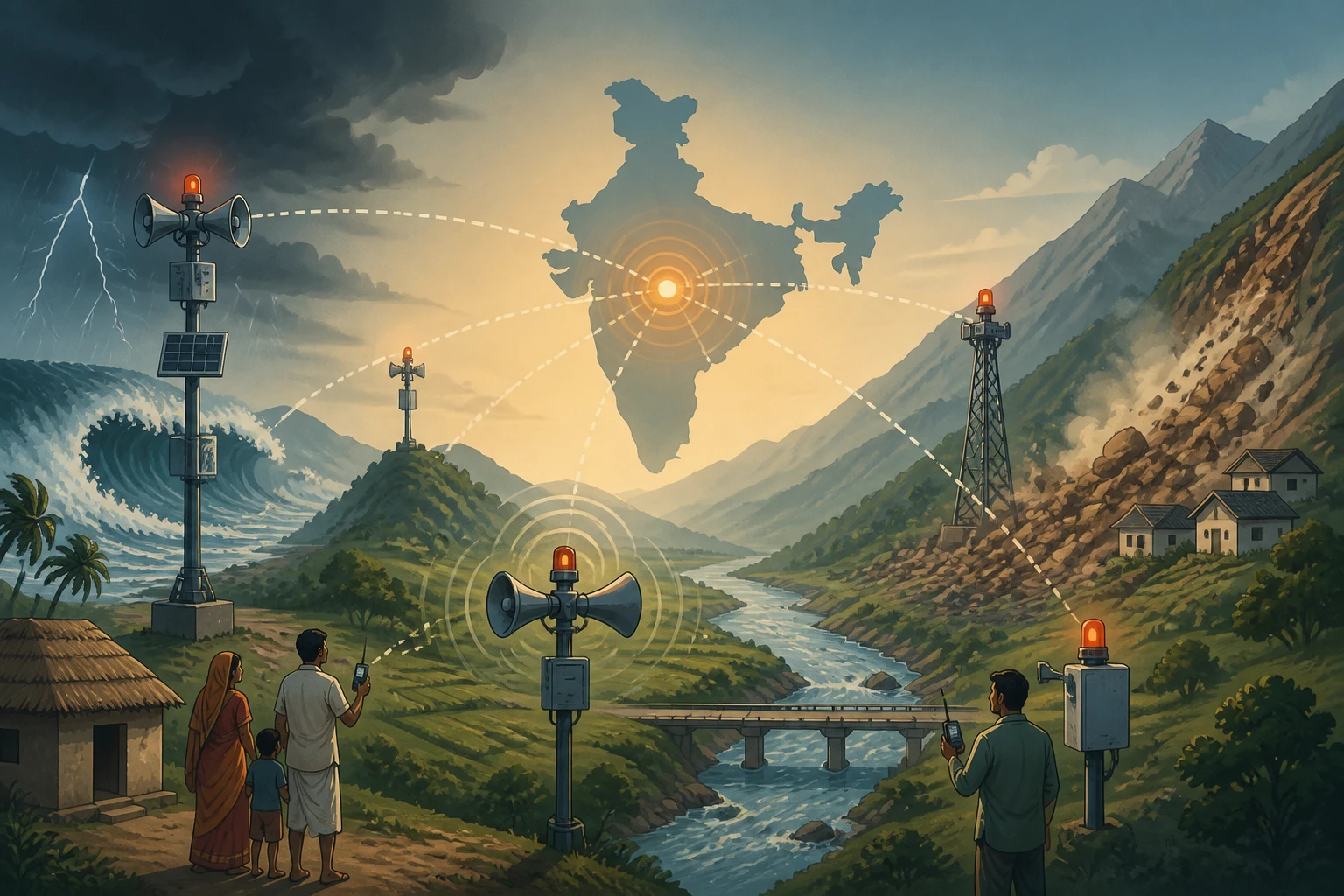
Every major disaster in India tends to follow a familiar pattern. Floodwaters rise. Cell towers get overwhelmed or knocked offline. Millions of people in the affected zone are suddenly unreachable—not because they don't have phones, but because the networks can't carry the load. Emergency SMS messages either arrive hours late or not at all.
India has now built something specifically designed to break that pattern.
The government has launched an indigenous Cell Broadcast System (CBS)—a technology that pushes emergency alerts directly to every phone within range of a cell tower, simultaneously, without relying on internet connectivity or individual SMS delivery queues.
Why SMS Was Never Built for This
To understand why CBS matters, it helps to understand what SMS actually is. When you send a text, it travels like a letter—addressed to one recipient, processed individually, queued when traffic is high. That model works fine on an ordinary Tuesday. It falls apart when a cyclone is making landfall and ten million people in coastal Odisha all need the same message at the same moment.
Cell broadcast works differently. Instead of individual packets addressed to individual phones, it's closer to a radio signal—one transmission, received by every compatible device in a geographic area simultaneously. No addressing. No queuing. No internet required.
The distinction sounds technical. The consequence is not. During a flood or an earthquake, the minutes saved between alert and action can determine whether a family evacuates or doesn't.
Multilingual by Design, Not by Patch
India's version of CBS carries another feature that's easy to overlook in the technical coverage: it's multilingual. Alerts can be delivered in regional languages—not just English or Hindi—meaning the system is designed around how India actually communicates, not how government communication has historically assumed it does.
This is more significant than it sounds. A warning in a language you don't fluently read is barely a warning at all. Building multilingual capacity into the architecture from the start, rather than treating it as an add-on, signals that the system was designed with reach in mind, not just coverage.
The Gap It's Closing
India isn't the first country to deploy cell broadcast technology. Japan and South Korea have used variations of it for years, and their systems are credited with saving lives during earthquakes and tsunamis. The US deployed its own version—what Americans see as "Wireless Emergency Alerts"—after concluding that existing channels were too slow and too unreliable for mass emergencies.
What's notable about India's CBS is that it's indigenous—built domestically rather than licensed or imported wholesale. That matters for long-term maintenance, customisation, and the ability to scale the system across one of the world's most linguistically and geographically complex countries.
The use cases the government has identified are wide: floods, cyclones, earthquakes, and terror incidents. Each of those scenarios shares a common feature—they tend to degrade the very infrastructure that conventional alert systems depend on, precisely at the moment those systems are needed most.
Alerts That Don't Need Bars
There's a quiet ambition in what India has built. Not every emergency technology problem needs a new app or a smarter algorithm. Sometimes the solution is designing around the failure mode—asking what happens when the internet goes down, and making sure the answer isn't silence.
CBS is India's answer to that question. Whether it reaches the people it's meant to reach, in time, and in a language they understand, will be the real test.