

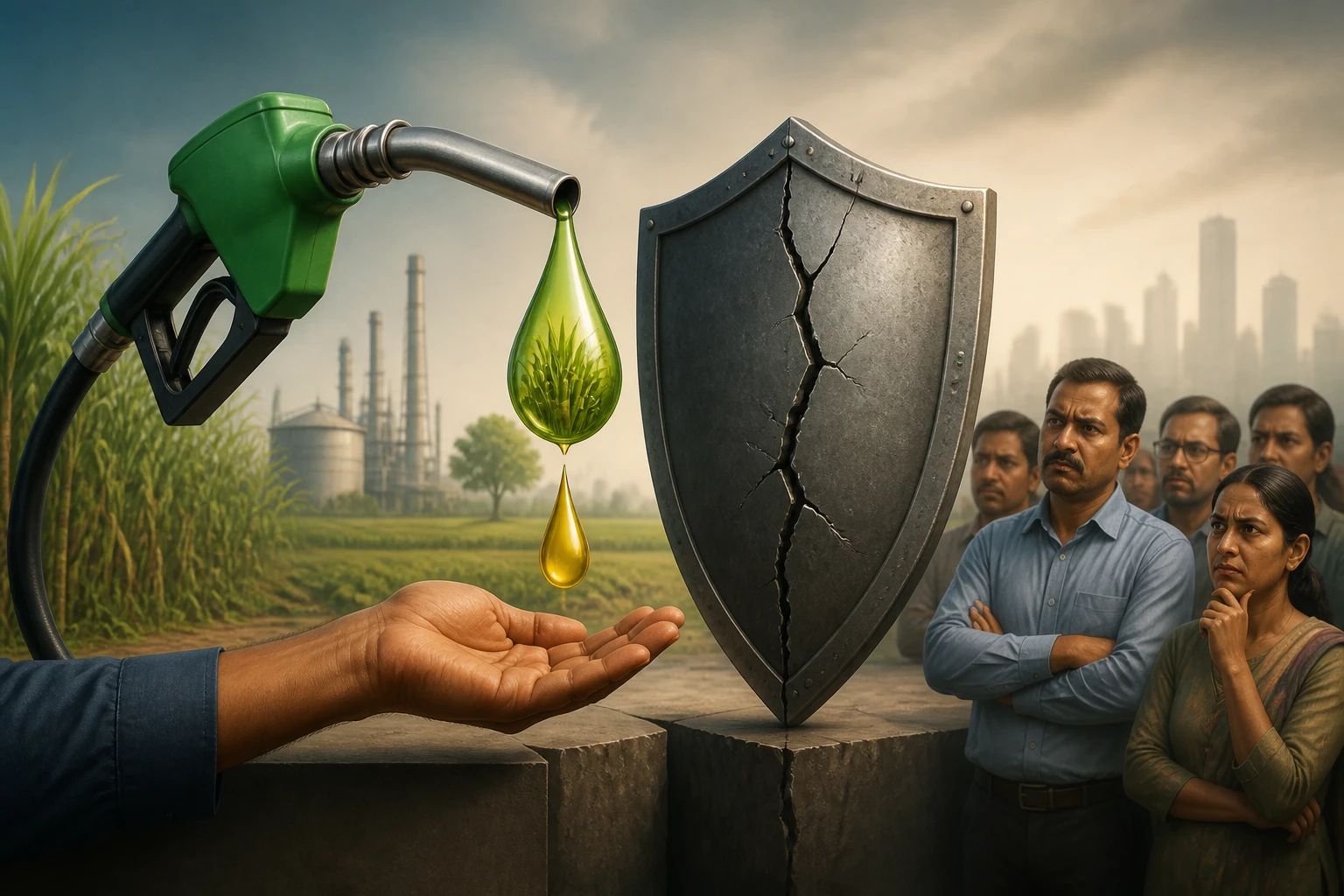
A blog post from one of India's largest insurers quietly set off a small panic last week — and the fallout reveals something the government's clean-fuel story has been quietly avoiding.
The Blog Post That Sparked the Concern
A company blog posted by ICICI Lombard on June 9, 2026 — and later edited on June 14, 2026 — sparked concerns about whether using E20 fuel in older, incompatible vehicles could be treated as negligence and lead to claim rejection. The backlash was swift enough that the insurer issued a formal clarification. ICICI Lombard stated that E20 fuel use does not impact the validity of motor insurance policies, and that the company does not reject claims merely based on fuel usage. Specifically, the type of fuel used in a vehicle is not a determining factor in claim admissibility — if a claim is admissible on conventional fuel, it remains admissible on E20.
Crisis averted? Not quite.
The Real Question No One Is Answering
The insurance scare was a symptom of a deeper problem: millions of vehicle owners genuinely do not know whether their cars were designed for E20, and nobody has clearly told them who bears the cost if something goes wrong.
While India has been gradually rolling out E20 since 2023, older blends like E5 and E10 — typically seen as more compatible with older vehicles — were also offered. Those older fuel mixes have now been removed from nearly all of the country's 90,000 fuel stations, leaving drivers with just one choice.
The compatibility gap is real. Older petrol vehicles, particularly those built to BS3 and BS4 standards, were designed for ethanol blends no higher than E5 or E10. Running E20 in these engines for extended periods can degrade rubber fuel hoses, seals, and gaskets faster than normal. Most cars manufactured from 2023 onwards — specifically since the adoption of BS6 Phase 2 — are designed to run on E20. Everything older sits in a grey zone.
In recent weeks, worried motorists took to social media over concerns about large fuel efficiency drops and confusing statements from carmakers — who first said E20 had not been tested for compatibility with older vehicles, but later backtracked, saying it is safe to use.
Who Absorbs the Transition Cost?
An insurer saying "we won't reject your claim for using E20" is reassuring, but it sidesteps the harder question. Motor insurance covers accidents and theft — not mechanical wear. Owners of older cars are advised to consider upgrading fuel system components to ethanol-grade materials, using specialised fuel additives, and following other steps recommended by vehicle manufacturers. That is an out-of-pocket expense the government's ethanol blending programme has not formally addressed.
India's energy transition has a communication problem as much as a technical one. Telling consumers that E20 is "progressive and environment-friendly" — as ICICI Lombard's statement put it — does not tell a 2018 hatchback owner in Nagpur what to actually do at the pump tomorrow. Until there is clearer consumer guidance, mandatory labelling, or a retrofitting support scheme for older vehicles, the trust deficit will keep flaring up — one blog post at a time.
Sources
- ICICI Lombard says E-20 fuel use won't affect motor insurance claims | Insurance News - Business Standard
- E20 Fuel Won’t Void Insurance, Says ICICI Lombard - Mechanical Breakdowns Outside Policy Scope
- www.malaymail.com
- E20 Petrol Becomes Mandatory At Every Pump Across India: Here's Exactly What That Means For Your Car
- Is your car E20-compliant? Full list of E20 petrol compatible vehicles and how to check - The Week
- ICICI Lombard Clarifies E20 Fuel Use Will Not Invalidate Motor Insurance - Outlook Money