

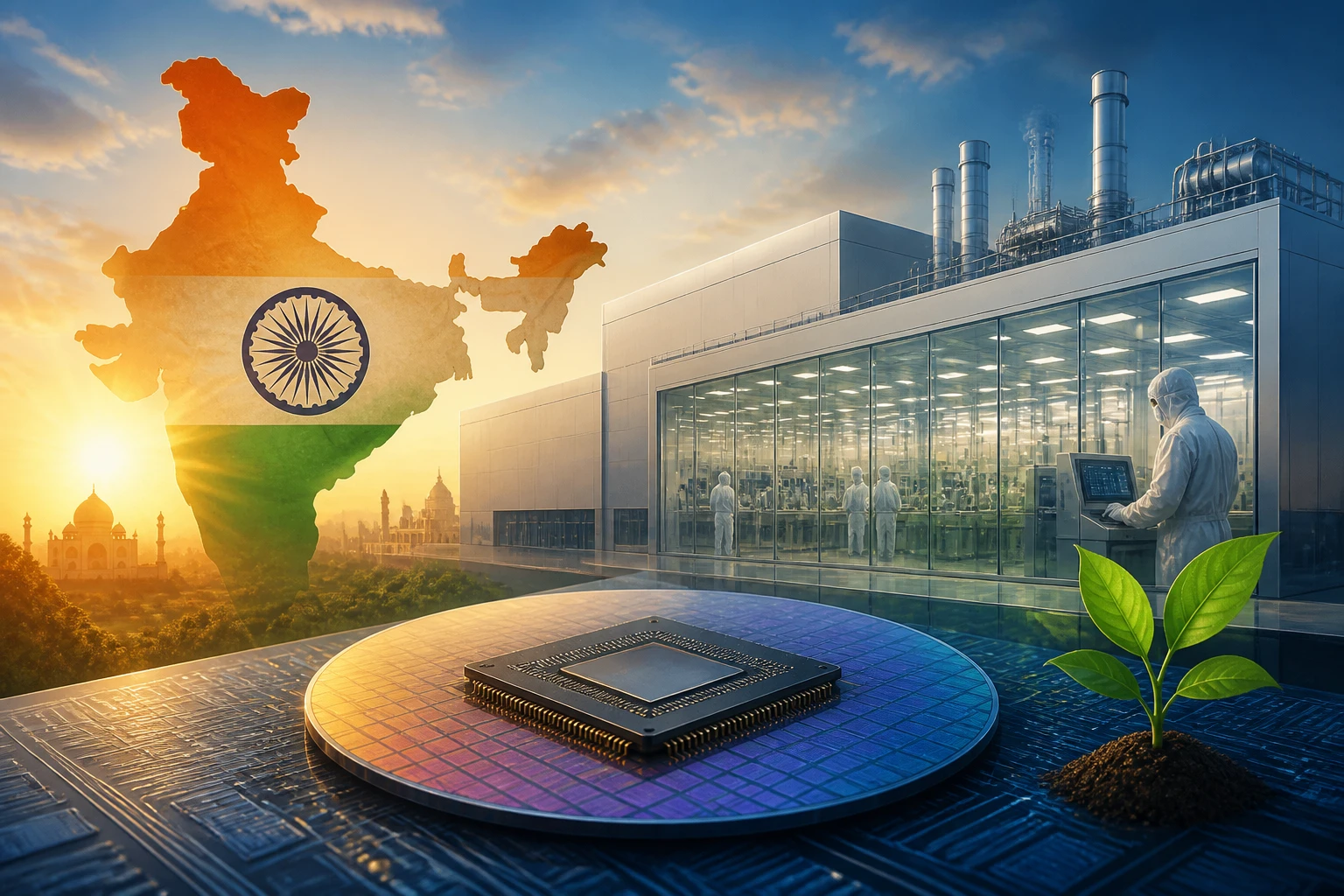
For decades, India has been the country that writes the software running inside the world's chips — but never the country that actually makes them. That's about to change.
Tata Electronics has partnered with ASML, the Dutch company whose lithography machines are indispensable to virtually every advanced chip on the planet, to build India's first front-end semiconductor fabrication plant in Gujarat. The project carries an $11 billion price tag. It is, by any measure, the most consequential bet India has made on its own industrial future in a generation.
Why "Front-End" Is the Part That Actually Matters
Not all semiconductor manufacturing is equal. Back-end work — assembling, packaging, and testing chips — is valuable, but it's the front-end fabrication, where raw silicon wafers are transformed into functioning circuits, that sits at the top of the value chain. It's also the part that almost no country outside a small cluster — Taiwan, South Korea, the United States, the Netherlands — has managed to pull off at scale.
India has done packaging work before. This is different. Front-end fabs require extreme precision, years of process refinement, and equipment so specialized that ASML is essentially a monopoly supplier for the most advanced machines. The fact that ASML is directly involved in this project isn't a footnote. It's the signal that this is a serious attempt, not a press release dressed up as industrial policy.
The Geopolitical Pressure Behind the Balance Sheet
An $11 billion investment needs a business case, and right now geopolitics is writing one in real time. The chip shortages that paralyzed global auto and electronics production earlier this decade exposed something uncomfortable: the world's supply of semiconductors runs through a dangerously narrow geography. Taiwan's proximity to China has made governments everywhere anxious about what a disruption there would mean.
India imports virtually all of its chips. For a country building out its electronics manufacturing base — smartphones, EVs, defense systems, data centers — that's a structural vulnerability. The Gujarat fab is, in part, an answer to that anxiety. Reducing import dependence isn't just good economics; in the current global environment, it's increasingly treated as a security imperative.
What Tata Is Actually Signing Up For
Building a fab is not like building a factory. The learning curve is brutal, the capital requirements are unforgiving, and yields — how many functional chips you get out of each wafer — can take years to optimize. Even experienced chipmakers routinely struggle with new nodes.
Tata Electronics is stepping into this as a relative newcomer to semiconductor manufacturing. The partnership with ASML provides critical technical scaffolding, but execution will define whether this project becomes a foundation or a cautionary tale. India has announced ambitious industrial projects before; the ones that matter are the ones that survive contact with reality.
A Necessary Beginning, Not a Finished Story
The Gujarat fab won't make India chip-independent overnight. That was never the point. What it does is establish the infrastructure, the institutional knowledge, and the supply chain relationships that a domestic industry needs to grow from. Every mature semiconductor ecosystem — in Taiwan, in South Korea — started with a first plant, a first bet, a willingness to absorb years of expensive learning.
India is finally making that bet. The $11 billion is large. The ambition is larger. Whether the execution matches both is the question that will take years, not quarters, to answer.