

Overview
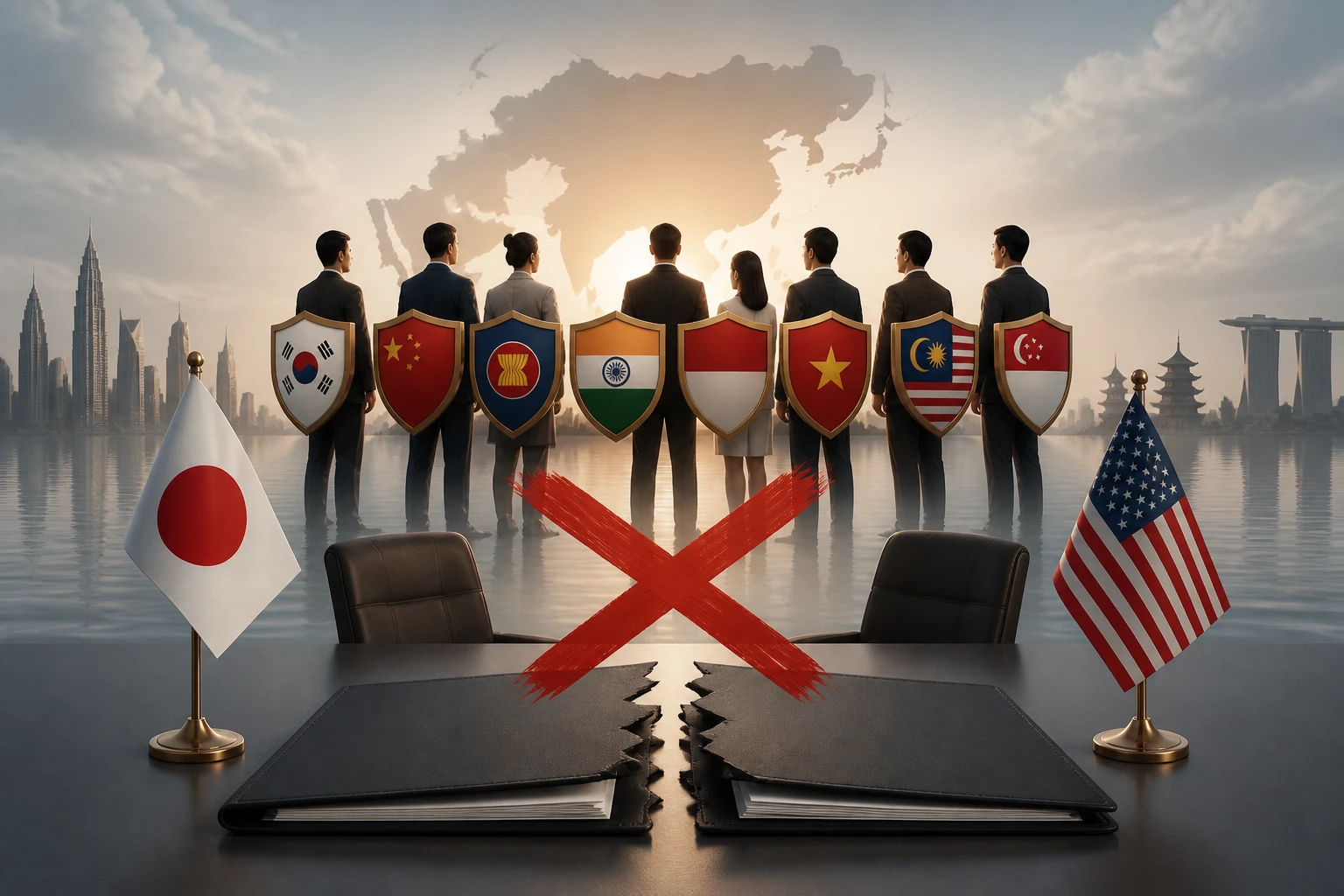
Imagine you're planning a dinner party with your neighbor, but every time you suggest a dish, they demand you cook it their way, use their ingredients, and pay for half the groceries while they keep all the leftovers. Eventually, you'd stop showing up, right? That's essentially what happened when Japan's top trade negotiator abruptly canceled a crucial trip to Washington last week, designed to finalize a joint statement on tariffs with the Trump administration. This diplomatic snub isn't just about hurt feelings—it represents a seismic shift in Asian economic strategy and signals the beginning of coordinated resistance to America's increasingly aggressive trade policies. For working professionals navigating global markets, this development could reshape everything from supply chains to investment flows across the Pacific.
The Problem
Japan's cancellation of trade talks reveals a fundamental breakdown in the traditional post-war economic order. The immediate trigger was the Trump administration's insistence on unilateral concessions from Japan, including agricultural market access and currency provisions, while offering minimal reciprocal benefits. Japan's trade surplus with the US reached $69.0 billion in 2018, making it a prime target for Trump's trade war rhetoric. But here's the deeper issue: this isn't happening in isolation. South Korea, Vietnam, and Thailand are simultaneously pushing back against similar American trade demands, creating what economists call a "coordination cascade." The problem extends beyond bilateral disagreements—it threatens the entire framework of multilateral trade cooperation that has driven Asian economic growth for decades. When major trading partners start walking away from negotiating tables, it signals that traditional diplomatic pressure tactics are no longer effective.
Analysis
The implications ripple across three critical dimensions: economic, geopolitical, and structural. Economically, Japan's move indicates Asian nations are prioritizing regional integration over trans-Pacific relationships. The Comprehensive and Progressive Trans-Pacific Partnership (CPTPP), which the US abandoned, now looks increasingly attractive as an alternative framework. Trade data shows intra-Asian trade has grown by 127% since 2010, while US-Asia trade growth has slowed to just 43% over the same period.
From a policy perspective, this represents a strategic recalibration. Asian economies are essentially calling America's bluff, betting that their combined economic weight—representing $25.7 trillion in combined GDP—gives them negotiating leverage. Think of it like a group of employees collectively deciding not to work overtime for an unreasonable boss—individually vulnerable, but powerful together.
The business implications are profound. Supply chain managers are already diversifying away from US-dependent routes, while financial markets are pricing in reduced trans-Pacific trade flows. The Japanese yen strengthened 2.3% against the dollar following the announcement, suggesting investors view this as a sign of economic independence rather than instability.
Real-World Examples
Toyota Motor Corporation exemplifies the shifting landscape. The company recently announced a $13.5 billion investment in Southeast Asian manufacturing facilities, explicitly designed to reduce dependence on US market access. CEO Akio Toyoda stated that "geographic diversification has become a risk management imperative."
Samsung Electronics provides another telling case study. The South Korean giant has quietly relocated 23% of its US-bound production to Vietnam and India over the past 18 months, citing "regulatory uncertainty" in US-Korea trade relations.
Expert analysis supports this trend. Dr. Kishore Mahbubani, former Singaporean diplomat and current policy researcher, argues that "Asian economies have reached a tipping point where regional integration offers more growth potential than trans-Pacific dependence." McKinsey & Company's latest report on Asian trade flows shows that 68% of regional trade now occurs within Asia itself, compared to just 47% in 2008. This data suggests Japan's diplomatic stance reflects underlying economic realities rather than political posturing.
The Challenge
The complexity lies in untangling decades of economic interdependence without triggering a broader trade war. Japan cannot simply pivot away from the US market overnight—American consumers still represent 19.4% of Japanese exports. Similarly, US companies have $480 billion invested in Asian markets, creating mutual vulnerability. The regulatory frameworks governing everything from intellectual property rights to currency exchange mechanisms were built around US-led institutions. Replacing these systems requires coordinated policy changes across multiple governments, currencies, and legal systems—a process that typically takes years, not months.
Future Implications
This diplomatic rupture likely accelerates three major trends: the rise of Asian regional trade blocs, increased currency cooperation among Asian central banks, and the development of alternative financial infrastructure independent of US-dominated systems. The Asian Infrastructure Investment Bank (AIIB) has already gained momentum as a World Bank alternative, with 102 member countries and $150 billion in committed capital.
For working professionals, this means career opportunities are shifting eastward, while investment portfolios need rebalancing toward Asian assets. Companies with Asia-Pacific exposure may outperform those dependent on trans-Pacific trade relationships. The technology sector faces particular disruption, as Asian countries develop domestic alternatives to American platforms and services.
Looking Ahead
Japan's canceled trade talks may seem like a minor diplomatic spat, but they represent something much larger: the end of unchallenged American economic hegemony in Asia. The question isn't whether this shift will continue—it's whether American policymakers will adapt to a multipolar economic reality or double down on increasingly ineffective pressure tactics. What happens next could determine whether the Pacific remains a bridge between economies or becomes an economic moat.