

Overview
Picture this: You're a pharmaceutical company trying to develop a life-saving drug, but you need to predict how thousands of different chemical compounds will react with each other. Traditionally, this would take years of expensive lab experiments and countless hours of trial and error. But what if an AI could predict these reactions in minutes while guaranteeing that the fundamental laws of chemistry aren't violated? That's exactly what MIT researchers have achieved with their groundbreaking FlowER system, potentially revolutionizing everything from drug discovery to materials science.
Here's What's Happening
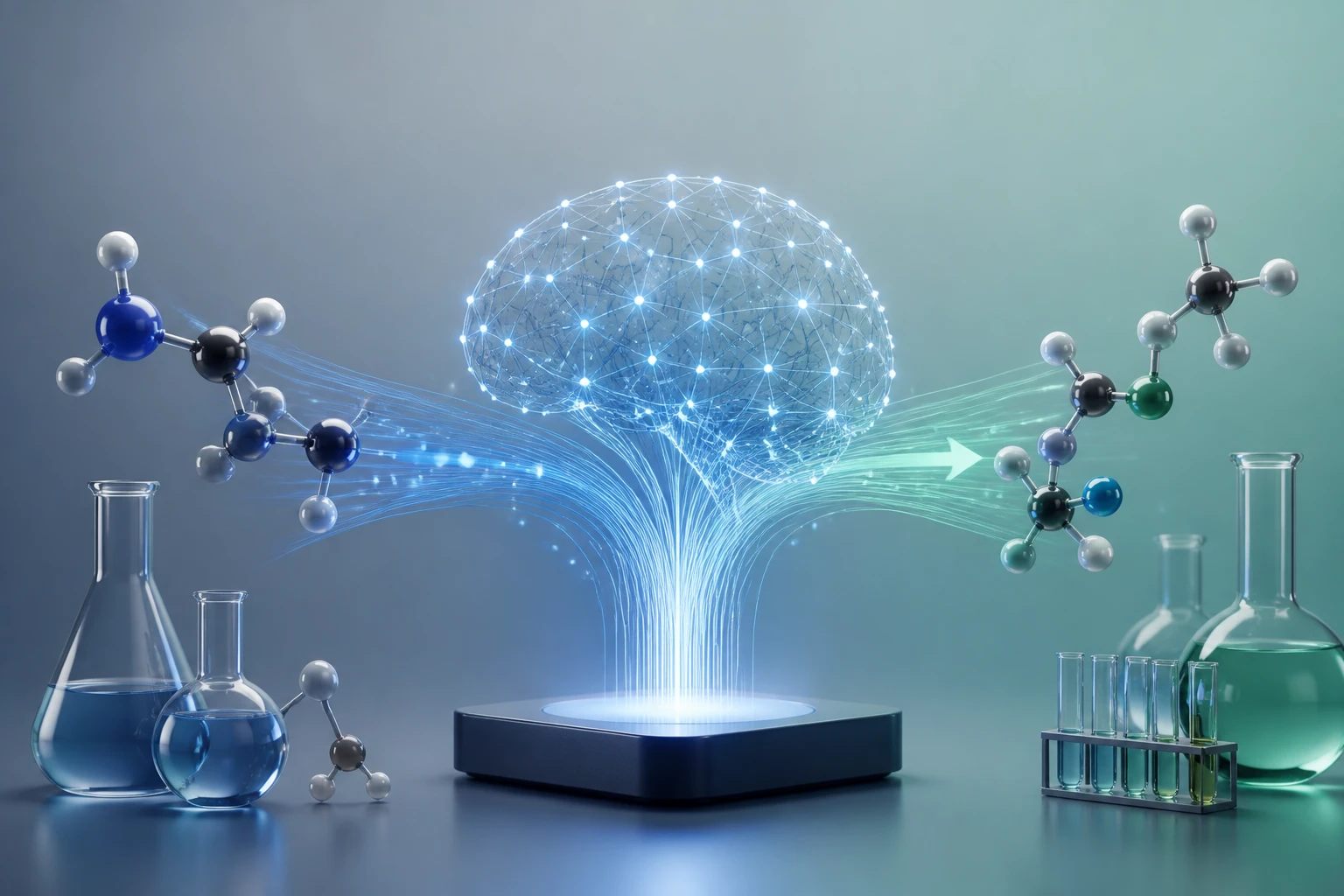
MIT's Computer Science and Artificial Intelligence Laboratory (CSAIL) has developed FlowER (Flow matching for Electron Redistribution), a generative AI system that can predict chemical reactions with unprecedented accuracy. Unlike previous AI models that sometimes produced chemically impossible results, FlowER strictly enforces two fundamental principles: conservation of mass and conservation of electrons.
The system represents a major breakthrough because it solves a problem that has plagued AI-driven chemistry for years. Previous models, while impressive, occasionally suggested reactions that violated basic chemistry laws - like creating or destroying atoms out of thin air. FlowER ensures that every atom going into a reaction comes out somewhere, and every electron is properly accounted for, making its predictions both scientifically sound and practically useful.
Let's Break This Down
Think of chemical reactions like a carefully choreographed dance where partners (atoms) switch around, but nobody can leave the dance floor or magically appear. Traditional AI models sometimes suggested impossible dance moves, but FlowER acts like a strict choreographer ensuring every move follows the rules.
The breakthrough lies in FlowER's architecture. The system uses flow matching, a sophisticated machine learning technique that learns to transform one molecular structure into another while maintaining chemical constraints. It's trained on vast databases of known chemical reactions, allowing it to understand patterns in how molecules behave and interact.
Here's where it gets impressive: FlowER can process reactions involving complex organic molecules with dozens of atoms, something that would typically require extensive computational resources or laboratory testing. The system has been tested on over 190,000 chemical reactions from established databases, showing remarkable accuracy in predicting both the products formed and the pathways taken.
For Indian pharmaceutical companies like Dr. Reddy's Laboratories or Cipla, this technology could be transformative. Drug development currently costs $1.3 billion on average and takes 10-15 years per successful drug. FlowER could dramatically reduce the initial screening phase, helping companies identify promising compounds faster and more reliably.
The system also addresses a critical challenge in sustainable chemistry. As India pushes toward greener manufacturing processes, FlowER could help companies design reactions that produce fewer toxic byproducts and require less energy, aligning with the government's National Chemical Policy goals.
The Bigger Picture
This development reflects a broader trend where AI is becoming increasingly sophisticated in scientific applications. While Google's AlphaFold revolutionized protein structure prediction, FlowER tackles the equally complex challenge of reaction prediction.
For young professionals in India's growing biotech and pharmaceutical sectors, this represents both opportunity and disruption. Companies will likely need specialists who understand both chemistry and AI, creating new career paths at the intersection of these fields. Indian Institute of Science and IITs are already incorporating AI into their chemistry curricula, recognizing this shift.
The technology also has implications for India's $50 billion chemical industry. From agrochemicals to specialty chemicals, companies could use FlowER to optimize processes, reduce waste, and accelerate innovation. This could help Indian firms compete more effectively with global giants while adhering to increasingly strict environmental regulations.
What's Next?
FlowER is still in research phase, but its potential applications are vast. Beyond pharmaceuticals, it could revolutionize battery technology, help design better catalysts for renewable energy, and even aid in developing new materials for India's semiconductor ambitions.
The next challenge is scaling the system for industrial use and integrating it with existing research workflows. As AI becomes more central to scientific discovery, professionals who can bridge the gap between computational predictions and laboratory reality will be in high demand. For India's ambitious young workforce, this represents a chance to lead in the next wave of scientific innovation, where artificial intelligence doesn't replace human expertise but amplifies it exponentially.