

In 2018, more than 4,000 Google employees signed a petition opposing the company's work on Project Maven — a Pentagon program that used AI to analyse drone footage. Google eventually declined to renew the contract when it expired. The message from the Valley was clear: warfare is not our business.
Seven years later, that consensus has collapsed — and no company embodies the reversal more sharply than Anduril Industries.
From VR Headsets to Autonomous Weapons
Anduril Industries was founded in 2017 in Irvine, California by Palmer Luckey, co-founder of Oculus VR, Brian Schimpf, and Trae Stephens. The origin story matters: Facebook acquired Oculus VR for about $2 billion, and Luckey walked away from that world to build something deliberately uncomfortable. His premise was simple — America's defence industrial base was moving too slowly, and Silicon Valley had the tools to fix it.
Anduril's business model diverges fundamentally from traditional defence contractors. Rather than waiting for government requests and relying on taxpayer-funded R&D, the company self-funds development and sells finished products — a "commercial model" that compresses timelines from years to months.
The Software That Runs the Battlefield
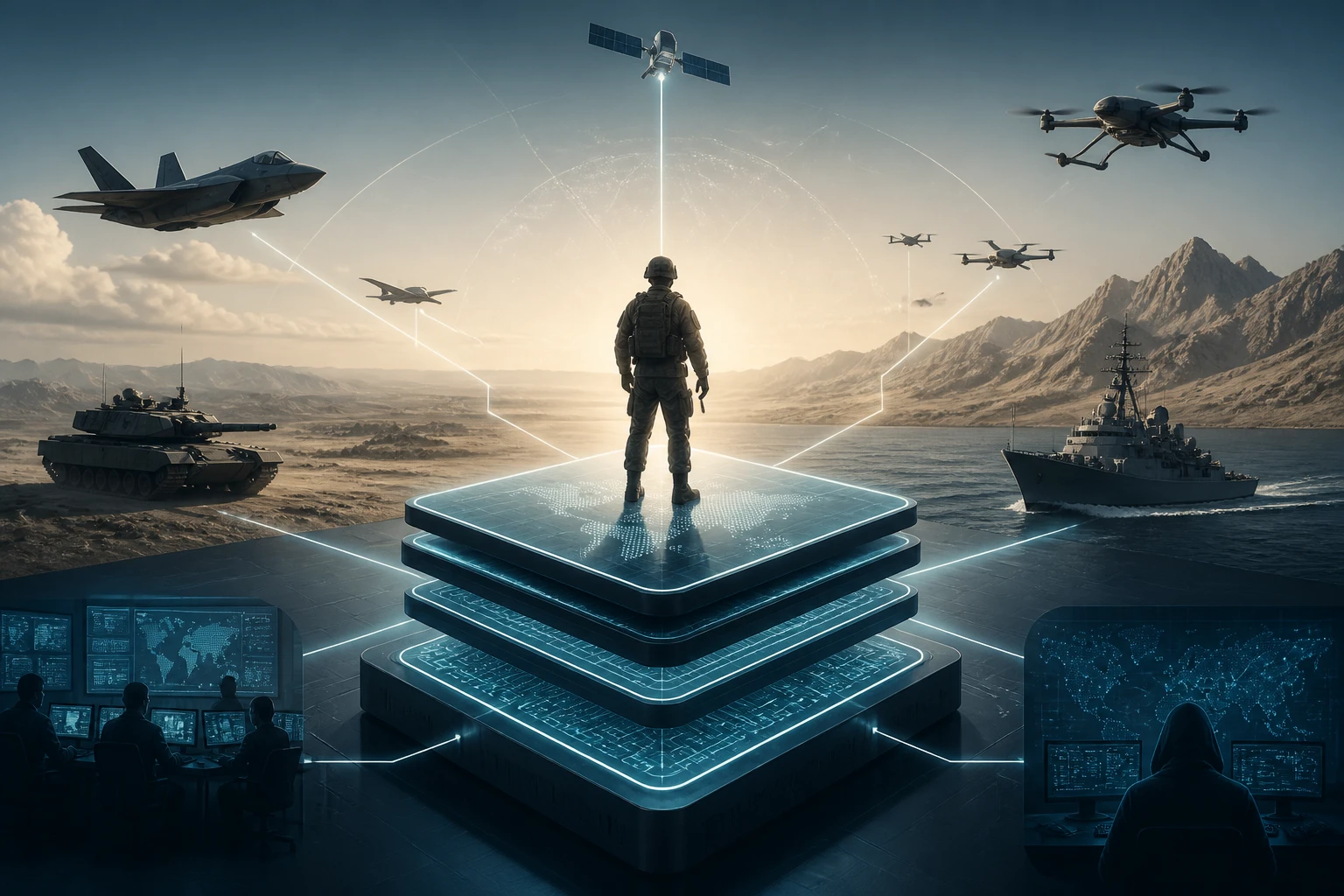
The centrepiece of Anduril's product suite isn't a weapon — it's an operating layer. Lattice is an AI software platform designed to integrate data from a multitude of sensors and systems, enabling real-time situational awareness and data-driven decision-making. Think of it as the iOS for military hardware: Lattice OS manages mission autonomy, allowing aircraft to act as semi-autonomous "loyal wingmen" for human pilots.
The hardware running on that platform is expanding fast. The YFQ-44A Fury, a jet-powered semi-autonomous drone designed to fly alongside crewed fighter jets as part of the U.S. Air Force's Collaborative Combat Aircraft programme, went from a clean-sheet design to a fully built, flight-tested aircraft in 365 days. The company is also selling autonomous systems — including its Fury drone and Ghost Shark submarine — to U.S. partners including Australia, Japan, South Korea, and Taiwan.
Arsenal-1: Manufacturing at Software Speed
Valuation headlines tell part of the story. Anduril's valuation reached $61 billion as of May 2026. But the more consequential number is in Ohio. Arsenal-1 is Anduril's hyperscale manufacturing facility, designed to produce tens of thousands of autonomous defence systems per year, with over $900 million of capital investment behind it. The facility opened months ahead of schedule — a rarity in the defence business, according to Anduril's own co-founder.
In March 2026, the U.S. Army officially awarded Anduril a 10-year enterprise contract with a ceiling of up to $20 billion, consolidating more than 120 separate procurement actions into a single framework.
Why This Matters Beyond America
Silicon Valley's estrangement from the Pentagon began during the Vietnam War, when many engineers soured on working with the U.S. government — and deepened in the years that followed. That estrangement created a vacuum. Legacy contractors like Lockheed Martin and Northrop Grumman filled it, but with cost-plus contracts and decade-long procurement cycles that suited a different era.
The Anduril model — self-funded R&D, software-first architecture, commercial manufacturing timelines — is a direct challenge to that world. The company is riding a record surge in global defence spending and a visible shift in Silicon Valley sentiment toward working with the military.
For Indian readers watching this space, the implications are direct. India's own defence modernisation ambitions, its push for indigenous platforms, and its deepening technology partnerships with the U.S. all exist in a world where the definition of a defence contractor is being rewritten — not in Washington, but in California.
Sources
- Several Google employees resign over controversial military project
- Google set to end involvement in controversial Project Maven
- Anduril revenue, valuation & funding | Sacra
- Palmer Luckey: From Oculus Founder to Anduril Defense Tech Leader | Built In
- Anduril Industries: Investor Insights: Rewriting the defence industrial base at a $30.5 Billion Valuation
- Inside Arsenal-1: Anduril's massive Ohio plant taking shape—First jets ship this spring (photos)
- Inside Arsenal-1: Anduril's Ohio mega-factory goes live in days (PHOTOS)
- Will Anduril founder Palmer Luckey’s insistence on deferring to U.S. interests scare off the allies he wants to arm? | Fortune
- Anduril - 2026 Funding Rounds & List of Investors - Tracxn
- Arsenal-1 | Anduril
- Palmer Luckey, American Vulcan - Tablet Magazine