

Overview
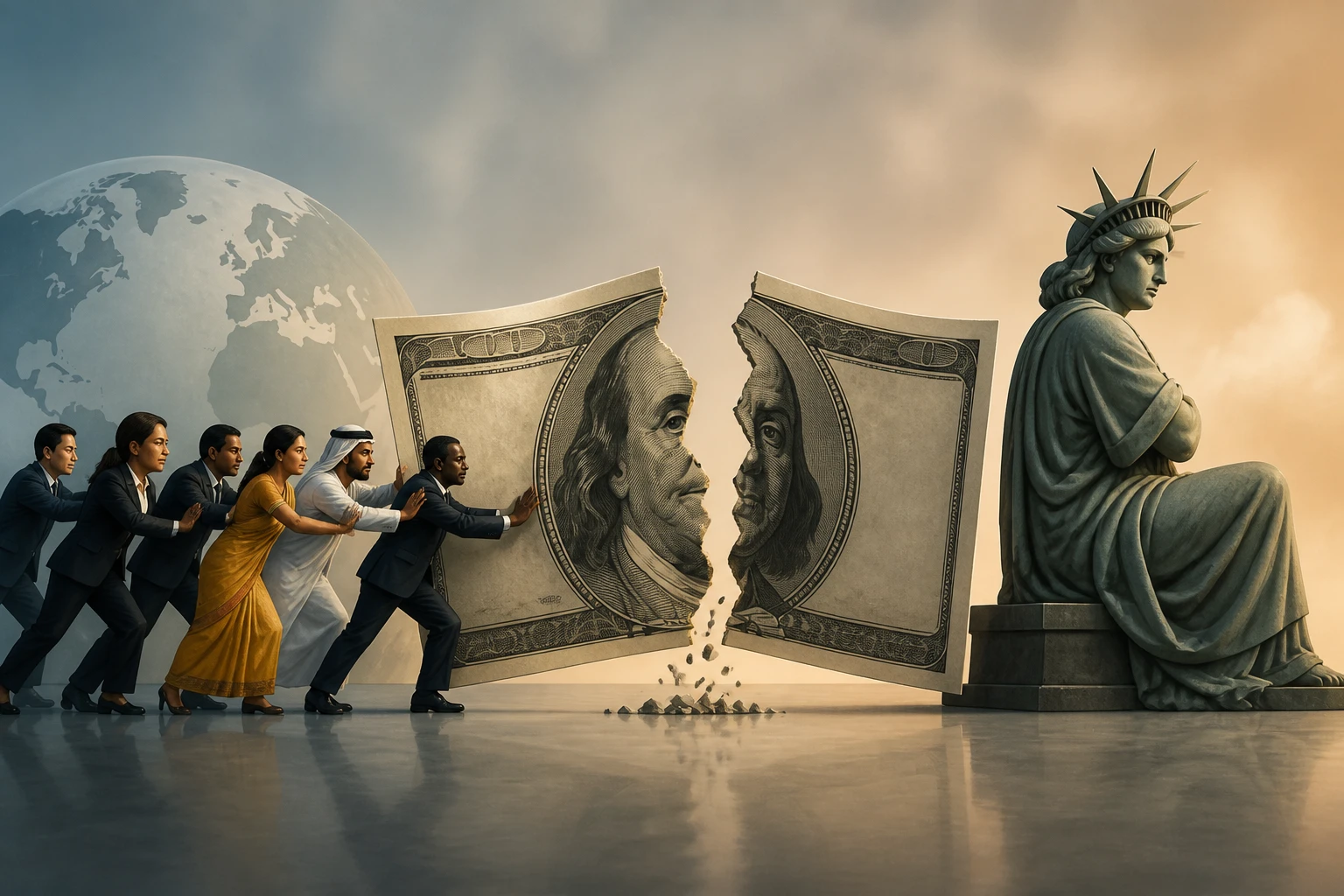
Imagine if everyone in your friend group suddenly stopped accepting your birthday party invitations and started planning their own celebrations instead. That's essentially what's happening to the US dollar on the global stage. For nearly eight decades, the American dollar has been the world's favorite currency – the go-to choice for international trade, like oil purchases, cross-border investments, and central bank reserves. But something interesting is brewing. Countries like China, Russia, India, and Brazil are increasingly saying "thanks, but no thanks" to dollar-dominated transactions. Instead, they're striking deals using their own currencies – yuan, rubles, rupees, and reais. This shift, known as de-dollarization, isn't just an economic curiosity; it's a fundamental restructuring of global finance that could impact everything from your investment portfolio to the price you pay for gas.
The Problem
The dollar's dominance isn't accidental – it's been carefully constructed since the 1944 Bretton Woods Agreement. Currently, the US dollar accounts for about 59% of global foreign exchange reserves and roughly 40% of international payments, according to the Bank for International Settlements. This gives America what economists call an "exorbitant privilege" – the ability to print money that the world gladly accepts, borrow cheaply, and impose economic sanctions effectively.
But cracks are showing. Russia's exclusion from SWIFT following its Ukraine invasion accelerated de-dollarization efforts. Countries realized that dollar dependence meant vulnerability to US foreign policy decisions. Think of it like this: if all your business transactions went through your competitor's bank account, wouldn't you eventually want your own payment system? That's exactly what's happening. The Chinese yuan's share of global payments has grown from 2% in 2015 to over 4.5% today – seemingly small, but representing hundreds of billions in shifted transactions.
Analysis
The implications ripple across three critical dimensions. Economically, reduced dollar demand could weaken America's ability to finance deficits cheaply. When fewer countries need dollars for trade, there's less demand for US Treasury bonds, potentially raising borrowing costs for everything from government spending to corporate loans.
Geopolitically, dollar dominance has been America's financial superpower. Sanctions work because countries need dollars for global trade. If major economies can trade directly in local currencies, US sanctions become less effective – like trying to ground someone who's built their own airplane.
From a business perspective, this creates both risks and opportunities. Companies heavily invested in dollar-denominated assets might face currency volatility. However, businesses operating in emerging markets could benefit from reduced exchange rate risks when trading locally.
The Federal Reserve's aggressive interest rate policies have also pushed countries toward alternatives. Higher US rates make dollar borrowing expensive, incentivizing local currency arrangements. It's like a store raising prices so much that customers start shopping elsewhere – even if the alternatives aren't perfect, they become attractive enough.
For working professionals, this matters because portfolio diversification becomes more complex, supply chain costs might shift unpredictably, and career opportunities in international finance are increasingly requiring multi-currency expertise.
Real-World Examples
China and Saudi Arabia have begun discussing yuan-denominated oil sales, potentially disrupting the petrodollar system that's existed since the 1970s. While still in early stages, even partial implementation could redirect billions away from dollar markets.
India and Russia have established a rupee-ruble trading mechanism, allowing them to trade everything from oil to defense equipment without dollars. India saved an estimated $2.8 billion in currency conversion costs in 2023 alone through such arrangements.
The BRICS nations (Brazil, Russia, India, China, South Africa) are exploring a common currency for intra-bloc trade. While complex to implement, their combined GDP of $28 trillion represents serious economic muscle.
European companies are increasingly invoicing in euros for intra-European trade, reducing dollar dependency. Airbus, for instance, shifted significant portions of its pricing to euros, protecting against dollar volatility while serving European customers.
Even central banks are diversifying reserves. The People's Bank of China has reduced dollar reserves from 79% to approximately 58% over the past decade, while increasing gold and other currency holdings.
The Challenge
Creating dollar alternatives isn't like switching payment apps on your phone. The dollar benefits from network effects – everyone uses it because everyone else uses it. Alternative currencies need liquidity, stability, and trust – qualities built over decades.
Most challenging is the lack of deep, sophisticated financial markets in alternative currencies. The US bond market's $26 trillion size provides unmatched liquidity for global investors. No other currency offers comparable market depth, making complete dollar replacement practically difficult in the near term.
Future Implications
This transition will likely be gradual rather than sudden – think evolution, not revolution. Regional currency blocs may emerge, with the yuan dominating Asia-Pacific trade, the euro strengthening in European-African corridors, and the dollar maintaining influence in the Americas.
For professionals, this means developing multi-currency literacy. Understanding yuan markets, euro dynamics, or commodity-linked currencies becomes increasingly valuable. Investment strategies need geographic and currency diversification beyond traditional dollar-centric approaches.
The shift also suggests a more multipolar financial world. Rather than one dominant currency, we might see several regional champions, each serving specific trade corridors and economic relationships. This complexity creates opportunities for those who understand it and challenges for those who don't adapt.
Companies will need sophisticated currency risk management, and professionals skilled in navigating multi-currency environments will command premium salaries.
Looking Ahead
The great dollar detox isn't about the currency's immediate collapse – it's about the gradual erosion of absolute dominance. For working professionals, the key question isn't whether this will happen, but how quickly to adapt skill sets and investment strategies for a multipolar currency world. Are you preparing for a financial landscape where dollar fluency alone isn't enough?