

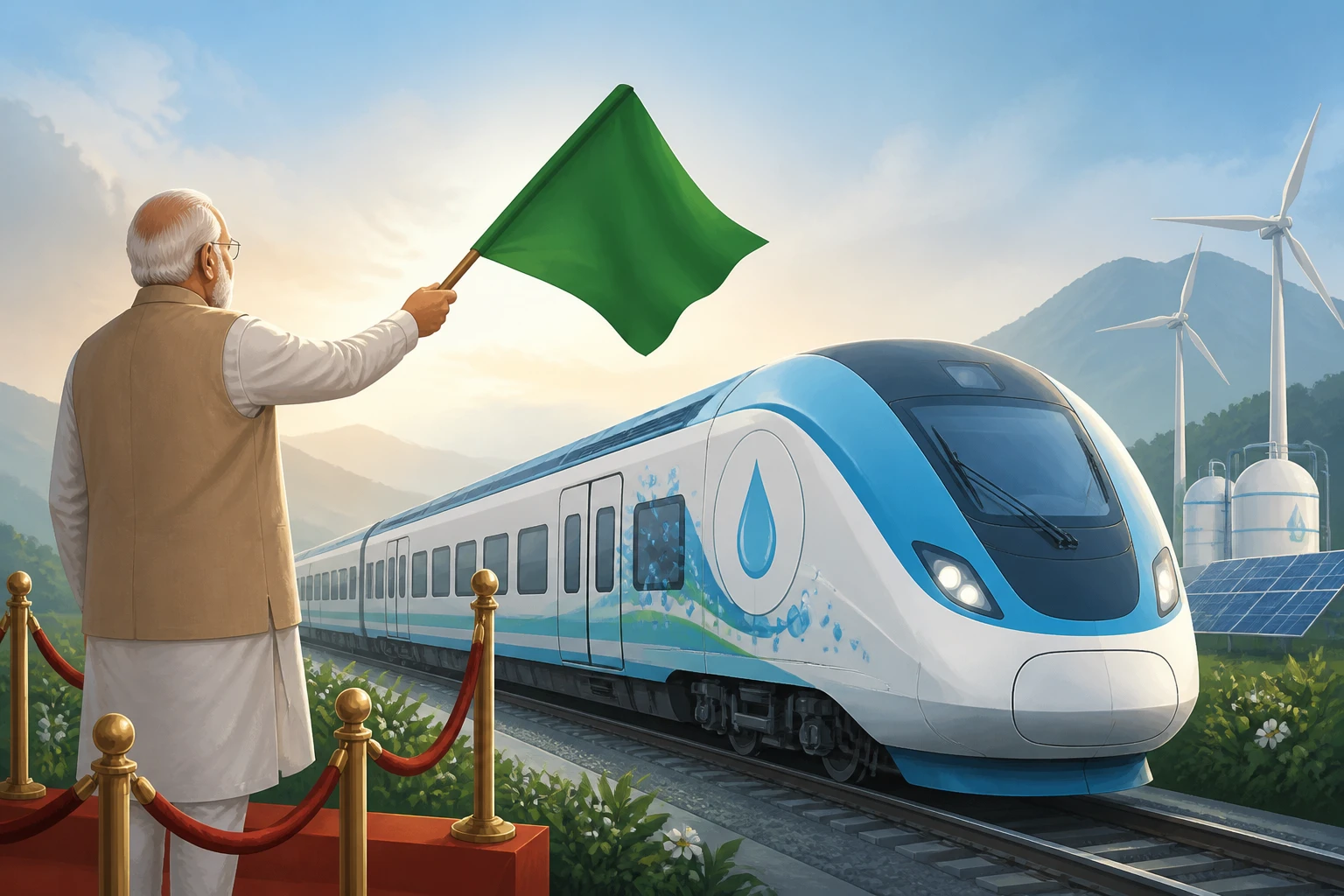
On 17 July 2026, Prime Minister Narendra Modi flagged off India's first hydrogen-powered train from Jind, Haryana. The train will operate on the 89-km Jind–Sonipat section, covering the route in about two hours. PM Modi called it the world's most powerful hydrogen train, equipped with 3,200 horsepower and 10 coaches, making it the longest hydrogen train currently in operation globally. It is also entirely homegrown. Union Minister Ashwini Vaishnaw highlighted that the entire propulsion system was developed indigenously under the Atmanirbhar Bharat initiative.
That's the headline. But the real story is more nuanced.
Water Out, Nothing Else
To understand why this matters, start with the chemistry. Inside the fuel cell, hydrogen reacts chemically with oxygen from the air to produce electricity. That electricity powers the train's motors, while the only direct by-product of the reaction is water vapour. No carbon dioxide, no particulate matter, no noise from combustion.
The energy density advantage is significant too. Hydrogen carries 120 MJ/kg of energy, compared to diesel's 43 MJ/kg. That gap explains why hydrogen, despite its logistical complexity, attracts serious engineering interest for heavy transport.
The train has a maximum operational speed of 75 kmph and is expected to make two round trips daily, consuming nearly 300 kg of hydrogen. To keep it fuelled, the country's largest railway hydrogen storage and refuelling facility has been established at Jind, storing nearly 3,000 kg of hydrogen at a time.
Why Not Just Electrify Everything?
Here's a fair question: India's electric train network is already vast. Indian Railways has electrified more than 99% of its routes, which reduces the need for hydrogen on main-line corridors. So why hydrogen at all?
The answer lies in where electric wires can't go. While Indian Railways has achieved nearly 100% electrification across its major trunk routes, several scenic, historic, and remote lines cannot be easily fitted with overhead electric wires. This is where the "Hydrogen for Heritage" initiative comes in — the government plans to deploy 35 hydrogen trains across ecologically sensitive tourist destinations, such as the Kalka–Shimla Railway, Darjeeling Himalayan Railway, and Nilgiri Mountain Railway. Running a conventional electric catenary through a UNESCO-listed mountain ecosystem is neither practical nor desirable.
Still, there are legitimate efficiency questions. Hydrogen requires multiple energy-intensive stages — including production, compression, transport, storage, and reconversion into electricity — making it less energy-efficient than battery-electric systems. Analysts broadly view hydrogen as a complementary technology rather than a universal replacement.
The Bigger Bet: Capability, Not Just Commuting
Indian Railways will use the Jind–Sonipat route as a pilot project to assess the technology before deciding whether to expand hydrogen-powered services. The pilot also feeds into something larger. The project aims to build expertise in hydrogen propulsion, safety, storage, and maintenance, while supporting the objectives of the National Green Hydrogen Mission.
With this, India has joined a select group of countries that have operational hydrogen-powered trains, marking an important step towards the adoption of clean and sustainable mobility in the railway sector. The Jind–Sonipat line is, in that sense, less a destination and more a proving ground — for the technology, the supply chain, and India's ambition to own the intellectual property of its own clean-transport future.
Sources
- India's First Hydrogen Train Launched by PM Modi
- PM Modi Flags Off India’s First Hydrogen-Powered Train in Haryana, Boosting Make in India and Green Rail Innovation
- India's First Hydrogen Train Is Here: How It Works And Why It Could Change Rail Travel? | Outlook India
- India's First Hydrogen-Powered Train: Advancing Green Rail Mobility - IBG News
- Hydrogen Trains in India: Green Transition or Experiment?
- Hydrogen-Powered Trains in India: The Future of Green Transportation Explained
- PM Modi flags off India's first hydrogen-powered train from Haryana's Jind | India News - Business Standard