

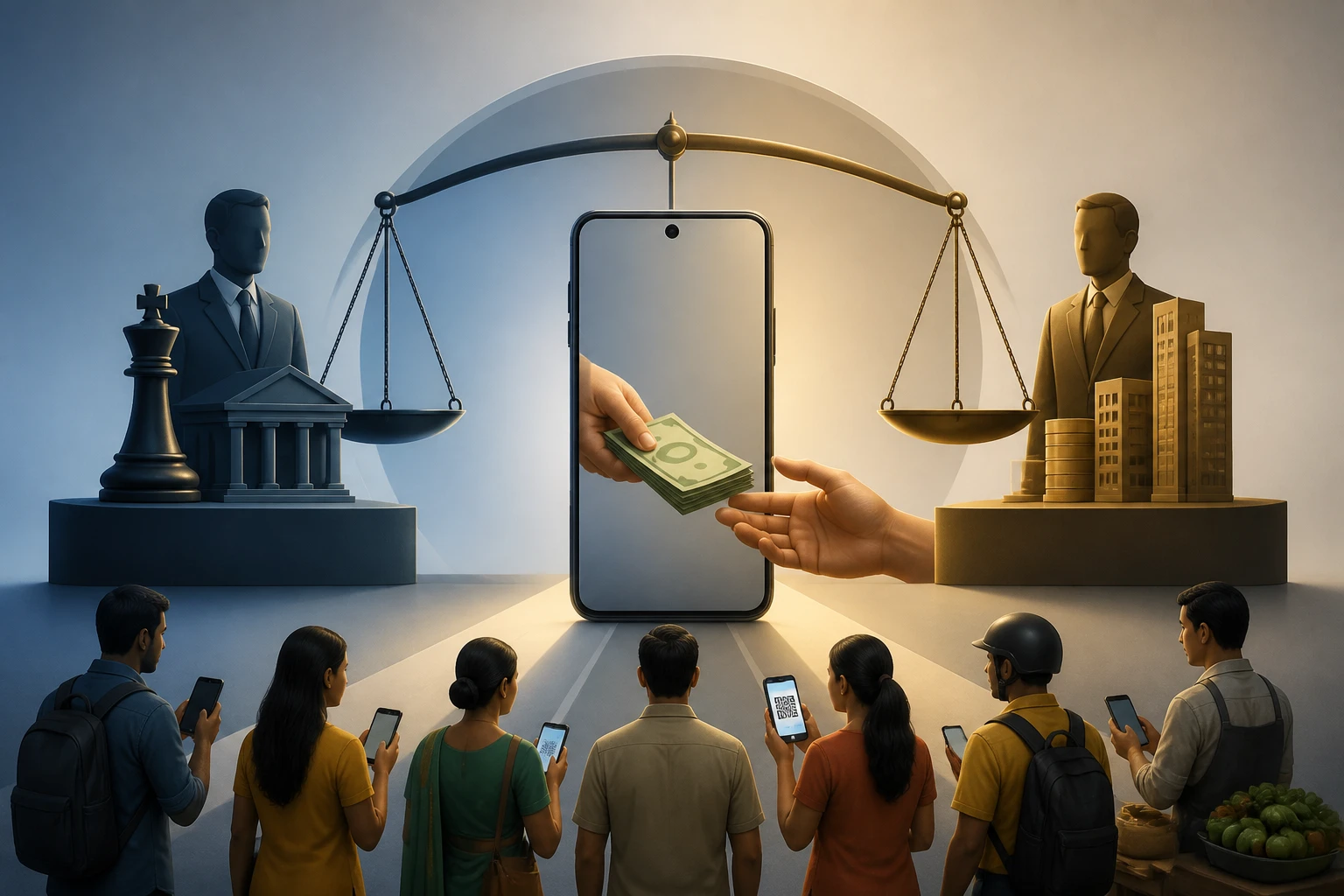
The Bill That Unlocked the Cage Without Releasing the Animal
For the past five years, India's zero-MDR rule was written into law — not just policy. Since January 2020, MDR has been zero for RuPay Debit Cards and BHIM-UPI transactions, enforced through amendments to the Payment and Settlement Systems Act, 2007 and the Income-tax Act, 1961. Banks had no legal room to charge merchants even if they wanted to.
That changed last week. Parliament passed the Taxation and Other Laws (Amendment) Bill, 2026, which modified the legal provisions governing electronic payments — and, in doing so, gave the Centre greater flexibility to decide which payment modes remain protected from transaction charges. Crucially, the legislation does not itself impose any charge on UPI transactions. It removes the existing statutory reference linking the no-charge protection to specific modes prescribed under the Income-tax Act, and replaces it with a provision empowering the Central Government to specify, by notification, which electronic payment modes the no-charge regime will cover.
The cage door is open. The animal hasn't moved.
Why ₹2,000 Is the Magic Number
The policy discussions circling this amendment are not about your ₹200 chai payment. The MDR the government is considering could be introduced on UPI transactions above ₹2,000, while person-to-person transfers are expected to remain free. And the maths behind that threshold is striking: the ₹2,000 threshold would cover about 5% of all UPI transactions by volume but account for around 65% of the total transaction value.
That arithmetic is the entire argument. A tiny slice of transaction count, an enormous slice of monetary flow — and therefore the funding base for banking infrastructure and security costs that currently go uncompensated.
Policymakers are reportedly evaluating a model under which UPI transactions above ₹2,000 made to businesses could attract an MDR of around 0.25% to 0.5%. Under one specific proposal, businesses with an annual turnover of ₹1 crore to ₹1.5 crore or more would attract an MDR of 0.05% to 0.07% on UPI transactions above ₹2,000, leaving roughly 90% of merchants accepting UPI — the small and micro businesses — entirely untouched.
Who Actually Pays Whom
Here is where the public discourse gets muddled. Most headlines frame this as "UPI charges are coming." They aren't — not for you. MDR is not paid out to the app you scan a QR code with. It gets split between every party that touches the transaction: the buyer's bank (the issuing bank) and the merchant's bank (the acquiring bank).
The Reserve Bank of India says MDR is divided among issuers, acquirers, card networks and other entities involved in the payment chain. Think of it as a toll road where the merchant pays the entry fee, and that fee is then shared among the road's builders and operators.
As acquiring and issuing banks, large lenders currently process UPI transactions without earning MDR, relying instead on government incentives. The proposed framework could provide an additional source of payment-processing income. This matters because the current government subsidy model was always a workaround, not a permanent solution.
The Consumer Reality Check
Finance Minister Nirmala Sitharaman made clear in the Rajya Sabha that the legislation does not impose any tax on UPI and that the digital payment system will remain free for consumers. She stated that the UPI-related amendment is only an enabling provision and does not itself impose any tax or transaction charge on users. She also said the government does not intend to impose any MDR charges on small merchants, as they remain central to UPI's inclusive growth.
The honest consumer takeaway: your P2P transfers to family, your small purchases at the kirana store — none of that is on the table. The debate is about whether a large retailer paying you back fractionally less per scan is a fair trade for a sustainable digital payments ecosystem. Any levy would require legislative approval, a Gazette notification, and RBI guidelines detailing transaction categories, rates, and implementation. The law has changed. The charge has not — yet.
Sources
- india%2Funion cabinet approves rs 1500 crore to incentivise low value upi transactions 3453376
- Parliament Passes Taxation Amendment Bill, Paving Way For Possible UPI Charges
- Parliament Passes Taxation Laws Amendment Bill, Paving Way For Possible UPI Charges
- MDR on UPI transactions over ₹2,000? Here’s what we know so far - BusinessToday
- UPI Merchant Charges: Govt Eyes MDR on Transactions Over ₹2,000 - Storyboard18
- UPI’s Monetisation Moment: Why MDR Is Back On The Table
- India's Payments MDR removal benefits Phonepe the most
- UPI vs cards: Why merchants pay MDR on cards but not on UPI payments | Finance News - Business Standard
- UPI MDR heatmap: SBI, ICICI Bank, Axis Bank and PhonePe stand to gain, retailers could pay more: Report - BusinessToday
- Parliament passes Taxation and Other Laws (Amendment) Bill, 2026 | Akashvani News