

Overview
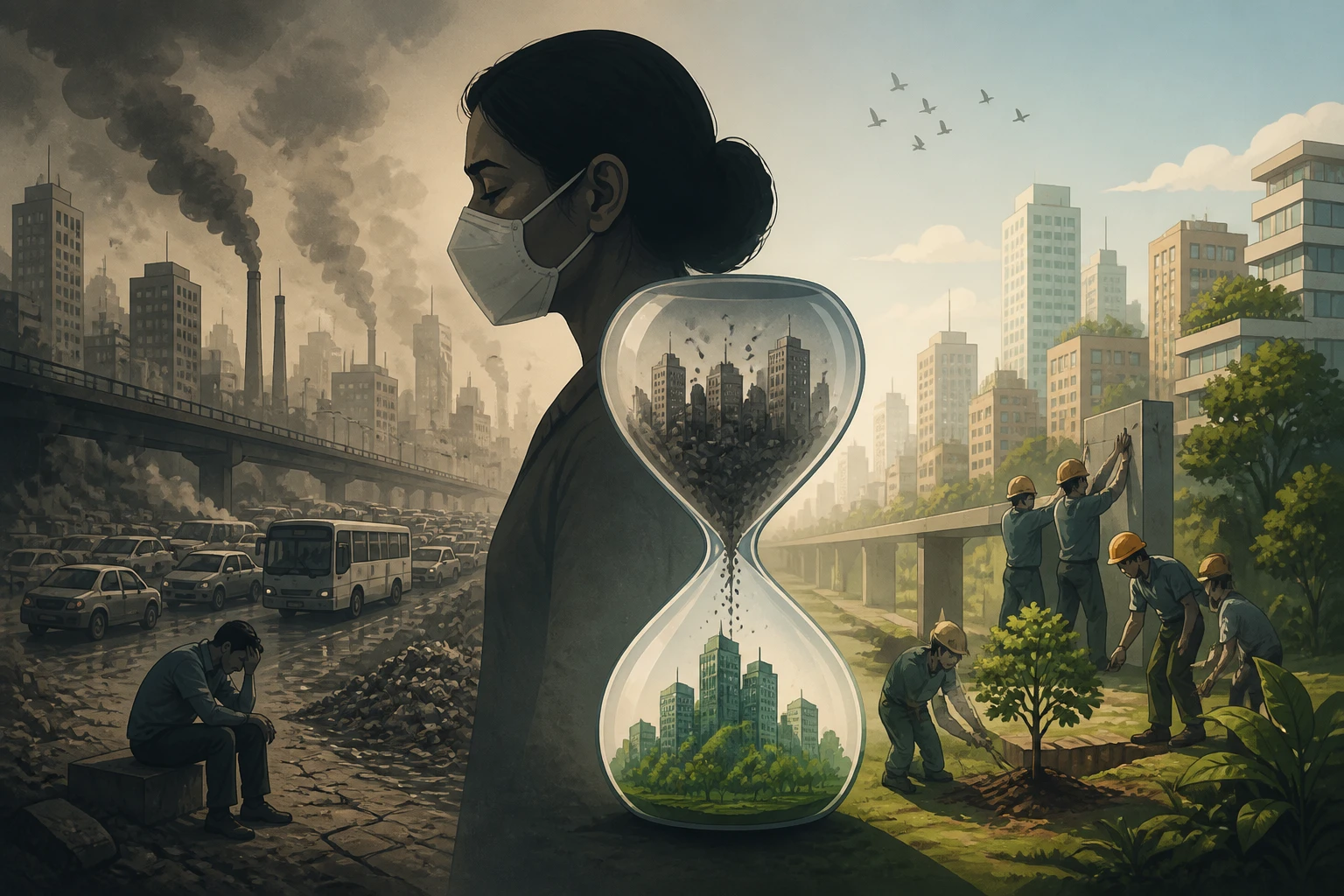
Imagine your smartphone slowing down faster than you can install updates. That's exactly what's happening to Indian cities right now. While you're stuck in traffic this morning, breathing air that feels thicker than usual, Mumbai, Delhi, and six other major cities are racing toward a crisis point. By 2030, these urban centers will experience twice as many heatwaves while accommodating India's swelling population of 1.46 billion people. It's like trying to fit an elephant into a car that's already breaking down – the infrastructure simply can't keep pace with the pressure. For working professionals like us, this isn't just an environmental concern; it's about whether our cities will remain functional places to build careers and lives.
The Problem
Indian cities are caught in a perfect storm of rapid urbanization and climate change. Think of it like a pressure cooker with the heat turned up and no release valve. Urban heat islands – areas where concrete and asphalt trap heat – are making cities significantly warmer than surrounding areas. Delhi already experiences temperatures 4-6 degrees higher than its outskirts, and this gap is widening.
The numbers are staggering. India's urban population is growing at 2.4% annually, adding roughly 30 million new city dwellers every year. Meanwhile, climate data shows that extreme heat days (above 40°C) in major cities have increased by 25% over the past decade. This isn't gradual change – it's exponential deterioration that's outpacing our ability to adapt infrastructure, housing, and basic services.
Analysis
The economic implications are massive and multi-layered. Heat stress reduces worker productivity by up to 15% in outdoor industries, while increased air conditioning demand strains power grids, leading to frequent blackouts that disrupt business operations. For tech companies and startups, this means higher operational costs and talent retention challenges.
From a policy perspective, Indian cities face what economists call the "infrastructure debt" problem. We're trying to build 21st-century solutions on 20th-century foundations while dealing with 19th-century governance structures. Urban planning decisions made decades ago – like prioritizing vehicle-centric development over public transport – are now creating compounding problems.
The business angle reveals another layer of complexity. Real estate developers continue building dense, concrete-heavy projects because they're profitable, not because they're sustainable. Meanwhile, green building certifications cover less than 5% of new construction in major cities. The incentive structures are misaligned – short-term profits versus long-term livability.
This creates a vicious cycle: as cities become less livable, property values in bearable areas skyrocket, pushing middle-class families to urban peripheries with even worse infrastructure, further straining transportation networks and increasing carbon emissions.
Real-World Examples
Ahmedabad offers a compelling case study. After experiencing a devastating heatwave in 2010 that killed over 1,300 people, the city implemented India's first Heat Action Plan. They created cooling centers, improved early warning systems, and modified work schedules for outdoor laborers. The result? Heat-related mortality dropped by 25% in subsequent years.
Conversely, Gurgaon exemplifies the problem. Despite being a global business hub housing offices of Google, Microsoft, and hundreds of startups, basic infrastructure remains inadequate. During monsoons, the city floods; during summers, water shortage forces residents to rely on expensive private tankers. DLF and other developers built massive complexes without corresponding investment in civic infrastructure.
Pune's IT corridor faces similar challenges. Companies like Infosys and TCS have invested in green campuses with sustainable cooling systems, but employees still struggle with traffic, air quality, and water scarcity in surrounding areas. Some firms are now considering relocating operations to smaller cities with better infrastructure.
The Challenge
The root problem isn't lack of solutions – it's implementation complexity. Urban planning in India involves 74 different agencies across state and central governments. Getting approval for a simple flyover can take 5-7 years, while climate change operates on much faster timelines.
Additionally, the "commons problem" applies here. Individual developers, residents, and businesses make rational short-term decisions that collectively create long-term disasters. Everyone wants air conditioning, private cars, and larger apartments, but nobody wants to fund public transport, green spaces, or waste management systems.
Future Implications
If current trends continue, we're looking at a scenario where Indian cities become increasingly segregated between climate-resilient neighborhoods for the wealthy and heat-stressed areas for everyone else. This could trigger massive internal migration, with professionals moving to smaller cities or climate-safe zones.
The business impact will be profound. Companies may need to factor "climate risk" into location decisions, potentially reshaping India's economic geography. Cities that act now – investing in public transport, green infrastructure, and sustainable housing – will likely capture a disproportionate share of talent and investment.
For working professionals, this means career decisions will increasingly involve climate considerations. The cities offering the best job opportunities today may not be the most livable tomorrow.
Looking Ahead
Here's the uncomfortable truth: individual actions alone won't solve this crisis. While we can make sustainable choices, the scale of urban transformation needed requires coordinated policy action, massive infrastructure investment, and fundamental changes to how cities are planned and governed. The question isn't whether Indian cities can remain livable – it's whether we'll act fast enough to prevent a complete urban breakdown.