

India's rooftop solar boom is real — and it is starting to create its own problems.
India installed 7.1 GW of rooftop solar capacity in 2025, more than doubling year-on-year from 3.2 GW in 2024. Residential consumers drove roughly three-quarters of that growth, largely on the back of the PM Surya Ghar: Muft Bijli Yojana. The scheme, with a total government outlay of ₹75,021 crore, targets one crore households by FY27 — and has already crossed 50 lakh installations at 14.8 GW of capacity.
That is, by any measure, a policy success. So why is the industry now pushing to change it?
When Everyone Exports at Noon, the Grid Flinches
The problem is physics. During sunny afternoon hours, household demand is low while solar generation peaks. When many homes on the same feeder export power simultaneously, power flow can reverse toward the distribution transformer — a major shift for low-voltage and 11 kV networks. DISCOMs in high-penetration feeders across parts of Gujarat, Rajasthan, and Delhi already report voltage rise and reverse power flow issues during midday.
This is the duck-curve problem — not in Texas or California, but on India's neighbourhood electricity lines.
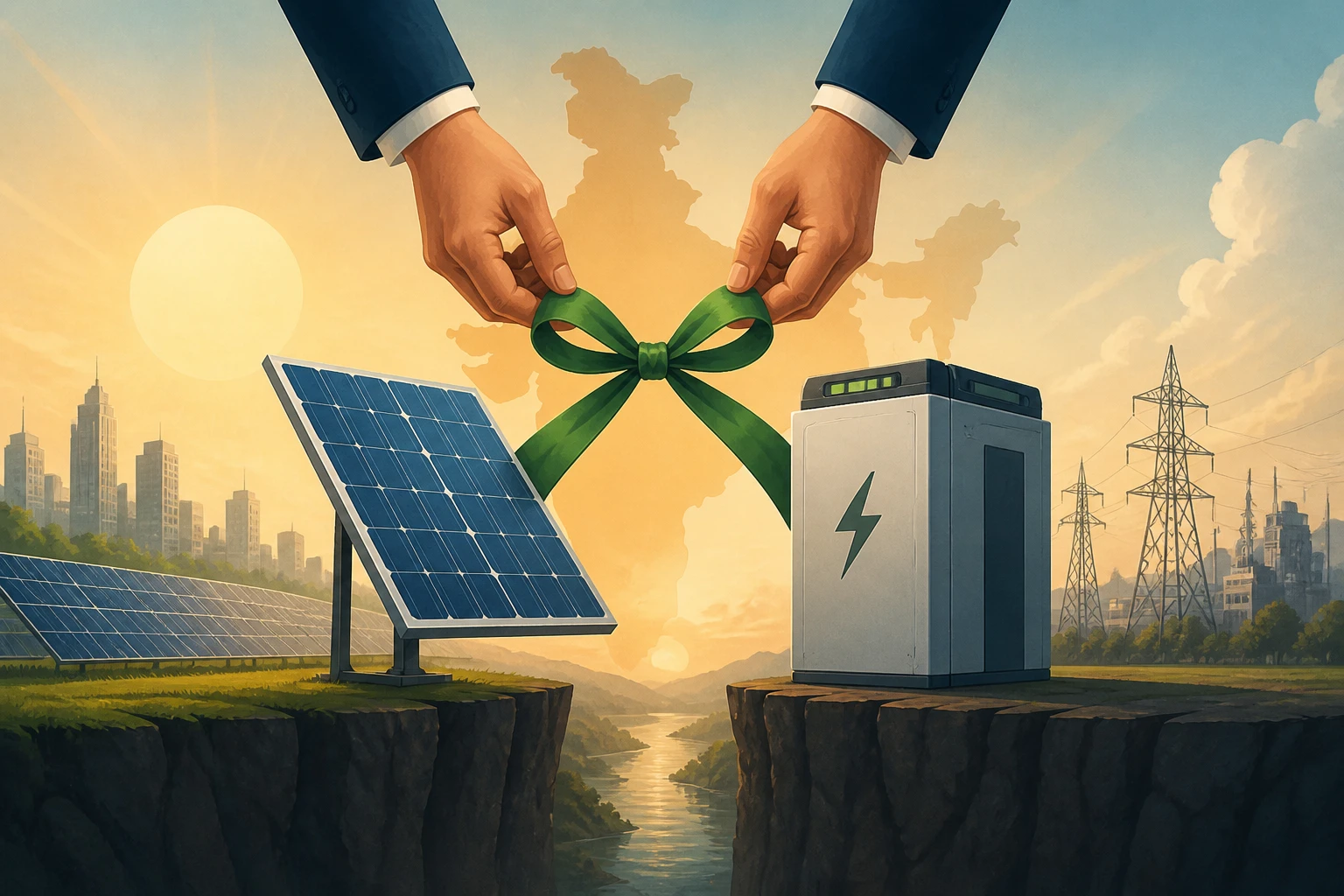
The fix the industry is lobbying for is Battery Energy Storage Systems, or BESS: attach a battery to the rooftop panel, and instead of flooding the grid at noon, the household stores that surplus for its own evening use. Battery storage can increase solar self-consumption, reduce grid dependence, and lower electricity bills. Batteries can also reduce reverse power flow, moderate local voltage stress, and help DISCOMs manage peak demand.
What Industry Is Asking the MNRE to Do
MNRE held a brainstorming session on July 23 to chart the future roadmap of PM Surya Ghar 2.0. Discussions included representatives from the International Solar Alliance, power distribution companies, policy think tanks, and rooftop solar developers.
Industry leaders and experts called for the integration of BESS with rooftop solar, differentiated support, and policy continuity to boost investor sentiment. A hybrid BESS architecture — covering household batteries for consumer resilience, community-level batteries for local network management, and utility-scale systems for bulk balancing — was flagged as the most effective approach.
Equally significant is the call for stability. Industry representatives warned against sudden policy changes, arguing these can be counterproductive. Investors in a sector with long payback horizons need to know the rules won't shift beneath them.
The next phase of PM Surya Ghar is likely to move beyond installation-based subsidies and adopt a performance-oriented framework that rewards actual electricity generation, battery storage, lifecycle maintenance, and grid-support services.
How to Get on the Solar Panel Yourself
If you want to participate in the current scheme, the process is fully online. Getting started at pmsuryaghar.gov.in involves registering your state, electricity distribution details, and contact information — designed to be straightforward for first-time applicants. After receiving DISCOM approval, you choose a registered vendor for installation; once installed, you upload your details online for a net meter, and commissioning is confirmed by the DISCOM. The subsidy is then credited as a Direct Benefit Transfer to your Aadhaar-seeded bank account.
The Argument That Still Needs Settling
MNRE has been clear that consultations are at a preliminary stage and no decision has been taken — so BESS inclusion in Surya Ghar 2.0 remains a proposal, not policy. The cost of batteries still meaningfully raises the upfront investment for a household, and the government will need to determine how much of that it is willing to subsidise.
But the underlying logic is hard to argue with. A solar panel that floods the grid at noon and leaves the homeowner buying expensive power at 7 pm is only half a solution. Storage is what turns rooftop solar from a daytime convenience into genuine energy independence — for the household, and for the grid behind it.
Sources
- India installs 7.1 GW of rooftop solar in 2025, up 122% YoY - pv magazine India
- Govt weighs industry proposals for next phase of rooftop solar scheme | India News - Business Standard
- Rooftop Solar after PM Surya Ghar | Electrical India Magazine
- PM Surya Ghar 2.0: Battery Storage and Rooftop Solar Policy
- Industry seeks battery integration, policy continuity for PM Surya Ghar | Industry News - Business Standard
- PM Surya Ghar 2.0 May Pair Capital Support with Generation-Linked Incentives - Asia Pacific | Energetica India Magazine
- PM Surya Ghar 2.0: A New Era for Rooftop Solar in India
- Apply for PM Surya Ghar Muft Bijli Yojana Online in 5 Steps
- PM Surya Ghar Yojana 2025: Solar Subsidy Online Apply Kaise Karein