

Overview
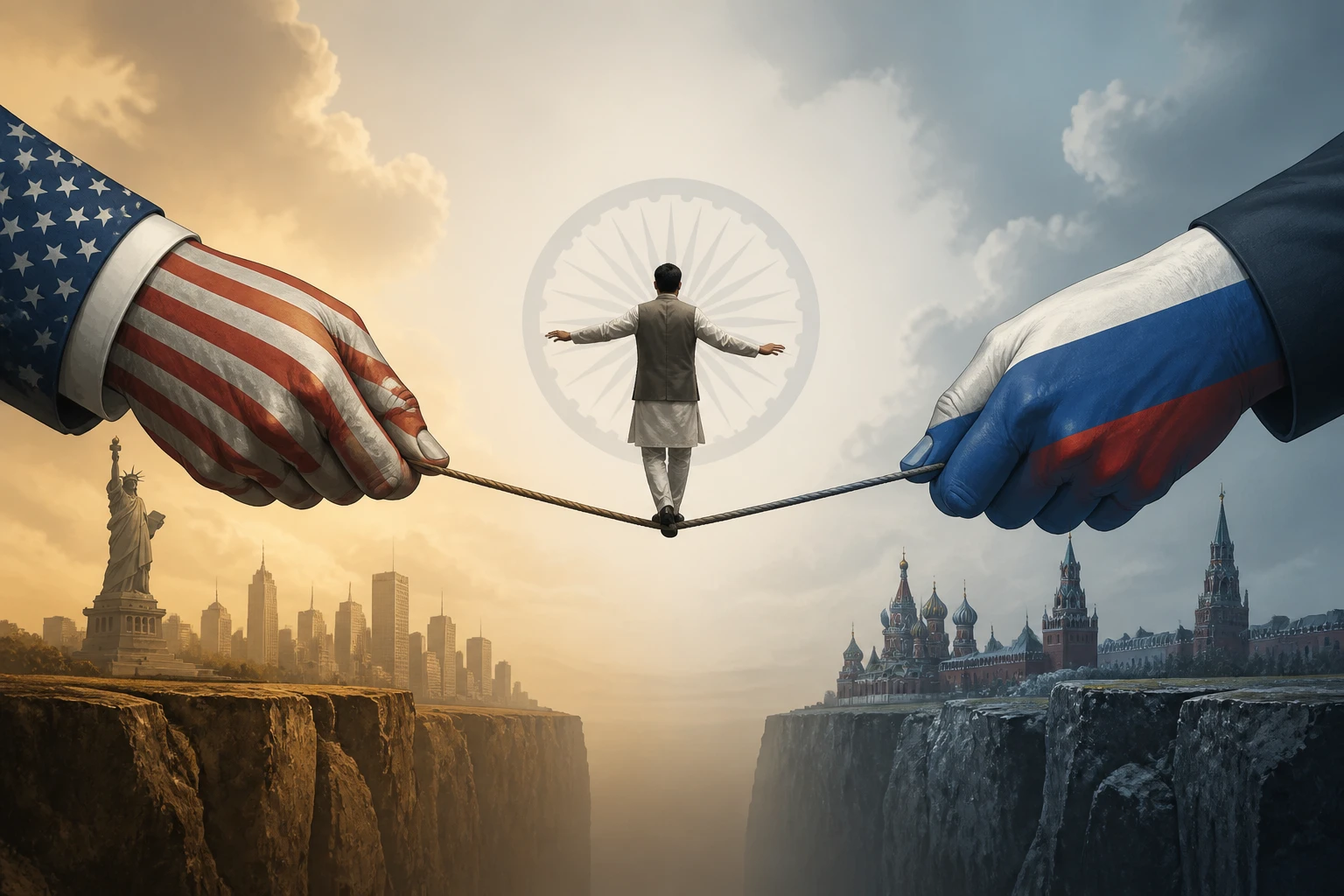
Imagine you're at a family dinner where your divorced parents are sitting at opposite ends of the table, both demanding you choose sides. That's essentially the position India finds itself in today with America and Russia. When President Trump announced 50% tariffs on Indian goods for continuing to buy Russian oil, New Delhi faced an impossible choice: maintain its decades-old policy of strategic autonomy or bow to Washington's pressure. This isn't just about oil or trade—it's about whether middle powers like India can survive in an increasingly bipolar world where neutrality is becoming a luxury few can afford.
The Problem
India's dilemma runs deeper than just energy imports. The country imports roughly $35 billion worth of Russian oil annually, making Russia its second-largest oil supplier after Iraq. This Russian oil comes at a 15-20% discount compared to global prices, saving India billions of dollars that directly impact fuel costs for its 1.4 billion citizens. But Trump's tariff threat puts this arrangement in jeopardy. The proposed tariffs could cost Indian exporters approximately $20 billion annually, affecting everything from IT services to pharmaceutical exports. India's non-aligned movement philosophy, which served it well during the Cold War, is now being tested in ways the founding fathers never anticipated. The question isn't just economic—it's existential for India's foreign policy doctrine.
Analysis
The economic implications are staggering. India's $190 billion trade relationship with the US dwarfs its $65 billion trade with Russia, making the American market irreplaceable. However, switching oil suppliers isn't like changing your Netflix subscription. India would need to pay premium prices for Middle Eastern oil, potentially increasing its import bill by $8-10 billion annually. This cost would inevitably trickle down to consumers through higher fuel prices, affecting everything from transportation to manufacturing costs.
From a strategic perspective, India faces what experts call the "middle power trap." Countries like India, Brazil, and Turkey built their foreign policies on strategic autonomy—the ability to engage with multiple powers simultaneously. But in today's zero-sum game between the US and its rivals, this flexibility is disappearing. The Russia-Ukraine conflict has forced nations to pick sides, and India's historical ties with Moscow through defense cooperation (Russia supplies 60% of India's defense equipment) complicate any quick pivot.
The policy implications extend beyond economics. India's relationship with Russia isn't just transactional—it's built on decades of partnership during India's most vulnerable moments, including the 1971 Bangladesh Liberation War when Russia vetoed UN resolutions against India.
Real-World Examples
Reliance Industries, India's largest private company, has already begun reducing its Russian oil purchases from 40% to 25% of total imports, signaling corporate India's awareness of geopolitical risks. Similarly, Tata Motors and Mahindra Group have expressed concerns about potential supply chain disruptions if tariffs materialize.
The Indian IT sector, which employs over 5 million people, is particularly vulnerable. Companies like Infosys and TCS derive 60-65% of their revenues from the US market. A 50% tariff on IT services could make Indian companies uncompetitive overnight, potentially costing hundreds of thousands of jobs.
Even generic pharmaceutical companies like Dr. Reddy's Labs and Cipla, which supply 40% of generic drugs to the US market, face existential threats. These companies have already started lobbying through industry associations, warning that tariffs could increase medicine costs for American consumers while devastating Indian exporters.
The Challenge
The fundamental challenge isn't just choosing between two partners—it's about redefining what strategic autonomy means in 2025. Unlike the Cold War era, today's conflicts aren't ideological but economic and technological. India can't simply declare neutrality when supply chains, payment systems, and technology standards are increasingly controlled by competing blocs. The SWIFT banking system, semiconductor supply chains, and digital payment networks all force countries into alignment, making true independence nearly impossible.
Future Implications
This situation signals a broader shift toward a multipolar world where middle powers must make increasingly difficult choices. India's response will likely influence other nations facing similar dilemmas—from Turkey balancing NATO membership with Russian relations to Saudi Arabia managing ties between Washington and Beijing.
For working professionals, this means supply chain volatility, currency fluctuations, and sector-specific disruptions will become more common. The IT sector might see accelerated nearshoring trends, while manufacturing could witness supply chain diversification. Energy prices will remain volatile, affecting everything from transportation costs to manufacturing inputs. Companies will need to build geopolitical risk assessment into their strategic planning, something previously reserved for defense contractors.
Looking Ahead
India's choice between America and Russia isn't just about foreign policy—it's about whether the world can accommodate countries that refuse to choose sides. The outcome will determine if strategic autonomy survives the 21st century or becomes another casualty of great power competition. Can India thread the needle, or will it be forced to abandon decades of independent foreign policy? The answer may well define the global order for the next generation.