

Overview
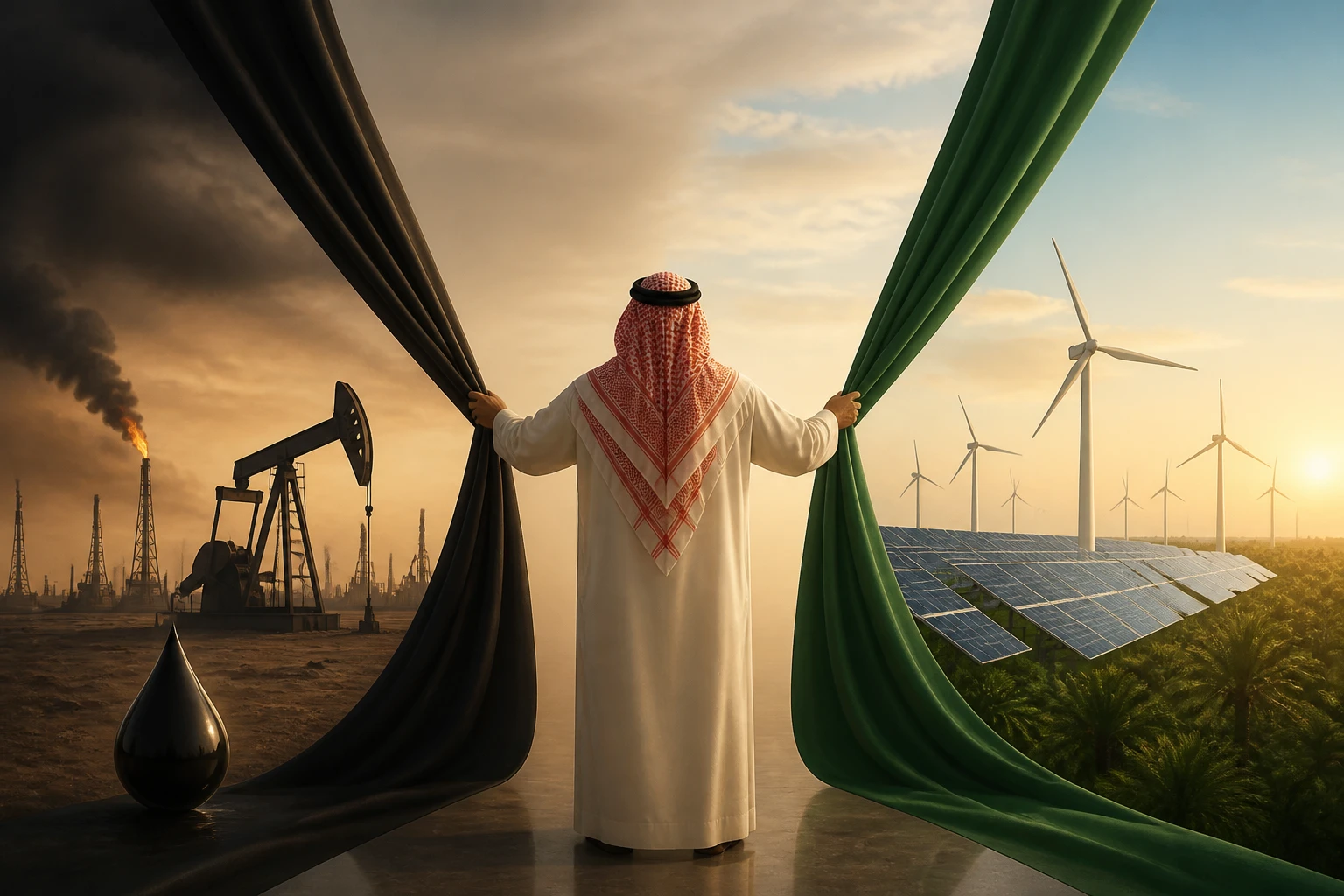
Picture this: The world's biggest drug dealer suddenly decides to open a health clinic. Sounds absurd, right? Yet that's essentially what's happening in Saudi Arabia. The kingdom that built its fortune on black gold is now betting its future on something it once considered an existential threat: renewable energy. In 2023, Saudi Arabia announced plans to invest over $200 billion in solar and wind projects through initiatives like NEOM and the Saudi Green Initiative. This isn't just corporate greenwashing—it's a fundamental reimagining of how the world's largest oil exporter plans to survive the next century. For working professionals watching global markets, this shift represents one of the most significant economic pivots of our time.
The Problem
Saudi Arabia faces what economists call the "resource curse paradox"—being too dependent on a single commodity that may soon become obsolete. Currently, oil revenues account for 75% of Saudi government income and 87% of export earnings. But here's the kicker: global oil demand is projected to peak by 2030, just as electric vehicles and renewable energy reach mass adoption.
Think of it like being the world's best typewriter manufacturer when computers are about to hit the market. The Saudis recognize that their $833 billion economy needs diversification—fast. Climate commitments from major economies mean their biggest customers are actively trying to buy less oil. Meanwhile, the kingdom's own energy consumption is growing by 7% annually, forcing them to burn valuable export oil for domestic electricity. It's like eating your seed corn during a harvest festival.
Analysis
The economic implications of Saudi Arabia's renewable pivot extend far beyond environmental concerns. From a geopolitical perspective, this move challenges the traditional petrodollar system that has dominated global finance since the 1970s. If Saudi Arabia can generate wealth from renewable energy exports—particularly green hydrogen—it maintains its position as an energy superpower while reducing dependence on oil revenues.
Business-wise, this creates massive opportunities in energy storage, solar panel manufacturing, and grid infrastructure. The NEOM project alone aims to generate 4 million jobs and contribute $48 billion annually to GDP by 2030. This isn't just about replacing oil—it's about positioning Saudi Arabia as the renewable energy hub connecting Europe, Asia, and Africa.
The policy implications are equally significant. Saudi Arabia's Vision 2030 targets 50% renewable energy in the domestic mix, freeing up 1 million barrels of oil daily for export. This strategy allows them to maintain oil export revenues while building renewable capacity—essentially hedging their bets on both sides of the energy transition.
Real-World Examples
NEOM, Saudi Arabia's $500 billion futuristic city project, exemplifies this transformation. The development will run entirely on renewable energy, featuring green hydrogen production facilities capable of generating 650 tons daily by 2026. Air Products, the American industrial gases company, has already committed $5 billion to build the world's largest green hydrogen plant there.
Saudi Aramco, once purely an oil company, now invests heavily in carbon capture technology and renewable projects. The company recently announced partnerships with TotalEnergies and ACWA Power for massive solar installations. Meanwhile, the Saudi sovereign wealth fund (PIF) has allocated $20 billion specifically for renewable energy investments globally.
Red Sea Global, another Saudi mega-project, demonstrates practical implementation. This luxury tourism development will be 100% powered by renewable energy, using advanced battery storage systems and solar panels designed to withstand desert conditions. The project serves as a real-world testing ground for technologies that could be scaled across the kingdom.
The Challenge
However, transforming an oil-dependent economy isn't like flipping a switch. Saudi Arabia faces significant technical challenges: desert sandstorms damage solar panels, extreme temperatures reduce efficiency, and energy storage remains expensive. The kingdom also lacks the skilled workforce needed for renewable energy projects, requiring massive training and education investments.
Regulatory complexity adds another layer of difficulty. Integrating renewable energy into existing oil-dependent infrastructure requires completely new legal frameworks, grid management systems, and international trade agreements. The transition must happen fast enough to stay relevant but slow enough to avoid economic disruption.
Future Implications
For working professionals, Saudi Arabia's renewable energy embrace signals broader shifts in global supply chains, investment flows, and career opportunities. Companies with Saudi exposure—from construction giants like Bechtel to technology firms like Tesla—may see significant business growth. The kingdom's transformation could also stabilize oil prices by reducing supply, benefiting energy investors.
Green hydrogen exports represent Saudi Arabia's biggest long-term bet. If successful, the kingdom could become Europe's primary clean energy supplier, replacing Russian gas with Saudi solar power. This shift would reshape Mediterranean trade routes and create new geopolitical alliances. For professionals in energy, finance, or international business, understanding this transition becomes crucial for career planning and investment decisions.
Looking Ahead
Saudi Arabia's renewable energy pivot reveals a fundamental truth about modern economics: adaptability trumps tradition. The same strategic thinking that made the kingdom rich from oil now drives its renewable energy investments. Whether this $200 billion gamble pays off will determine not just Saudi Arabia's future, but the entire Middle East's role in the post-oil world economy. The question isn't whether Saudi Arabia can embrace renewable energy—it's whether the rest of the world is ready for a green-powered Saudi Arabia.