

Overview
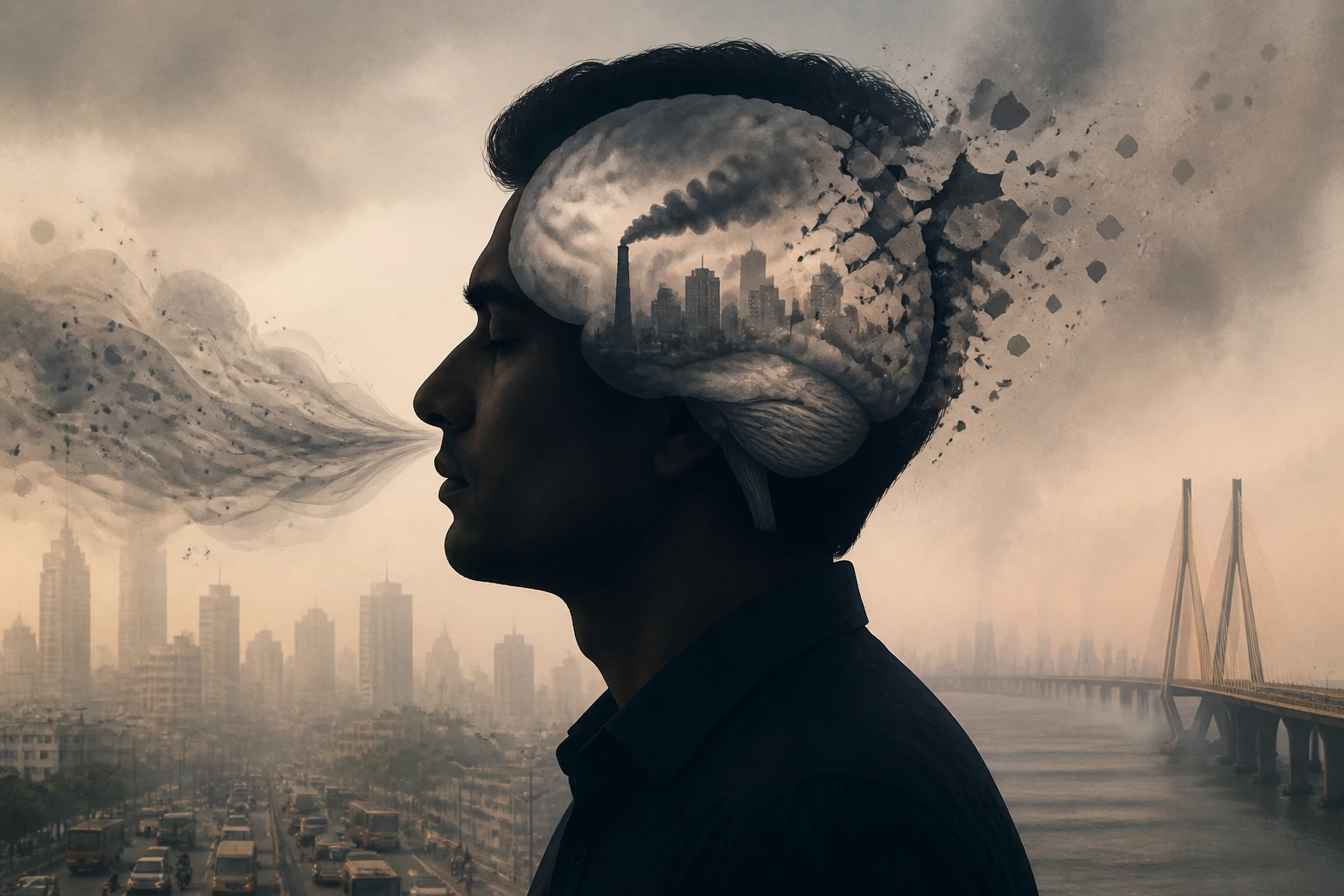
Picture this: You're sitting in your Bandra-Kurla Complex office, sipping your third cup of coffee, when a colleague mentions they've been forgetting important client names lately. Another teammate complains about struggling to focus during presentations. Everyone assumes it's work stress, but what if there's an invisible culprit lurking outside your air-conditioned office? Mumbai's air quality isn't just making you cough – it might be quietly rewiring your brain. While we've long understood that polluted air damages our lungs, groundbreaking research now reveals a more sinister truth: the same toxic particles choking Mumbai's skyline are potentially sabotaging our cognitive abilities, memory, and decision-making skills. For working professionals aged 20-40, this isn't just a health concern – it's a career threat hiding in plain sight.
The Problem Defined
Think of your brain like a high-performance computer that needs clean air to function optimally. When fine particulate matter (PM2.5) – particles so tiny they're 30 times smaller than the width of human hair – enters your bloodstream through your lungs, they don't just stay there. These microscopic invaders travel directly to your brain, crossing the blood-brain barrier like uninvited guests sneaking into a private party.
Mumbai's air quality regularly exceeds WHO safety standards by 2-3 times, with PM2.5 levels often soaring above 60-80 µg/m³ during peak pollution months (the safe limit is 15 µg/m³). But here's what's truly alarming: recent studies from the Indian Institute of Science show that chronic exposure to such pollution levels can reduce cognitive performance by up to 10-15% over just five years.
The mechanism is devastatingly simple. Once in your brain, these particles trigger neuroinflammation – essentially, your brain's immune system goes haywire, attacking healthy neurons in its attempt to fight off the pollutants. This process damages the prefrontal cortex (responsible for decision-making) and the hippocampus (crucial for memory formation). It's like having a slow-motion concussion that lasts for years, except you don't even realize it's happening.
For Mumbai's 2.1 million working professionals, this represents a silent epidemic that's potentially undermining productivity, creativity, and career advancement across the city's financial and tech sectors.
Analysis
The economic implications are staggering when you consider Mumbai contributes nearly 12% of India's GDP. If air pollution is diminishing cognitive performance among the city's workforce, we're looking at a productivity crisis that extends far beyond individual health concerns.
From a business perspective, companies are unknowingly losing competitive edge. Research from Harvard T.H. Chan School of Public Health demonstrates that employees in high-pollution environments show measurably slower response times in cognitive tests, reduced ability to process complex information, and impaired strategic thinking. For Mumbai's financial services sector – which employs over 400,000 professionals – even marginal cognitive decline translates to millions in lost revenue through suboptimal trading decisions, flawed risk assessments, and reduced innovation.
The policy angle reveals a complex web of challenges. Mumbai's pollution stems from vehicle emissions (40%), industrial sources (30%), construction dust (20%), and other factors (10%). While the Maharashtra Pollution Control Board has implemented various measures, the cognitive health aspect remains largely unaddressed in public policy discussions. Current air quality monitoring focuses on respiratory impacts, completely overlooking neurological consequences.
Insurance companies are beginning to take notice. Some international insurers now factor air quality into health premiums, recognizing the long-term cognitive and neurological risks. This trend could soon reach Indian markets, potentially making health coverage more expensive for professionals working in high-pollution cities like Mumbai.
The real estate implications are equally significant. Properties in areas with better air quality – like Powai or parts of South Mumbai near the coastline – command premium prices not just for lifestyle reasons, but increasingly for health considerations. Forward-thinking developers are incorporating air filtration systems as standard amenities, recognizing that air quality is becoming a key differentiator in Mumbai's competitive real estate market.
Real-World Examples
Tata Consultancy Services (TCS) has quietly begun installing advanced air purification systems across their Mumbai offices, though they haven't publicly linked this to cognitive performance concerns. Internal productivity metrics reportedly show improved employee performance in offices with better air quality management, though TCS hasn't released specific data.
Goldman Sachs' Bangalore office conducted an internal study comparing employee performance across their Indian locations. While they haven't published results, sources suggest cognitive performance metrics were notably different between high-pollution and low-pollution office environments, influencing their future office location strategies.
Dr. Sundeep Salvi, Director of the Chest Research Foundation in Pune, has documented cases where Mumbai professionals in their 30s show brain imaging patterns typically associated with much older individuals. "We're seeing premature aging of brain tissue that correlates directly with pollution exposure duration," he notes.
Microsoft India has begun offering "clean air days" – work-from-home options during high pollution periods – as part of their employee wellness program. While positioned as a general health initiative, the policy recognizes the cognitive impact of pollution exposure on their workforce.
The Challenge
Solving Mumbai's air quality crisis isn't as simple as installing more air purifiers or buying electric vehicles. The challenge operates on multiple complex levels that resist easy solutions.
Regulatory complexity is enormous. Mumbai's pollution sources span multiple jurisdictions – from Municipal Corporation of Greater Mumbai (MCGM) to Maharashtra State Road Development Corporation to central government agencies. Coordinating effective action requires unprecedented inter-agency cooperation that's historically proven difficult to achieve.
The economic reality creates perverse incentives. Industries contributing to pollution often provide essential employment and tax revenue. Strict enforcement could drive businesses away, potentially harming the very professionals we're trying to protect. It's a classic catch-22 that policymakers struggle to resolve.
Individual solutions like air purifiers and masks provide limited protection. You can't wear an N95 mask during client presentations or keep your office windows permanently sealed. The problem requires systemic change that individual action alone cannot achieve.
Awareness gaps compound the challenge. Most professionals still don't understand the cognitive implications of air pollution, focusing primarily on visible respiratory symptoms while ignoring the invisible neurological damage occurring daily.
Future Implications
The cognitive impact of Mumbai's air pollution could reshape the city's economic trajectory over the next decade. As remote work becomes more normalized post-pandemic, talented professionals may increasingly choose to relocate to cleaner cities, potentially triggering a brain drain that could undermine Mumbai's status as India's financial capital.
Artificial intelligence and automation may accelerate this trend. As routine cognitive tasks become automated, human workers increasingly need to perform complex analytical and creative functions – precisely the capabilities most vulnerable to pollution-induced cognitive decline. Mumbai's workforce risks becoming less competitive in an AI-driven economy if air quality continues deteriorating.
The startup ecosystem could suffer disproportionately. Innovation requires peak cognitive performance, and Mumbai's pollution may be silently undermining the city's entrepreneurial potential. Cities like Pune and Hyderabad, with relatively better air quality, may gain competitive advantages in attracting top talent and fostering innovation.
Healthcare costs will likely surge as the long-term neurological impacts become apparent. Early-onset dementia, cognitive decline, and neurological disorders linked to pollution exposure could create unprecedented healthcare burdens over the next 20-30 years.
Looking Ahead
Mumbai stands at a crossroads where environmental policy becomes economic strategy. The question isn't whether air pollution affects cognitive performance – the science is clear. The question is whether Mumbai will recognize this threat before it permanently undermines the city's human capital advantage. For working professionals, the stakes couldn't be higher: your career success may literally depend on the air you breathe. The time for awareness has passed; the time for action is now.