

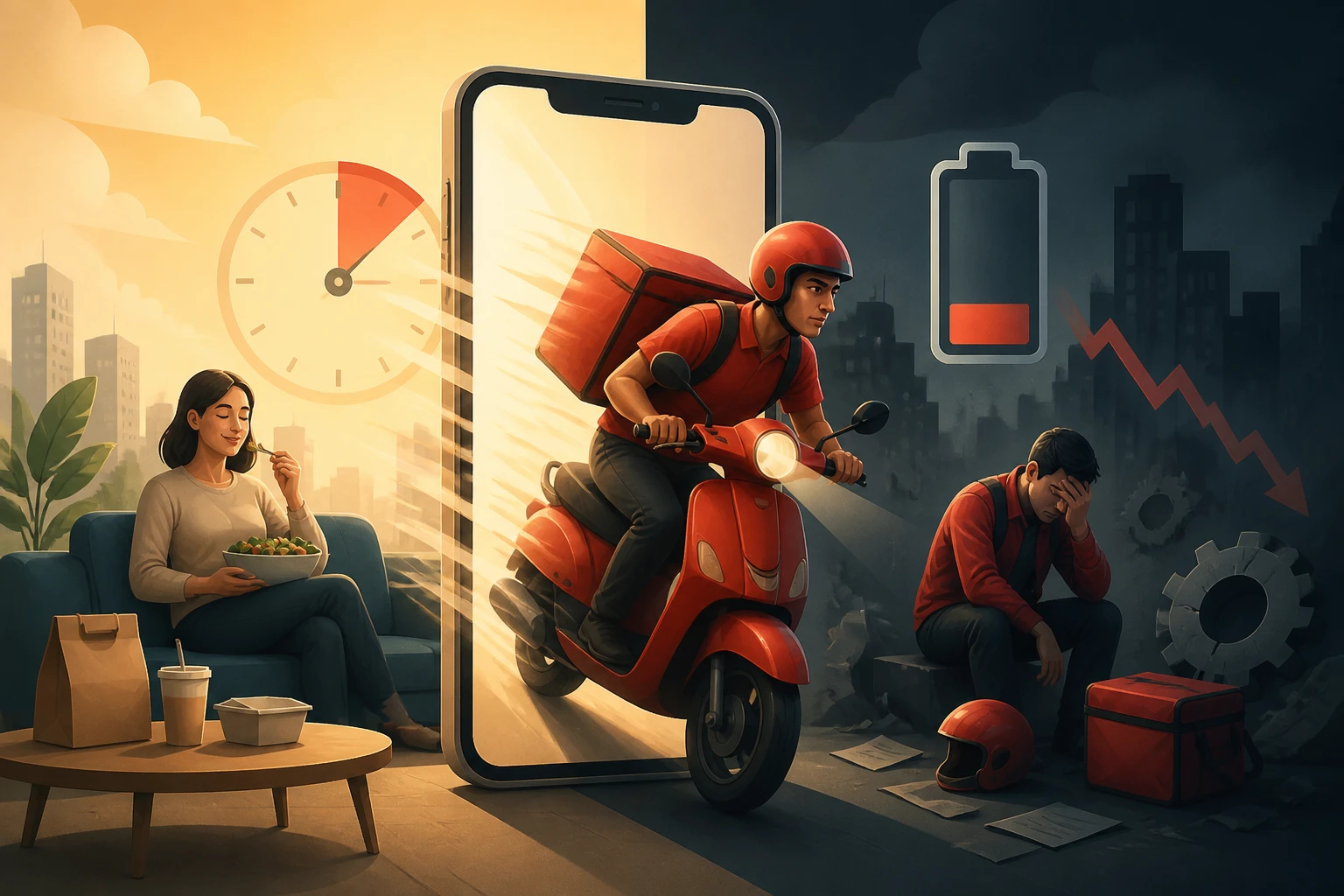
Overview
Picture this: It's 2 PM on a Tuesday, you're drowning in back-to-back meetings, and your stomach is growling louder than your boss during quarterly reviews. You open your favorite food delivery app, and there it is – a gleaming "10-minute delivery" badge next to that burger you've been craving. Sounds like a dream, right?
Well, DoorDash, Uber Eats, Instacart, and dozens of other platforms are betting their future on this promise. The race for ultra-fast delivery has become the new battleground in the food delivery wars, with companies pouring billions into infrastructure that can get your order from kitchen to doorstep faster than you can finish reading this paragraph. But here's the thing – this obsession with speed might be solving the wrong problem entirely, and it could fundamentally reshape how we think about convenience, labor, and urban logistics in ways that nobody saw coming.
The Problem
The numbers tell a compelling story. According to recent industry data, 67% of consumers say delivery speed is their top priority when choosing a food delivery platform, surpassing even price considerations. The average delivery time has become the new metric that determines market leadership, with companies treating minutes like precious currency.
Think of it like this: imagine if every pizza shop in your neighborhood suddenly promised to deliver in 10 minutes instead of 30. You'd probably choose the fastest one, right? That's exactly what's happening in the delivery space, except these companies aren't just promising faster service – they're completely restructuring their entire business models around speed.
But here's where it gets interesting. This isn't just about customer satisfaction anymore. Food delivery margins are razor-thin, typically hovering around 2-5% after accounting for operational costs. Companies are hoping that ultra-fast delivery will create customer loyalty so strong that people will pay premium fees and order more frequently, finally making these platforms profitable.
Analysis
The economics behind 10-minute delivery are fascinating and complex. To understand why companies are obsessing over this, imagine trying to run a relay race where every runner needs to be positioned perfectly, and any delay costs you the entire race.
Zomato reported spending over $200 million in 2023 alone on their "Zomato Instant" infrastructure, which includes setting up thousands of micro-fulfillment centers in major cities. These aren't traditional warehouses – they're small spaces strategically placed within 2-3 kilometers of high-demand areas, pre-stocked with popular items.
From a business strategy perspective, ultra-fast delivery serves multiple purposes. First, it creates a significant competitive moat – once a company has the infrastructure for 10-minute delivery, competitors need massive capital investment to match it. Second, it increases order frequency. When getting food is as easy as getting water from your fridge, people order more impulsively.
However, the economic implications are staggering. Each 10-minute delivery requires maintaining inventory that might spoil, paying delivery partners premium rates for instant availability, and operating dense networks of micro-warehouses in expensive urban real estate. The unit economics only work if order volumes increase dramatically and customers accept higher service fees.
From a policy perspective, this trend is creating new urban challenges. Cities are seeing increased traffic from delivery vehicles, parking issues, and questions about labor practices as platforms push for faster delivery times.
Real-World Examples
Getir, the Turkish company that pioneered grocery delivery in under 10 minutes, expanded globally but recently pulled out of multiple markets including the UK and Spain, citing unsustainable costs. Their burn rate exceeded $1 billion annually at its peak, demonstrating how expensive ultra-fast delivery can be.
Conversely, Gopuff in the United States has found moderate success by focusing on specific product categories like snacks, drinks, and convenience items rather than full meals. They've managed to maintain 15-minute average delivery times while achieving better unit economics by limiting their inventory to high-turnover, non-perishable items.
Amazon Prime Now offers perhaps the most telling case study. Despite Amazon's massive logistics expertise and infrastructure, they quietly discontinued their 1-2 hour delivery service in many markets, finding that the costs outweighed customer willingness to pay premium prices.
Industry expert Sarah Chen, a logistics researcher at MIT, notes: "The companies succeeding with ultra-fast delivery are those treating it as a premium service for specific use cases, not as a replacement for traditional delivery models."
The Challenge
Here's why this isn't as simple as just hiring more delivery drivers and opening more warehouses. Ultra-fast delivery creates a complex web of operational challenges that scale exponentially with speed requirements.
Consider food safety regulations. Traditional restaurants have time to properly prepare food while maintaining safety standards. But when you're promising 10-minute delivery, that includes cooking time. This pushes platforms toward pre-prepared foods, which raises questions about quality and freshness.
Then there's the labor challenge. Delivery partners need to be constantly available and positioned strategically across cities. This requires either keeping workers idle between orders (expensive) or creating sophisticated prediction algorithms that can anticipate demand patterns in real-time (technologically complex and often inaccurate).
Regulatory compliance adds another layer. Many cities are implementing restrictions on delivery vehicle access, noise ordinances, and labor protection laws that make ultra-fast delivery logistics increasingly difficult to navigate legally and ethically.
Future Implications
The obsession with 10-minute delivery is reshaping urban infrastructure in profound ways. Cities are seeing the emergence of "dark stores" – retail spaces that look like stores but only serve online orders. This is changing commercial real estate patterns and neighborhood dynamics.
Consumer behavior is also evolving. Early data suggests that ultra-fast delivery availability increases impulse ordering by 40%, but it also raises expectations across all delivery services. Once customers experience 10-minute delivery, 30-minute delivery feels frustratingly slow.
The employment implications are significant. Ultra-fast delivery requires a different type of workforce – more like emergency responders than traditional delivery drivers. This could mean better pay for some workers but also more stressful, demanding work conditions.
Environmental concerns are mounting too. Faster delivery typically means less efficient routing, more partially-filled vehicles on the road, and increased packaging waste from pre-positioned inventory that expires unused.
Looking at the competitive landscape, this trend might actually backfire for the industry as a whole. If every platform offers ultra-fast delivery, it stops being a competitive advantage and just becomes an expensive baseline expectation that erodes profitability across the board.
Looking Ahead
The real question isn't whether companies can deliver food in 10 minutes – it's whether they should. The race for ultra-fast delivery might be solving a problem that customers didn't know they had, while creating problems they definitely don't want: higher costs, reduced food quality, and environmental impact.
Perhaps the future lies not in being the fastest, but in being the most reliable, sustainable, and cost-effective. After all, is saving 20 minutes really worth paying 40% more for food that might not taste as good?