

Overview
You're at 15% battery by noon, and your phone is barely six months old. Sound familiar? Last week, your colleague Sarah complained that her iPhone 14 went from lasting two days to dying before dinner. Meanwhile, your friend Mike's Samsung Galaxy started randomly shutting down at 30% battery. If you're nodding along, you're not alone—73% of smartphone users report significant battery degradation within the first year of ownership. But here's the kicker: revolutionary solid-state battery technology promises to solve this trillion-dollar headache by 2025, potentially making your current charging habits obsolete.
The Problem
Think of your current lithium-ion battery like a busy subway system. Every time you charge and discharge, millions of lithium ions shuttle between two stations (the cathode and anode) through a liquid electrolyte corridor. Over time, this liquid corridor gets congested, ions get stuck, and the shuttle system breaks down—hence your battery's declining performance.
The numbers are staggering: smartphone batteries lose 20% of their capacity after just 500 charge cycles, which translates to roughly 18 months of typical use. For working professionals who rely heavily on their devices, this degradation costs the global economy an estimated $50 billion annually in lost productivity and premature device replacements. Your daily routine of checking emails, video calls, and navigation apps accelerates this degradation exponentially.
Analysis
The battery degradation crisis creates a complex web of economic and environmental implications. From a business perspective, companies like Apple and Samsung have built entire revenue streams around battery replacement services and planned obsolescence—Apple alone generates over $6 billion annually from repair services.
The policy angle reveals deeper concerns: the European Union's upcoming "Right to Repair" legislation specifically targets battery degradation, mandating that smartphone batteries must retain 83% capacity after 1,000 cycles by 2027. This regulatory pressure is forcing manufacturers to accelerate solid-state research.
Economically, professionals face a hidden tax of roughly $200-300 annually on battery-related issues—replacement costs, charging accessories, and productivity losses from dead devices. The environmental impact compounds this: over 5 billion smartphones worldwide mean billions of degraded batteries contributing to electronic waste.
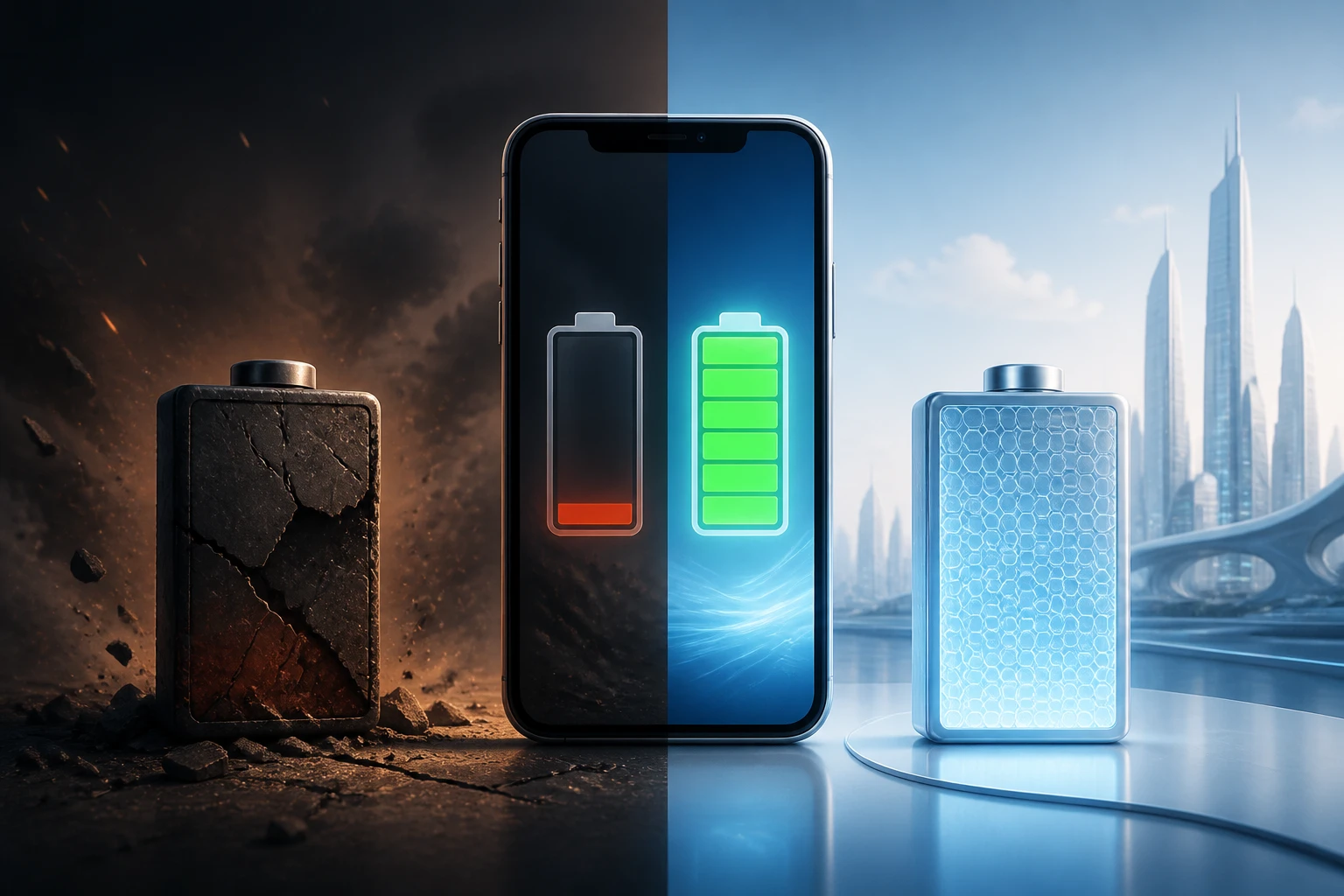
Solid-state batteries eliminate the liquid electrolyte problem entirely, replacing it with a solid ceramic or polymer layer. This is like upgrading from a congested subway to a high-speed bullet train—ions move more efficiently, last longer, and don't degrade the infrastructure.
Real-World Examples
Toyota leads the solid-state revolution, investing $13.5 billion in battery technology and promising commercial solid-state batteries by 2025. Their prototype batteries retain 90% capacity after 100,000 charging cycles—compared to current lithium-ion batteries that degrade significantly after just 500 cycles.
QuantumScape, backed by Volkswagen, demonstrated solid-state cells that charge to 80% in just 15 minutes while maintaining performance at -30°C. Meanwhile, Samsung announced their solid-state batteries will offer 500-mile range for electric vehicles and theoretically unlimited charging cycles for smartphones.
Apple has quietly filed over 200 patents related to solid-state technology, suggesting the iPhone could feature this technology as early as 2025. Industry analyst Ming-Chi Kuo predicts that solid-state adoption could reduce global electronic waste by 40% while extending device lifespans from 2-3 years to 7-10 years.
The Challenge
But here's the catch: manufacturing solid-state batteries at scale remains incredibly complex. Current production costs are 10 times higher than traditional lithium-ion batteries, and the ceramic electrolytes require precision engineering that only a few facilities worldwide can achieve.
The technology also faces what engineers call the "interface challenge"—ensuring perfect contact between solid components without microscopic gaps that could cause failure. Regulatory agencies are still developing safety standards for this new technology, creating potential delays in mass deployment.
Future Implications
Solid-state adoption could fundamentally reshape how we interact with technology. Imagine smartphones that maintain peak performance for a decade, electric vehicles that charge in minutes, or laptops that never need battery replacement. The economic implications are massive—reduced e-waste, lower consumer costs, and entirely new business models.
For working professionals, this means reliable devices that support productivity without the anxiety of battery degradation. The $120 billion smartphone battery market could consolidate around a few key players who master solid-state manufacturing, potentially creating new tech giants while disrupting existing ones.
Looking Ahead
The race to solid-state supremacy isn't just about better batteries—it's about reimagining our relationship with portable technology. As 2025 approaches, the question isn't whether solid-state batteries will arrive, but which companies will successfully scale production and capture this market transformation. Will your next smartphone be the last one you ever need to worry about charging?