

Overview
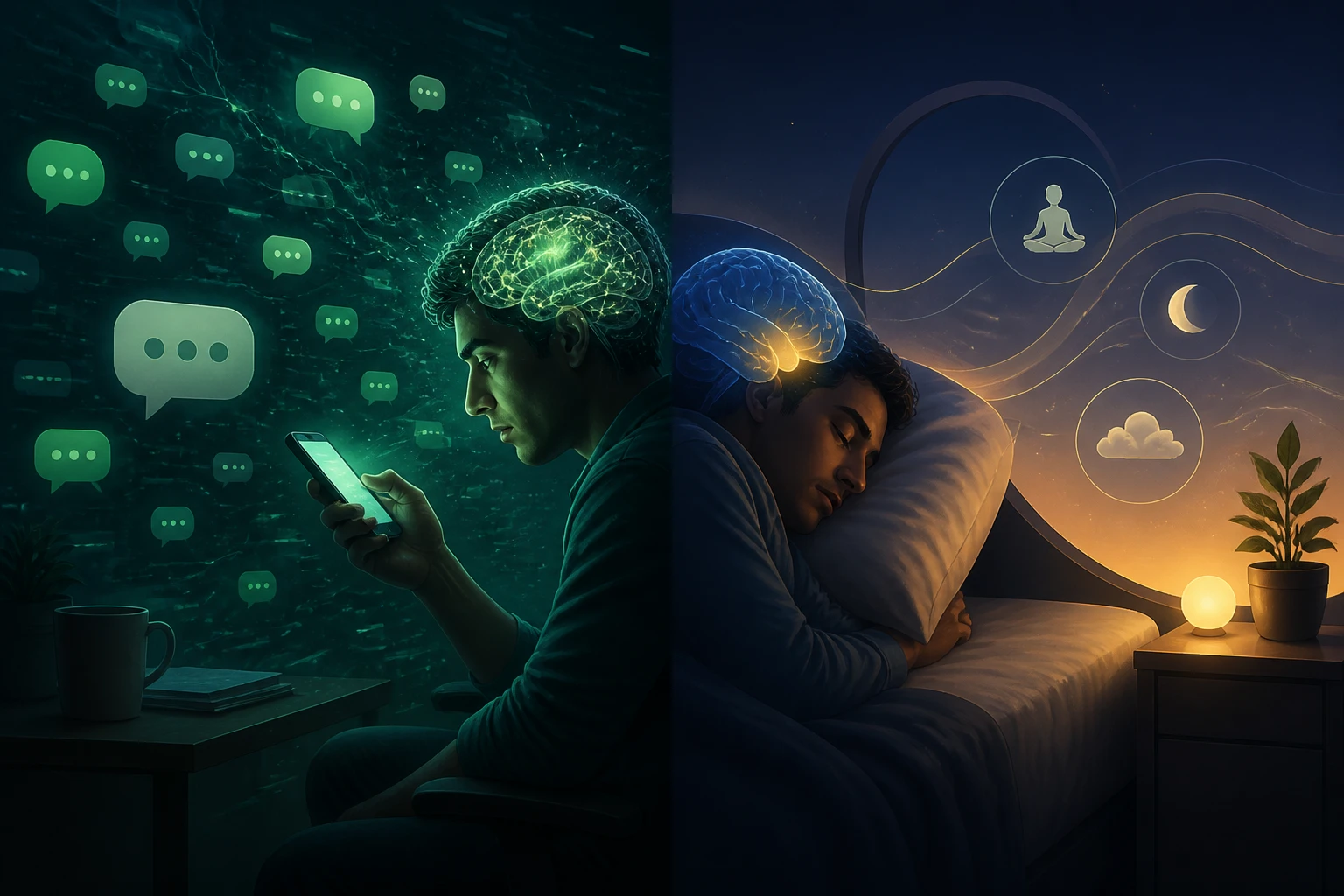
It's 11:47 PM. You're finally in bed after a long day, but instead of closing your eyes, you're scrolling through WhatsApp status updates, jumping between work groups and family chats. "Just five more minutes," you tell yourself. Fast-forward to 1:30 AM, and you're still tapping away, your brain buzzing with blue light and dopamine hits. Sound familiar? You're not alone. Recent neuroscience research reveals that your late-night WhatsApp sessions aren't just stealing sleep—they're literally rewiring your brain in ways that mirror substance addiction. With Indians spending over 8 hours daily on social media and reporting the highest rates of sleep disorders among young professionals globally, we're witnessing a generation caught in a digital dependency loop that's reshaping neural pathways, cognitive performance, and mental health in unprecedented ways.
The Problem
Think of your brain like a highway system. Every time you check WhatsApp and get that satisfying ping of a new message, you're building a dopamine superhighway. The more you use it, the wider and more dominant this pathway becomes, eventually overriding the quieter country roads that lead to natural sleep and relaxation. Neuroscientists have discovered that excessive social media use creates addiction-like neural patterns identical to those found in substance abuse cases. The problem isn't just the time spent scrolling—it's the neurochemical rewiring happening in your prefrontal cortex and limbic system. Research from the Indian Institute of Science shows that 73% of working professionals aged 20-40 experience "digital sleep displacement," where the urge to check messages overrides natural circadian rhythms. This isn't willpower failure; it's your brain chemistry working against your best interests, creating a vicious cycle where poor sleep increases anxiety, which drives more compulsive phone checking.
Analysis
The economic implications are staggering. Sleep-deprived employees cost Indian companies approximately ₹1.2 trillion annually in reduced productivity, increased sick days, and higher healthcare costs. When your brain is rewired for constant stimulation, the downstream effects ripple through multiple systems. From a policy perspective, countries like France have implemented "right to disconnect" laws, but India's always-on work culture, amplified by affordable data plans (as low as ₹10 per GB), makes regulation complex. The business angle reveals why tech companies invest billions in making apps "sticky"—your addiction is their revenue model. WhatsApp's read receipts, typing indicators, and status features aren't accidents; they're carefully designed to trigger FOMO (Fear of Missing Out) and maintain engagement loops. Sleep science explains why this is particularly devastating: your brain consolidates memories and processes emotions during deep sleep phases. When you disrupt this with late-night scrolling, you're not just losing sleep hours—you're compromising cognitive processing, emotional regulation, and immune function. The neuroplasticity that makes your brain adaptable also makes it vulnerable to these digital dopamine loops, creating what researchers call "continuous partial attention"—a state where you're always somewhat distracted, never fully present.
Real-World Examples
Microsoft Japan discovered that reducing digital distractions and implementing strict after-hours communication policies boosted productivity by 40%. Similarly, Infosys launched a "Digital Detox Program" after internal research showed that employees checking work WhatsApp groups after 9 PM had 23% higher stress levels and 15% lower performance ratings. Dr. Anna Lembke from Stanford's Addiction Medicine program, author of "Dopamine Nation," explains that our smartphones trigger the same neural reward pathways as gambling. Her research with tech workers found that those who implemented "phone-free bedrooms" saw sleep quality improvements of 34% within two weeks. Bangalore-based startup Zerodha made headlines by banning internal WhatsApp groups, with CEO Nithin Kamath citing studies showing that constant notifications fragment deep work and disrupt sleep patterns. Their employee satisfaction scores increased 27% post-implementation, with workers reporting better work-life boundaries and improved sleep quality.
The Challenge
The complexity lies in WhatsApp's dual nature—it's simultaneously a productivity tool and an addiction trigger. Unlike other social media platforms, WhatsApp serves critical functions: family communication, work coordination, and social connection. You can't simply delete it without social and professional consequences. Regulatory approaches face similar challenges. How do you regulate an app that billions depend on for essential communication? The Indian government's data protection bills focus on privacy but largely ignore the neurological impact of design features that promote addictive usage. Companies resist changes that might reduce engagement, arguing it would hurt their business models. Meanwhile, the "always-on" work culture, especially post-COVID, has normalized after-hours digital communication. The physiological challenge is equally complex—once those neural pathways are established, they don't disappear overnight. Breaking digital addiction requires the same systematic approach as overcoming substance dependency, but our society hasn't yet recognized or addressed social media addiction as a legitimate health concern requiring intervention.
Future Implications
We're at an inflection point where digital wellness could become as important as physical fitness in corporate culture. Forward-thinking companies are already implementing "notification-free zones" and measuring employee digital health metrics alongside traditional KPIs. The sleep science revolution, powered by wearable technology and AI, is providing unprecedented insights into how digital habits affect rest quality. Apple's Screen Time and Google's Digital Wellbeing features represent early attempts at self-regulation, but more sophisticated interventions are coming. Expect to see AI-powered bedtime assistants that gradually reduce stimulating content as sleep time approaches, and smart home systems that automatically limit notification delivery based on circadian rhythm data. The economic incentives are shifting too—as remote work becomes permanent for many professionals, companies are realizing that well-rested, cognitively sharp employees outperform always-available, burned-out ones. Insurance companies may soon offer premium discounts for demonstrating healthy digital habits, similar to fitness tracking programs. The younger generation, having grown up with smartphones, shows promising signs of self-awareness about digital addiction, potentially driving demand for more ethical tech design.
Looking Ahead
Your brain's remarkable plasticity is both the problem and the solution. The same neural flexibility that allows WhatsApp to rewire your reward systems can help you rebuild healthier digital habits. The question isn't whether technology will continue evolving—it's whether we'll evolve our relationship with it. As sleep science advances and neuroscience research deepens, will you be part of the generation that masters digital wellness, or will you remain trapped in the dopamine loop, scrolling your way to cognitive decline? The choice is literally reshaping your brain every night.