

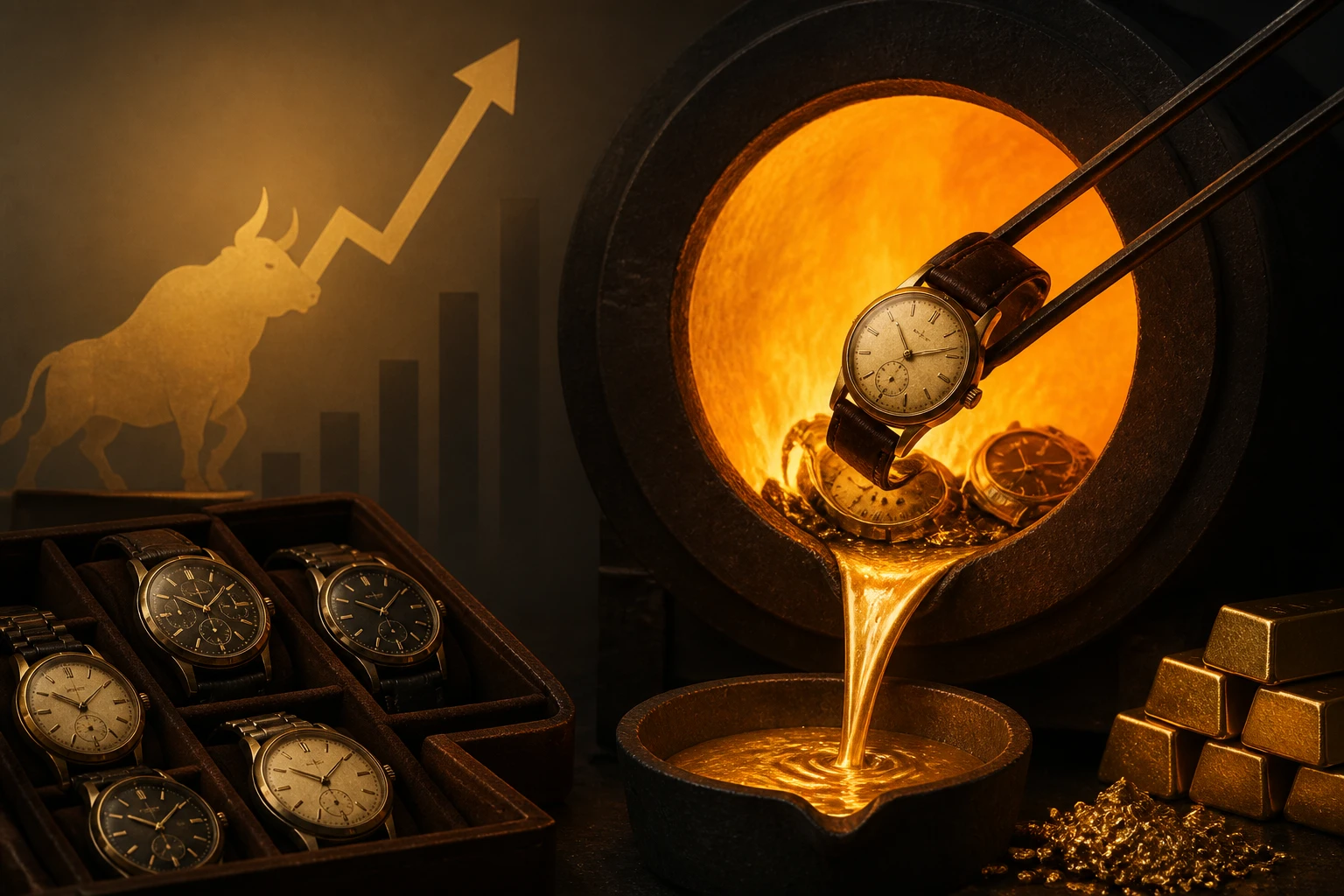
A late-1970s Omega Constellation — 18-carat gold, excellent condition — recently had its fate decided not by a watchmaker, but by a spreadsheet. British dealer Jon White of Gold Traders melted it down in May, one of dozens of mainstream luxury watches he has had scrapped this year as demand for investment gold has risen. His reasoning was blunt: the gold content of the Constellation was worth £5,750 (roughly $7,749) — 35% more than its estimated £4,000–4,500 auction value.
The watch didn't lose its craftsmanship. Gold simply stopped caring about it.
The Arithmetic That's Killing Heirlooms
Gold prices surged to a record $5,600 an ounce in January, driven by geopolitical concerns and trade anxieties pushing investors toward safe-haven metals. Even after pulling back, gold hovers around $4,200 per ounce — almost double its 2024 average. The market price for used watches has not moved in the same way. That gap is the problem.
Watches can hold anything from a sliver of gold to more than 200 grams, meaning their scrap value can run into tens of thousands of dollars. Once that scrap value crosses the resale price, the economics of collecting collapse. A timepiece stops being an object of desire and becomes, quite literally, raw material.
Not All Luxury Ages the Same Way
This is not happening uniformly across the market. The pressure is strongest where the watch is not rare enough to command a collector premium, but contains enough gold to make dismantling profitable. Used models by Omega and LVMH's TAG Heuer are most hit by the trend, according to Reuters interviews with over a dozen traders, industry experts, and investment advisers.
Less exclusive brands such as TAG Heuer, Breitling, and Omega struggle to command high resale prices, as buyers can purchase second-hand timepieces for far less than retail. Models such as Omega's Speedmaster often depreciate sharply once sold, exposing them to scrapping.
The contrast with ultra-exclusive marques is sharp. If a watch is scarce, culturally important, or backed by a strong collector market, its resale price can still sit comfortably above melt value. High-end brands that tightly manage new production, such as privately owned Patek Philippe and Rolex, command the highest premiums over melt value.
Scarcity as the Only Real Moat
There's a quiet lesson here for anyone who thinks of a luxury watch as an investment. The brands that survive a gold price shock are the ones where supply is ruthlessly constrained — where wait lists run "anything from two to eight years," and where demand from collectors consistently outpaces the metal underneath.
James Lamdin, founder of Watches of Switzerland's second-hand unit Analog Shift, said melting was "primarily happening with contemporary pre-owned and also with older vintage watches that are not already collectible."
Which means the sentimental middle — the good-but-not-great watch a parent bought to mark a milestone — is now the most financially vulnerable. For some owners, the idea of selling a watch only for it to be melted is too much to bear. "It may be a family piece, it may be their first watch," noted horological historian Adrian Hailwood. "They don't like the idea of it being destroyed, so they keep it."
The pressure may not be limited to older watches either. With gold expected to reach between $5,400 and $6,300 an ounce this year, the incentive to dismantle some watches will continue — and the furnace will keep being more honest than the auction house.
Sources
- Gold fever sends some vintage luxury watches to the melting furnace - MINING.COM
- Gold fever sends some vintage luxury watches to the melting furnace – Regional Media News
- How record gold prices are throwing vintage luxury watches into furnace | Industry News - Business Standard
- Gold fever sends some vintage luxury watches to the melting furnace | 93.3 The Drive