

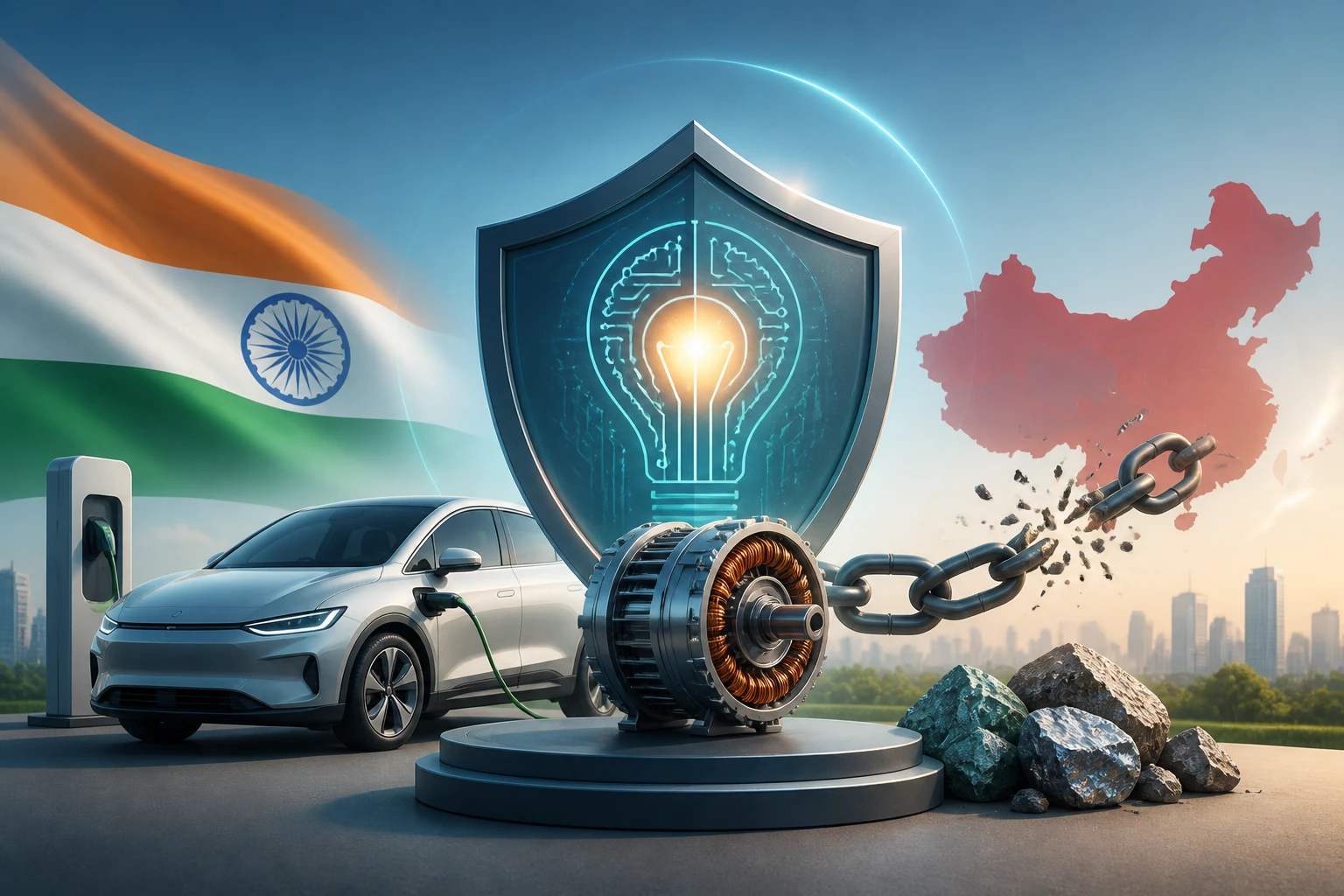
Every time an electric vehicle rolls off an assembly line, it carries a quiet geopolitical dependency inside its motor. Almost every EV on the road uses a Permanent Magnet Synchronous Motor, which relies on fixed rare-earth magnets embedded in the rotor to produce torque. And sourcing those magnets means, overwhelmingly, dealing with China. According to consultants AlixPartners, China controls up to 70% of global rare-earth mining, 85% of refining capacity, and about 90% of rare-earth metal alloy and magnet production.
A Bengaluru startup thinks it has found the exit door.
Software as a Substitute for Geology
On July 8, Vimag Labs, a Bengaluru-based deep-tech startup, secured its fifth Indian patent for a rare-earth-free electric motor platform that eliminates permanent magnets from the rotor and uses software-controlled power electronics to generate the magnetic field instead. The patented technology is called the Virtual Magnet Synchronous Motor, or VMSM.
Unlike a conventional Permanent Magnet Synchronous Motor, the VMSM creates and controls its magnetic field through software, power electronics, and control algorithms. Think of it as replacing a fixed physical component with a continuously managed electronic one — the "magnet" exists only as long as the software instructs it to.
Co-founder and CEO Manish Seth noted that the latest patent represents the outcome of more than 87,600 engineering hours invested in research and development. Founded in September 2025, Vimag Labs now holds five granted Indian patents, with 10 additional patent applications and 15 trademarks currently in progress.
Why the Timing Is Hard to Ignore
This isn't merely a clean-tech story — it's a supply chain security story. About 94.7% of light EVs currently use motors that rely on rare earth elements, according to S&P Mobility. IDTechEx expects more than 75% of passenger EVs will still use rare-earth-based motors by 2030, falling to only about 70% by 2035 — indicating how structurally locked-in the industry remains. Meanwhile, recent export restrictions from China, which dominates the mining and refining of rare earth elements, combined with geopolitical uncertainty, have transformed automakers' dependence into a significant strategic vulnerability.
From Lab to Road
Vimag isn't just filing patents and waiting. The startup has moved beyond laboratory development and is currently conducting pilot projects with two-wheeler and passenger vehicle manufacturers, and is expanding the platform for light commercial vehicles, heavy commercial vehicles, and industrial systems ranging from 200 kW to 600 kW.
The company raised USD 5 million in a Series A funding round led by Accel, along with Chakra Growth Fund and Thinkuvate, and has also signed a manufacturing MoU with Jendamark India to support large-scale production. Seth noted that the growing patent portfolio supports the company's commercial roadmap — including OEM partnerships, technology licensing, and future manufacturing expansion — calling it a crucial step towards commercialising indigenous electric motor technologies developed entirely in India.
The rare-earth problem is global. The solution, this time, is being engineered in Bengaluru.
Sources
- A $5M startup claims rare earth-free electric motor breakthrough | Electrek
- China’s Rare Earth Clampdown Threatens Global EV Supply Chain - Report
- Vimag Labs, India secures patent for rare earth‑free, software‑defined EV motor platform - MarkLines Automotive Industry Portal
- Vimag Labs Patents Rare Earth Free EV Motor Platform In India | Motoroids
- Vimag Labs Secures Fifth Patent for Magnet-Free Electric Motor Technology - MTDCNC - The home of CNC milling. turning, 5 axis and precision machining
- Indian Startup Vimag Labs Breaks China's Rare-Earth Monopoly With New Magnet-Free EV Motor- The Defense News
- China’s rare-earth dominance keeps EV makers dependent - Rest of World
- Eliminating rare earth elements from EV motor supply chains
- Vimag Labs Patents Rare-Earth-Free EV Motor Platform In India