

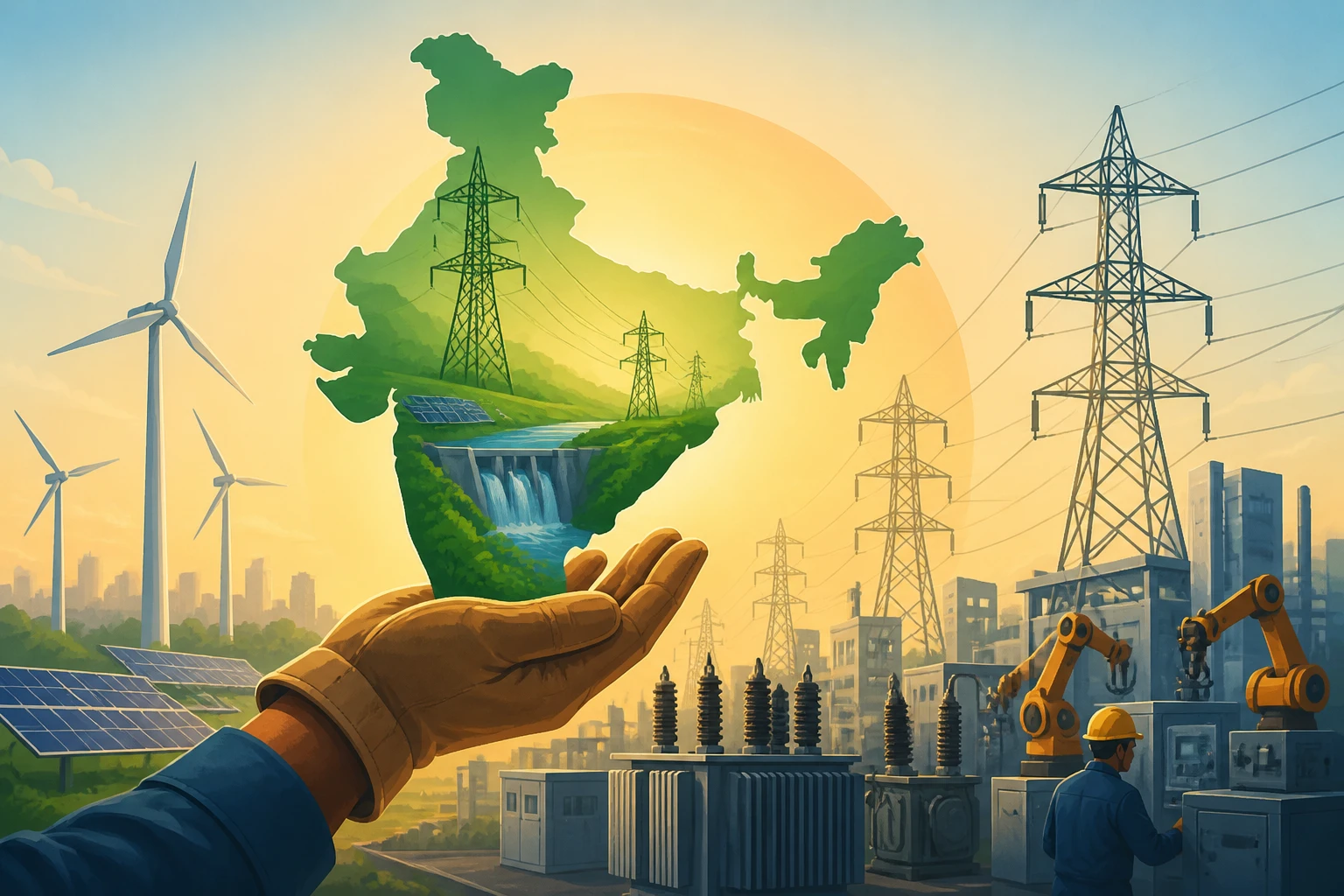
India's Power Grid Is Going 'Make in India'
For most people, electricity is invisible infrastructure — it works until it doesn't. But the systems that move power across thousands of kilometres are quietly becoming a geopolitical and industrial battlefield, and India just made a consequential move on that board.
The Ministry of Power has revised its localization rules for HVDC substations, setting a target of 60% domestic content by 2035. It sounds like a procurement guideline. It's actually an industrial policy with long-range consequences.
Why HVDC Is Worth Fighting For
HVDC — High Voltage Direct Current — is the technology that lets electricity travel efficiently over very long distances without the losses you'd see in a conventional grid. It's also what makes large-scale renewable energy integration viable. Wind farms in Rajasthan and solar parks in Gujarat can't power factories in Tamil Nadu without infrastructure capable of bridging that distance reliably.
This isn't fringe technology. As India pushes toward an increasingly renewable-heavy grid, HVDC systems become more central, not less. Whoever builds them, maintains them, and eventually exports them holds a meaningful position in the clean energy supply chain.
For years, that position has been held by a small set of global players. India has been a customer. The revised localization rules are an attempt to change that.
The 60% Number Is a Target, Not a Guarantee
Reaching 60% domestic content by 2035 is ambitious. HVDC substations are high-precision systems — the kind that demand specialized components, engineering expertise, and manufacturing tolerances that take years to develop. You can't simply swap in domestic suppliers and expect equivalent performance overnight.
What the policy does is create the demand signal that domestic manufacturers need to justify investment. That's how localization typically works: not by wishing capability into existence, but by guaranteeing enough future contracts that building the capability makes financial sense. The question is whether Indian manufacturers — and the global firms operating in India — respond quickly enough to meet that timeline.
There's also a credibility question. Localization targets in Indian industry have a mixed track record. Some sectors have achieved meaningful indigenization; others have seen the same imports continue under different labels. HVDC is complex enough that corners are hard to cut without consequences showing up in grid reliability.
What India Is Actually Building
Step back, and this policy is part of a broader pattern. India has been systematically trying to convert its scale — as a buyer of energy infrastructure, defence equipment, semiconductors, and more — into manufacturing depth. The logic is straightforward: if you're going to spend the money anyway, spend it in a way that builds domestic industry.
With HVDC, the stakes are particularly high because the technology sits at the intersection of energy security and industrial capability. A grid that depends on imported substation technology is a grid with a vulnerability. A domestic HVDC industry, on the other hand, can serve India's own expansion and potentially compete in other emerging markets going through similar energy transitions.
The 2035 deadline gives the industry roughly a decade — enough time to build real capability if the policy is implemented with consistency, not enough time to waste on half-measures.
Whether India becomes an HVDC manufacturer or remains an HVDC importer will say a lot about how serious the 'Make in India' push really is when the technology gets hard.