

Overview
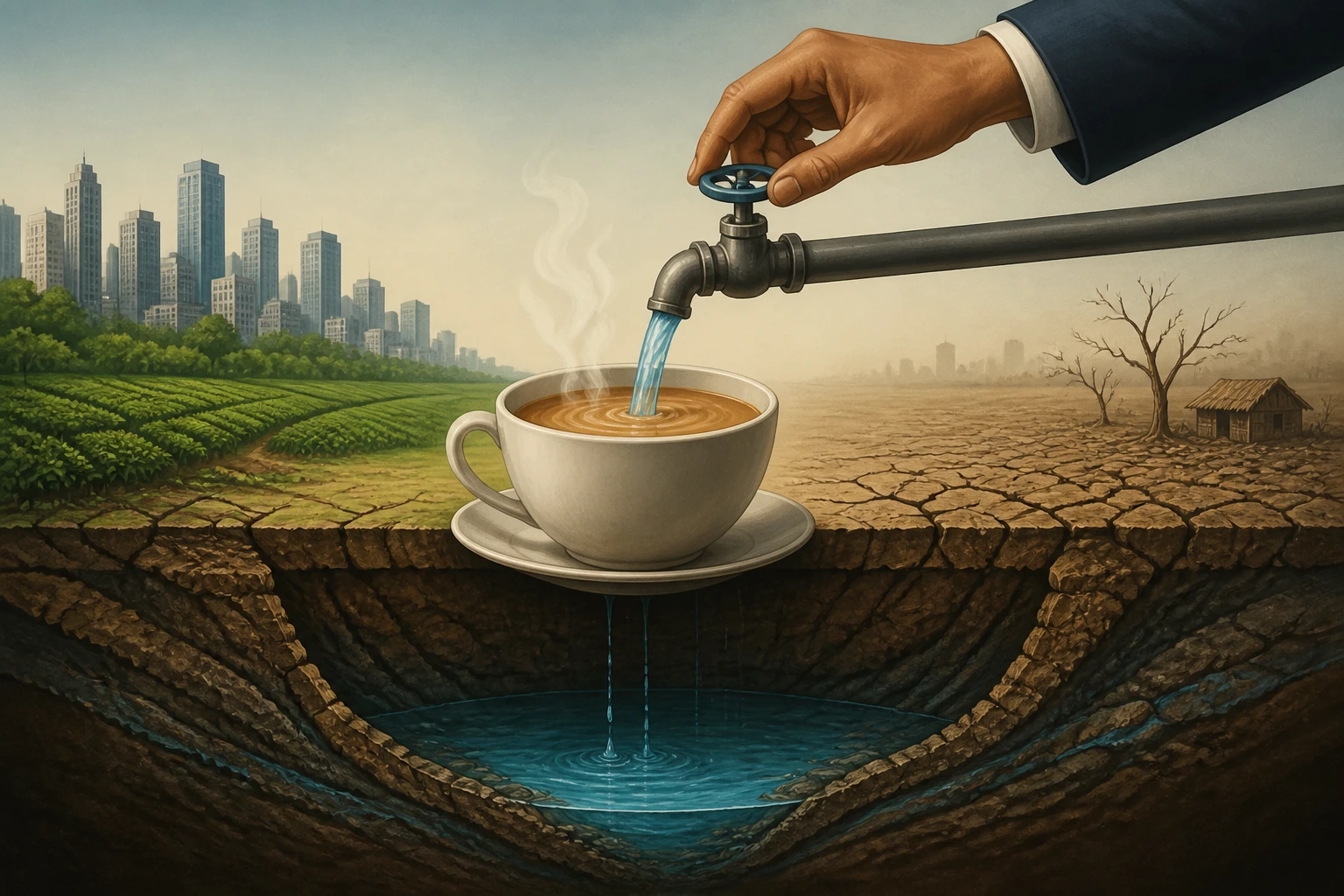
Picture this: You wake up groggy on a Monday morning, reach for your phone, and brew that essential cup of tea. As you sip the familiar comfort, you're unknowingly participating in what experts call "The Great Indian Groundwater Heist" – a massive, invisible crisis that's literally draining the nation dry, one cup at a time.
Think of India's groundwater like a massive underground piggy bank that took thousands of years to fill. Now imagine everyone – from farmers growing your tea leaves to the factory processing them – breaking that piggy bank daily, taking out way more than nature can put back in. The World Bank estimates that India consumes more groundwater than China and the US combined, yet we're adding barely a fraction back. Your morning ritual is connected to a crisis so vast that NASA satellites can actually measure the ground sinking beneath our feet.
The Problem
India's groundwater depletion crisis operates like a massive Ponzi scheme – except instead of money, we're stealing water from future generations. Central Ground Water Board data reveals that India extracts approximately 253 billion cubic meters of groundwater annually, while natural recharge barely reaches 180 billion cubic meters. That's a deficit of 73 billion cubic meters every single year.
Here's the kicker: your morning tea is part of a supply chain that's completely addicted to this "free" underground water. Tea plantations, processing units, and the entire agricultural ecosystem supporting your cuppa rely heavily on groundwater extraction. Over 60% of India's irrigation comes from groundwater, making it the backbone of our food and beverage industry.
The invisible nature of this crisis makes it particularly dangerous – unlike rivers drying up, groundwater depletion happens silently underground, making it easy to ignore until it's too late.
Analysis
The economic implications are staggering. Think of groundwater as India's hidden subsidy system – except it's not sustainable. When farmers and businesses extract "free" groundwater instead of paying market rates for surface water, they're essentially borrowing against the future at zero interest rates. This creates a massive market failure where the true cost of production is never reflected in prices.
From a business perspective, companies across sectors are building their operations on quicksand. Textile manufacturers, food processors, and beverage companies have established facilities in groundwater-rich regions without factoring in long-term water security. When the wells dry up, these investments become stranded assets.
The policy angle reveals India's regulatory nightmare. Water is a state subject, creating a fragmented governance structure where 29 states have different rules, enforcement mechanisms, and priorities. Some states offer free electricity for water pumping, inadvertently incentivizing overconsumption. Others have implemented water markets, but enforcement remains weak.
The agricultural sector consumes 78% of India's groundwater, with crops like rice and sugarcane – both water-intensive – being heavily subsidized. This creates perverse incentives where farmers grow water-guzzling crops in water-scarce regions simply because the economics work in the short term.
Real-World Examples
Punjab, once celebrated as India's Green Revolution success story, now faces a groundwater apocalypse. The state's water table drops 0.5-1 meter annually, and NASA studies show the region losing groundwater mass equivalent to double the capacity of India's largest reservoir. Farmers are drilling deeper – some boreholes now exceed 200 feet compared to 15-20 feet in the 1960s.
Nestlé India faced massive protests in Himachal Pradesh when local communities accused the company of over-extracting groundwater for its bottled water operations. The controversy highlighted how multinational corporations often establish operations in water-stressed regions without adequate impact assessments.
In Rajasthan's industrial belt, textile and dyeing units have caused groundwater levels to plummet. The Rajasthan High Court had to intervene, ordering industries to install water recycling systems and pay groundwater extraction fees. Many companies initially resisted, arguing it would make them uncompetitive globally.
Coca-Cola shut down its Plachimada plant in Kerala after community protests over groundwater depletion and contamination, demonstrating how water stress can derail major business investments.
The Challenge
Solving India's groundwater crisis isn't simple because it requires coordinating multiple stakeholders with conflicting interests. Farmers need cheap water for survival, industries require predictable supplies for operations, and urban populations demand affordable access.
Creating a unified national water policy requires constitutional amendments, since water remains a state subject. Meanwhile, implementing market-based pricing faces political resistance, as water is considered a public good. The sheer scale – monitoring millions of borewells across diverse geographic and climatic zones – makes enforcement extraordinarily complex.
Future Implications
The NITI Aayog warns that 21 Indian cities, including Delhi, Bengaluru, and Chennai, could run out of groundwater by 2030, affecting 100 million people. For working professionals, this translates into potential job relocations, higher living costs, and disrupted supply chains.
Industries will face stranded asset risks as water-intensive operations become unviable. Real estate values in groundwater-depleted regions could plummet, affecting millions of homeowners. The agricultural sector might witness forced crop pattern changes, impacting food prices and rural employment.
Climate change will exacerbate the crisis, with erratic monsoons reducing natural recharge while increasing demand. Companies that don't build water resilience into their business models today will face existential threats tomorrow. Early movers investing in water recycling, rainwater harvesting, and efficiency technologies will gain competitive advantages.
Looking Ahead
Your morning tea connects you to India's most pressing environmental challenge – one that threatens economic growth, food security, and social stability. The question isn't whether we'll face a groundwater crisis, but whether we'll act before it becomes irreversible.
As working professionals, every consumption choice we make has water footprints. Perhaps it's time to ask: What's the real price of that perfect cup of tea, and who's ultimately paying for it?