

Overview
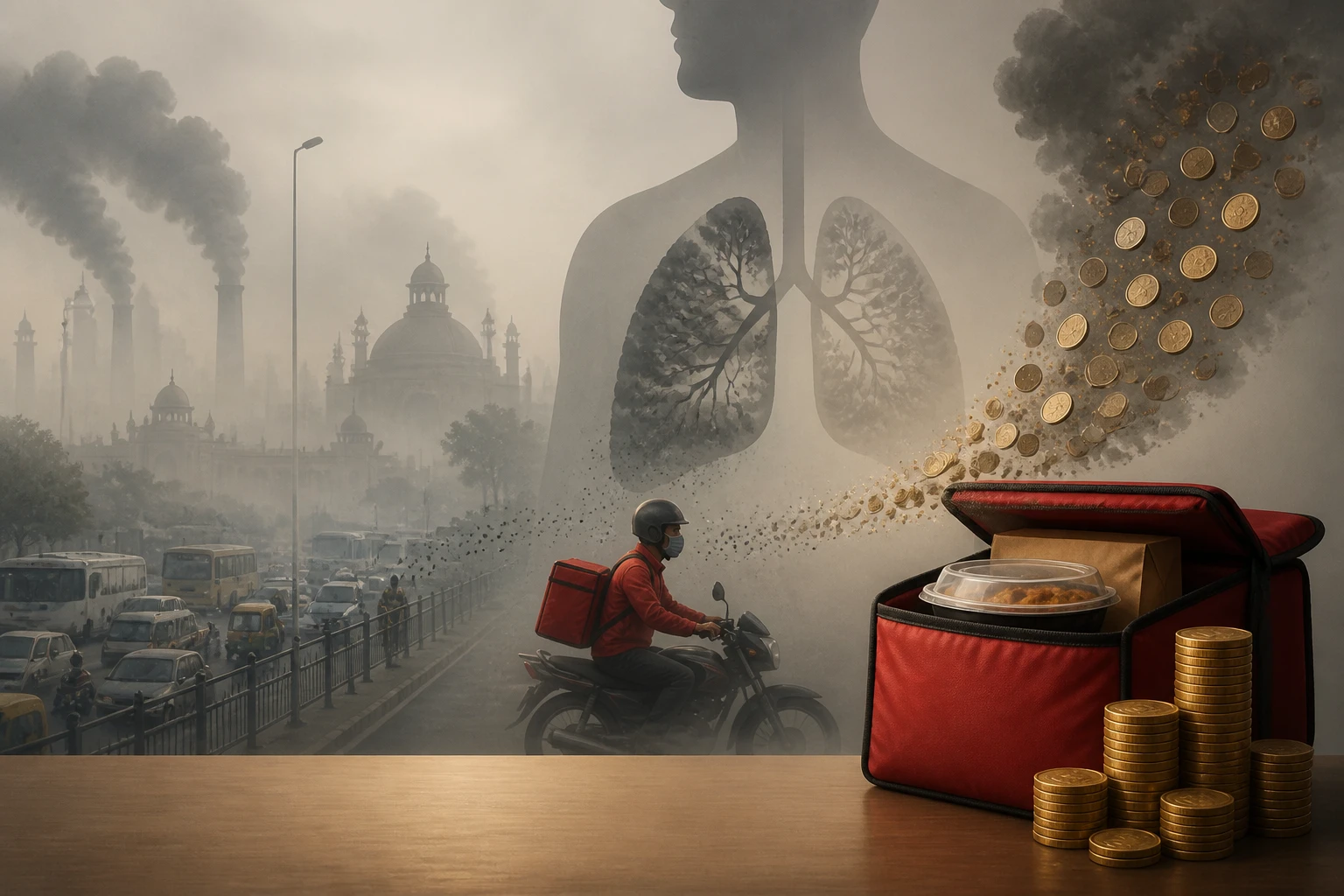
Picture this: You're working late on a Wednesday evening, and you decide to order your favorite biryani from that restaurant across town. The Zomato app shows a delivery fee of ₹25, but what you don't see is the hidden environmental tax Delhi's toxic air is adding to your meal. Your delivery partner is breathing air so polluted it's equivalent to smoking 10 cigarettes a day, leading to higher insurance costs, frequent sick leaves, and premium wages that food delivery companies quietly pass on to you.
Think of it like buying a car during a fuel crisis - the sticker price looks the same, but everything from transportation to manufacturing costs has invisibly inflated. Delhi's Air Quality Index (AQI) regularly crosses 400 during winter months (anything above 300 is considered hazardous), creating a cascade of hidden costs that make your ₹300 biryani actually cost the economy - and eventually you - much more than the app shows.
The Problem Defined
Delhi's air pollution crisis isn't just an environmental disaster; it's an economic one that's reshaping how businesses operate and price their services. When the AQI hits 450 - as it did in November 2023 - the city essentially becomes a gas chamber where normal economic activity becomes exponentially expensive.
Here's what's actually happening: Food delivery companies like Zomato and Swiggy are facing unprecedented operational challenges. Their delivery partners - the backbone of the gig economy - are experiencing respiratory issues at rates 40% higher than the national average, according to a 2023 study by the Indian Medical Association. This translates to more sick days, higher health insurance premiums, and increased attrition rates.
The ripple effects are staggering. Delivery times increase by an average of 25-30% during high pollution days as drivers take more breaks, wear protective gear, or simply refuse to work. Companies respond by offering pollution incentives - additional payments of ₹50-100 per day during severe pollution episodes to keep drivers on the road.
But the costs don't stop there. Vehicles require more frequent maintenance due to clogged air filters and engine wear from particulate matter. Fleet maintenance costs increase by approximately 15-20% during peak pollution months. Restaurants themselves face higher electricity bills as air purifiers and ventilation systems work overtime, costs that inevitably trickle down to menu pricing.
The most invisible cost? Reduced productivity and demand. When pollution levels spike, order volumes can drop by 20-25% as people avoid unnecessary deliveries, creating a vicious cycle where fixed costs must be distributed across fewer transactions, making each remaining order more expensive to fulfill.
Analysis
The economics of pollution create a fascinating case study in externalized costs - expenses that aren't directly reflected in market prices but are very real. Imagine if every cigarette smoker had to pay not just for their pack, but also for everyone else's increased healthcare costs and lost productivity. That's essentially what's happening with Delhi's air quality and your food delivery.
From a business perspective, companies are caught in an impossible situation. They can't simply stop operations during pollution spikes - that would mean losing market share to competitors and disappointing customers who've grown accustomed to on-demand services. Instead, they're forced to absorb mounting costs while maintaining price competitiveness, squeezing profit margins that were already razor-thin.
The policy angle reveals another layer of complexity. The government's Graded Response Action Plan (GRAP) restricts vehicle movement when pollution crosses certain thresholds, but exempts essential services including food delivery. This creates a regulatory gray area where delivery companies benefit from exemption while bearing the health costs of operating in hazardous conditions.
Labor economics tell perhaps the most compelling story. Delhi's delivery workforce - predominantly young men from economically disadvantaged backgrounds - face a cruel choice: risk their health for daily wages or lose income they can't afford to sacrifice. Companies are responding by introducing health insurance schemes and pollution masks, but these benefits ultimately get factored into operational costs.
The insurance industry has taken notice. Health insurance premiums for companies with large Delhi workforces have increased by 18-22% over the past three years, with air pollution cited as a significant risk factor. Some insurers are even considering pollution-based premium adjustments - a direct monetization of environmental damage.
What's particularly insidious is how these costs compound. Poor air quality doesn't just affect delivery workers - it impacts the entire supply chain. Truck drivers delivering ingredients to restaurants, warehouse workers sorting packages, even the restaurant staff preparing your food are all breathing the same toxic air, each adding their own layer of pollution-induced costs to your final bill.
Real-World Examples
Zomato's response to Delhi's pollution crisis offers a window into how companies adapt to environmental challenges. During the severe pollution episode of November 2023, the company introduced "pollution pay" - additional compensation for delivery partners working in AQI conditions above 300. While marketed as a worker welfare initiative, this cost was essentially distributed across all orders through adjusted delivery fees and commission structures.
Swiggy took a different approach, partnering with a healthcare provider to offer free respiratory check-ups for delivery partners in Delhi and NCR. The program revealed that 67% of tested delivery workers showed signs of respiratory stress, with many requiring ongoing medical care. The company now factors these healthcare costs into its operational budget, indirectly affecting pricing strategies.
A fascinating case study emerged from Shadowfax, a logistics company that handles last-mile delivery for multiple platforms. They noticed that during high pollution days, their vehicle fuel efficiency dropped by 8-12% due to increased idling time, frequent stops for drivers to rest, and engine strain from particulate matter. This seemingly small percentage translated to lakhs of rupees in additional fuel costs monthly.
Dr. Arvind Kumar, a prominent chest surgeon at Sir Ganga Ram Hospital, noted in a 2023 interview that they're seeing delivery workers with lung conditions typically found in industrial workers or heavy smokers. His clinic has started offering discounted consultations for gig workers, but the broader economic impact - lost workdays, medication costs, reduced life expectancy - represents millions in hidden economic damage.
Local restaurant chains have also adapted innovatively. Chaayos installed industrial-grade air purifiers in all their Delhi outlets, adding approximately ₹15,000 monthly per location in electricity costs. Haldiram's reported spending an additional ₹2.3 lakhs annually on specialized packaging to prevent food contamination during high pollution deliveries.
The Challenge
Solving this problem isn't as simple as installing more air purifiers or giving workers better masks. The challenge lies in the interconnected nature of urban systems and economic incentives that make quick fixes nearly impossible.
Regulatory complexity presents the first hurdle. Delhi's pollution sources include vehicular emissions, industrial activity, construction dust, and seasonal crop burning in neighboring states. Food delivery companies can control none of these factors, yet bear the consequences. Even if Zomato and Swiggy switched to 100% electric vehicles tomorrow, it would barely dent the overall air quality problem.
The economic incentive structure is fundamentally misaligned. Companies that pollute don't bear the full cost of their environmental damage, while businesses like food delivery platforms - which actually reduce vehicular trips by consolidating demand - end up paying the price. It's like being charged for water damage when you're not the one who left the tap running.
Scale presents another challenge. Delhi's gig economy employs over 2 million workers across various platforms. Any meaningful health intervention - comprehensive insurance, regular health screenings, protective equipment - requires coordination across dozens of companies and thousands of small businesses. The transaction costs alone make such coordination prohibitively expensive.
Perhaps most frustratingly, the measurement problem makes it difficult to quantify and address these hidden costs. How do you calculate the exact price impact of a delivery worker's slightly elevated asthma risk? How do you measure the productivity loss from mild respiratory irritation that doesn't require medical care but slows down deliveries?
Future Implications
The Delhi air pollution case study offers a preview of how climate change will reshape urban economics globally. As more cities grapple with environmental degradation, the hidden environmental taxes on everyday services will become increasingly visible and significant.
Technology solutions are emerging. Some companies are experimenting with AI-powered route optimization that factors in real-time air quality data, minimizing exposure time for delivery workers. Others are piloting enclosed delivery vehicles with air filtration systems, though the cost implications remain substantial.
The insurance industry is likely to drive the next wave of changes. As actuarial data clearly links air pollution to health outcomes, we can expect pollution-indexed insurance premiums to become standard. This will force companies to internalize environmental costs more directly, potentially leading to pressure for systemic environmental improvements.
Consumer behavior is already shifting. Premium services offering "clean air delivery" - where food is prepared and transported in controlled environments - are gaining traction among Delhi's affluent population. This creates a two-tier system where clean air becomes a luxury service, raising important questions about environmental justice.
The broader implication is that environmental degradation creates economic inequality. Those who can afford pollution premiums get better service, while others bear disproportionate health and economic costs. Your Zomato order is becoming a case study in how environmental problems become economic stratification tools.
Looking Ahead
The next time you tap "order now" on your food delivery app, remember that you're participating in one of the world's largest uncontrolled experiments in environmental economics. Delhi's air pollution isn't just making the sky gray - it's quietly inflating every transaction in the urban economy.
The question isn't whether these environmental costs will eventually appear on your bill more transparently, but when and how. Will we see explicit "air quality surcharges" during pollution spikes? Or will these costs remain hidden in gradually increasing base prices? More importantly, will this economic pressure finally force the systemic changes needed to clean Delhi's air, or will we simply accept pollution premiums as the new normal of urban life?