

Overview
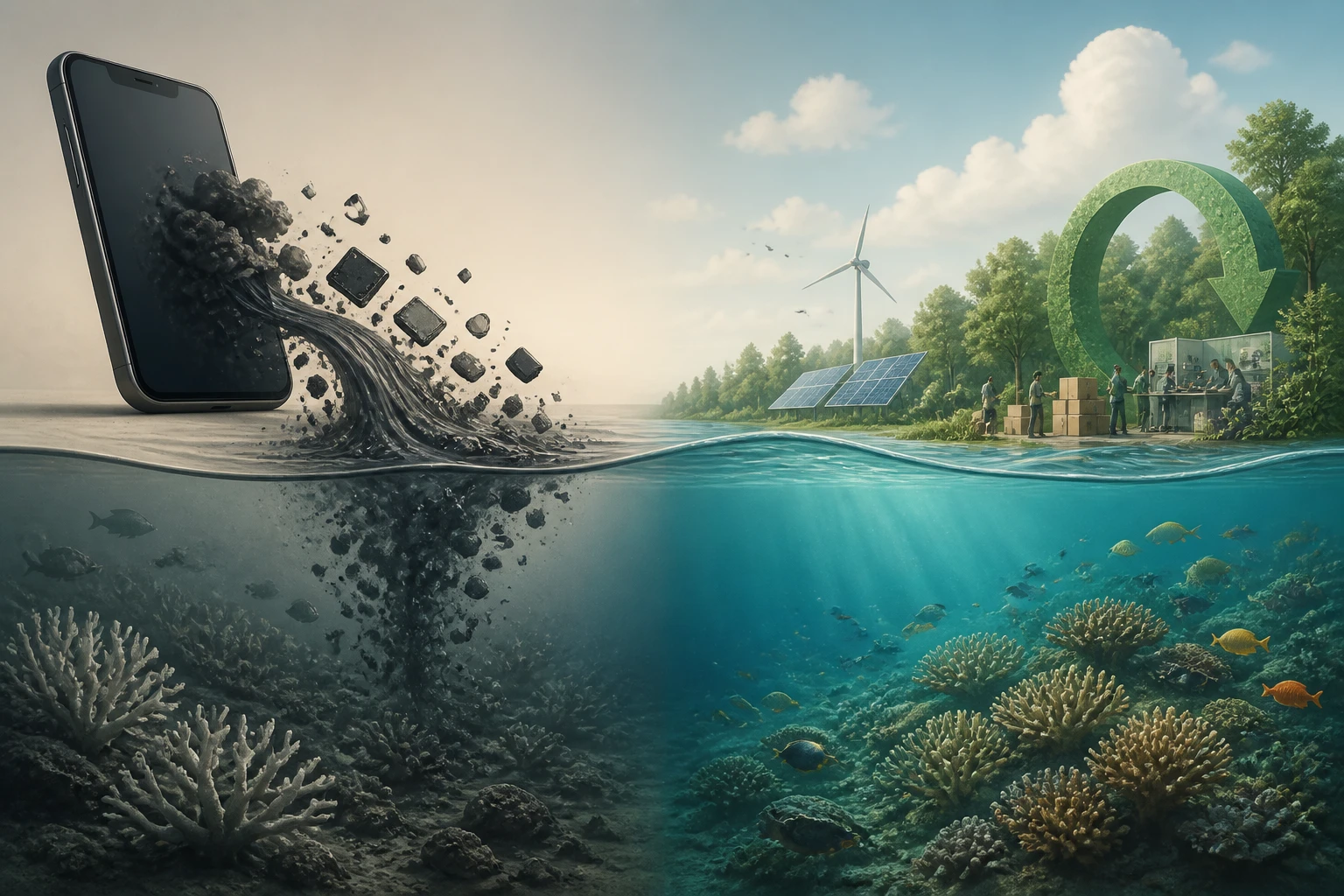
Picture this: You're scrolling through your smartphone while waiting for your morning coffee, casually browsing the latest electric vehicle deals. That innocent swipe might seem harmless, but here's the uncomfortable truth – your device is connected to a massive underwater mining operation that's quietly turning our oceans into acid baths. Deep-sea mining for rare earth metals has become the dirty secret behind our "clean" technology revolution. Every lithium-ion battery, every smartphone processor, every EV motor depends on minerals extracted from the ocean floor using methods that make traditional mining look environmentally friendly. With India's smartphone market growing by 7.3% annually and the government's ambitious electric vehicle targets under the Production Linked Incentive (PLI) scheme, we're inadvertently fueling an underwater environmental crisis that most consumers don't even know exists.
The Problem
Ocean acidification from deep-sea mining operates like adding vinegar to a fishbowl – except the fishbowl is our entire marine ecosystem. When mining companies scrape the seafloor for cobalt, nickel, and rare earth elements, they disturb sediment layers that have remained untouched for millions of years. This process releases sulfuric compounds that dramatically lower ocean pH levels, creating underwater dead zones where marine life simply cannot survive.
Think of it like this: if you explained ocean acidification to a 5-year-old, you'd say the ocean is like a giant swimming pool, and mining companies are dumping lemon juice into it. Fish and coral reefs are like plants – they can't grow in overly acidic water. Studies show that deep-sea mining operations can lower local pH levels by 0.3-0.5 units, which might sound small but represents a 300-500% increase in acidity. For context, the ocean has become 30% more acidic since the industrial revolution began, and deep-sea mining is accelerating this process exponentially.
Analysis
The economic implications create a perfect storm of competing interests. India's EV market is projected to reach $47 billion by 2030, driven by government subsidies and corporate sustainability commitments. This demand directly translates to increased deep-sea mining activities, as terrestrial sources of critical minerals become increasingly scarce and geopolitically complex.
From a policy perspective, the regulatory framework remains fragmented. The International Seabed Authority (ISA) governs mining in international waters, but enforcement mechanisms are weak. Countries like India are caught between meeting their climate commitments through EV adoption and inadvertently contributing to ocean degradation through mineral demand.
Business implications reveal a fascinating paradox. Companies like Amazon have committed to carbon neutrality by 2040 while simultaneously investing in seabed mining operations through their Climate Pledge Fund. This creates what economists call a "environmental arbitrage" – appearing green on land while externalizing environmental costs to marine ecosystems.
The supply chain complexity adds another layer. Indian EV startups like Ola Electric and Ather Energy source batteries from manufacturers who obtain minerals from deep-sea operations. This creates three degrees of separation between the end consumer and environmental impact, making accountability nearly impossible. The average smartphone contains 17 rare earth elements, many of which increasingly come from ocean floor deposits as land-based reserves diminish.
Real-World Examples
Amazon's approach illustrates the corporate contradiction perfectly. Through Amazon Web Services, the company powers cloud infrastructure for environmental monitoring organizations while simultaneously funding DeepGreen Metals (now The Metals Company), a controversial deep-sea mining startup. DeepGreen's operations in the Clarion-Clipperton Zone have extracted over 4.7 billion tons of mineral nodules, causing measurable pH changes across 150,000 square kilometers of ocean.
Tesla's supply chain provides another case study. The company's Gigafactory batteries increasingly rely on deep-sea sourced nickel and cobalt. Elon Musk publicly stated that Tesla would "give a giant contract" to companies that mine nickel efficiently, inadvertently incentivizing deep-sea operations that traditional terrestrial mining cannot match in scale or cost-effectiveness.
In India, Tata Motors' EV division faces similar challenges. Their partnership with Tata Chemicals for battery materials creates indirect connections to international mining consortiums, including several with deep-sea operations in Pacific waters.
The Challenge
The complexity of solving this problem resembles untangling a globe-spanning knot. Regulatory jurisdiction becomes murky when mining operations occur in international waters but serve supply chains across multiple countries. The International Seabed Authority has issued 31 exploration licenses covering over 1.45 million square kilometers of seafloor, but lacks enforcement mechanisms for environmental standards.
Economic realities further complicate solutions. Deep-sea mining costs 40-60% less than equivalent terrestrial operations while yielding higher concentrations of critical minerals. Alternative sourcing would increase smartphone and EV costs by 15-25%, potentially slowing adoption of technologies essential for climate change mitigation.
Technological alternatives like mineral recycling and urban mining exist but currently meet only 12% of global demand for rare earth elements. Scaling these solutions requires infrastructure investments that developing economies like India struggle to prioritize amid competing development needs.
Future Implications
The environmental debt of our digital transformation is coming due, and the bill is larger than expected. McKinsey projects that global demand for deep-sea minerals will increase 400% by 2030, driven primarily by EV adoption and renewable energy infrastructure. This trajectory puts us on course for irreversible ocean acidification in critical marine ecosystems.
For Indian professionals, this trend represents both risk and opportunity. The country's $26 billion Electronics System Design & Manufacturing (ESDM) sector could pioneer sustainable sourcing standards that influence global supply chains. Indian companies investing in mineral recycling technologies could capture significant market share as environmental regulations tighten.
Consumer awareness is beginning to shift corporate behavior. 71% of millennials report willingness to pay premium prices for environmentally responsible products, creating market incentives for companies to develop transparent, sustainable supply chains. This demographic pressure could accelerate development of alternative sourcing methods.
The geopolitical dimension adds urgency. Countries controlling deep-sea mining rights – primarily Pacific island nations – are beginning to demand higher environmental standards and revenue sharing, potentially disrupting current cost advantages that make ocean mining attractive.
Looking Ahead
The smartphone in your hand represents humanity's Faustian bargain with technology – we've gained unprecedented connectivity while mortgaging our ocean's future. As India races toward digital and electric mobility goals, the question isn't whether we can afford sustainable sourcing, but whether we can afford not to pursue it. The next smartphone you buy could either perpetuate this underwater environmental crisis or support the emerging circular economy that might just save our oceans.